Wall Street Piles Into SpaceX With a Flurry of Bullish Calls — But the Bill Is Coming Due

Morgan Stanley, Goldman and others initiated coverage on SpaceX after the IPO quiet period ended, with roughly 80% of analysts rating the stock a Buy. But the rosy consensus masks a stark warning: the company faces years of massive capital spending and a daunting need for outside cash.

SpaceX Wall Street ratings Buy target price $300
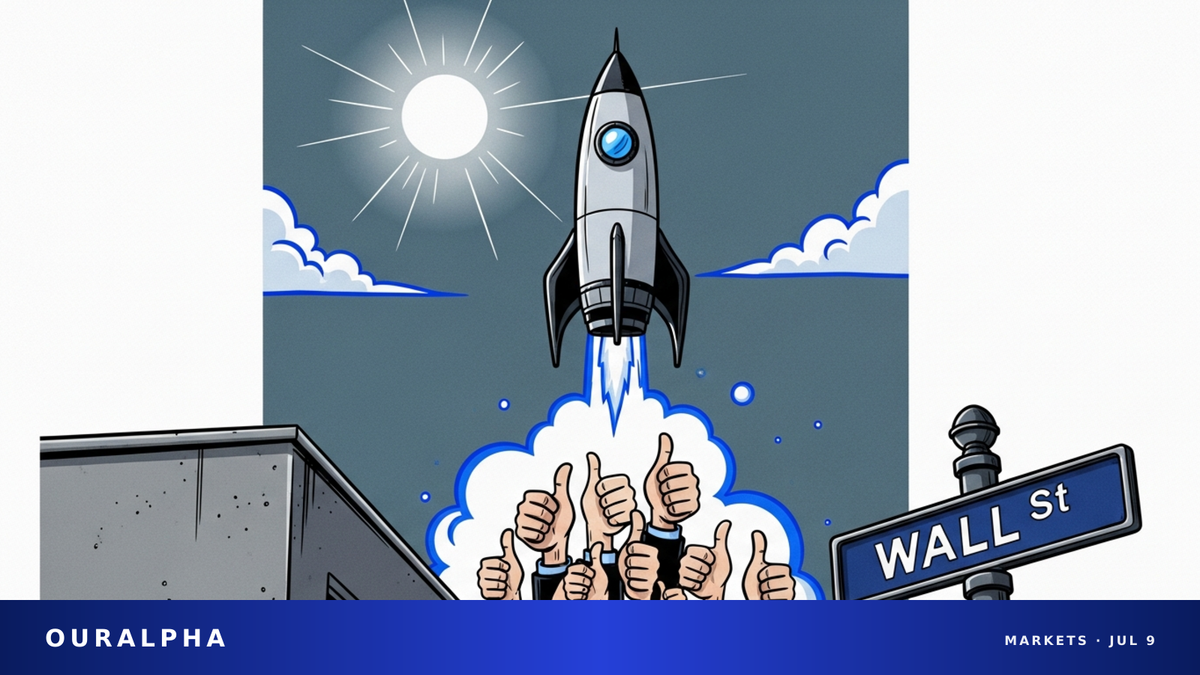
Wall Street piles into SpaceX with a flurry of bullish calls.

SpaceX (SPCX) has drawn a wave of bullish initiations from Morgan Stanley, Goldman Sachs and other top Wall Street banks since its IPO quiet period ended. Roughly 80% of analysts rate the stock a Buy or Overweight, but many also flag the company's enormous capital spending needs and future financing requirements as major risks.

  • Morgan Stanley initiated at Overweight with a $300 price target, implying roughly 90% upside from Monday's close. The bank sees revenue exceeding $3.3 trillion by 2040.
  • Goldman Sachs initiated at Buy with a $205 target, citing SpaceX's differentiated position across space, connectivity and AI.
  • FactSet data shows 80% of 21 analysts rate the stock Buy or Overweight. The consensus price target is roughly $247, a more than 60% premium to Tuesday's close.
  • Raymond James analyst Brian Gesuale issued the Street's highest target at $800, implying a roughly $10.5 trillion valuation.
  • Long-term investor Jeremy Grantham warns he is "at least 90% certain" of a sharp reversal in SpaceX's stock, calling some of the company's claims "completely unimaginable."
  • SpaceX was fast-tracked into the Nasdaq 100 on Tuesday, July 7, but the stock struggled to hold above $150. As of after-hours trading on July 8, SPCX was at $132.22, down 1.60% from the prior close.

SpaceX (SPCX) completed the largest IPO in history on June 12, raising roughly $86 billion. When the underwriting banks' quiet period ended this Tuesday, July 7, Wall Street analysts unleashed their first wave of coverage. The tone was overwhelmingly bullish, but the reports also laid out, in unusual detail, the enormous capital requirements and financing challenges the company faces in the years ahead.[Axios]

As of 7:00 PM ET on July 8 (7:00 AM Beijing time on July 9), SpaceX shares traded at $132.22 in after-hours action, down 1.60% ($2.15) from the prior close of $134.37. During the regular session, the stock hit a low of $126.71 and a high of $132.39, opening at $129.49.[Seeking Alpha]

Morgan Stanley and Goldman Lead the Bullish Charge

Morgan Stanley fired the first shot, initiating SpaceX at Overweight with a $300 price target — among the highest on the Street and implying roughly 90% upside from Monday's close. The bank argues SpaceX can "massively convert energy into intelligence to power the next era of AI" and projects revenue will exceed $3.3 trillion by 2040, citing a "newly created addressable market for connectivity and physical AI services."[Seeking Alpha]

Goldman Sachs analyst Eric Sheridan also initiated coverage with a Buy rating and a $205 price target. Goldman sees SpaceX as uniquely positioned across space, connectivity and AI, with each market having the potential to become a multi-trillion-dollar opportunity over a five-year-plus timeframe.[Seeking Alpha]

According to Barron's, the IPO banks collectively published 14 new Buy ratings after the quiet period ended. Of the 21 analysts tracked by FactSet, 80% rate the stock Buy or Overweight, with only 10% at Sell or equivalent. The consensus price target is roughly $247, a more than 60% premium to Tuesday's close.[Barron's]

The most aggressive call came from Raymond James analyst Brian Gesuale, who set a $800 price target, implying a roughly $10.5 trillion valuation — the highest on the Street.[Let's Data Science]

Massive Capex and Financing Needs Are the Real Risk

Despite the overwhelmingly positive ratings, multiple banks detailed significant risks in their initiation reports, with financing needs repeatedly highlighted.

Morgan Stanley pointed to SpaceX's dependence on founder Elon Musk, conflicts of interest related to Tesla, regulatory or geopolitical risks, and that "financing needs also constitute a major risk, as limited market depth could slow the deployment of new technologies." The bank projects SpaceX's annual capital expenditure will reach $300 billion by 2031, that the company won't turn free cash flow positive until after 2035, and that it will need an average of roughly $84 billion in external capital annually between 2027 and 2034.[Axios]

Goldman similarly noted that SpaceX will need to raise roughly $270 billion in debt capital between 2026 and 2030 (including the recently completed $25 billion debt financing) just to sustain operations until it is expected to turn free cash flow positive in the fourth quarter of 2030.[Axios]

Bank of America analysts described a "powerful flywheel": launch services support space applications, applications generate cash flow, and cash flow funds infrastructure investment. But they acknowledged that AI infrastructure investment will consume far more cash than the satellite business can generate.[Axios]

Valuation Debate: AI Narrative vs. Reality

The core of the valuation debate centers on SpaceX's AI prospects. The company internally estimates its total addressable market at a staggering $28.5 trillion, with roughly 90% attributed to AI-related activities. In 2025, the company generated roughly $19 billion in revenue but posted a net loss of nearly $6 billion. Bulls argue that AI-driven revenue will grow from current levels to trillions of dollars by 2035, driven primarily by computing and data service sales rather than launch or Starlink connectivity.[Let's Data Science]

But Jeremy Grantham, the veteran long-term investor and co-founder of GMO, issued a stark warning. In a July 5 interview with Morningstar, he said he is "at least 90% certain" of a sharp reversal in SpaceX's stock, calling some of the company's claims "completely unimaginable."[Let's Data Science]

An Axios analysis also noted a potential conflict of interest behind the wall-to-wall bullishness: the enormous capital SpaceX will need to raise in the future will largely flow through these same banks, generating hefty underwriting fees. In that environment, an analyst willing to issue a Sell rating risks losing tens of millions of dollars in underwriting business.[Axios]

Stock Performance and Index Inclusion

After pricing its IPO at $135 on June 12, SpaceX shares surged in the first few sessions but have since struggled. On Tuesday, July 7, the stock battled to hold above $150 — its first-day trading price. That same day, Nasdaq fast-tracked SpaceX into the Nasdaq 100 index, a condition Elon Musk had set for listing the IPO on the exchange.[Axios]

As of after-hours trading on July 8, SPCX was at $132.22, below its IPO price. During the session, the stock hit a low of $126.71, down 1.60% from the prior close.

This content is for informational purposes only and does not constitute investment advice, trading advice, or any guarantee of returns.

Keep Reading

Tesla Earnings Preview: Why Wall Street Is Betting on a Blowout Quarter

Tesla Earnings Preview: Why Wall Street Is Betting on a Blowout Quarter

As Q2 earnings season kicks into high gear, all eyes are on Tesla (TSLA). As of 4:00 PM ET on July 9, shares closed at $406.13, up 3.06% from the prior session. A growing chorus of analysts and institutions expects Tesla to deliver a "blowout" quarter, fueled by AI infrastructure spending and a resilient economy. But the market is also on edge — when expectations run this hot, even a minor miss can spark volatility.

  • As of 4:00 PM ET on July
Read full story →

Stay ahead of the market — never miss a deep dive

Follow OurAlpha for AI-driven US equity research and market insight, every day.