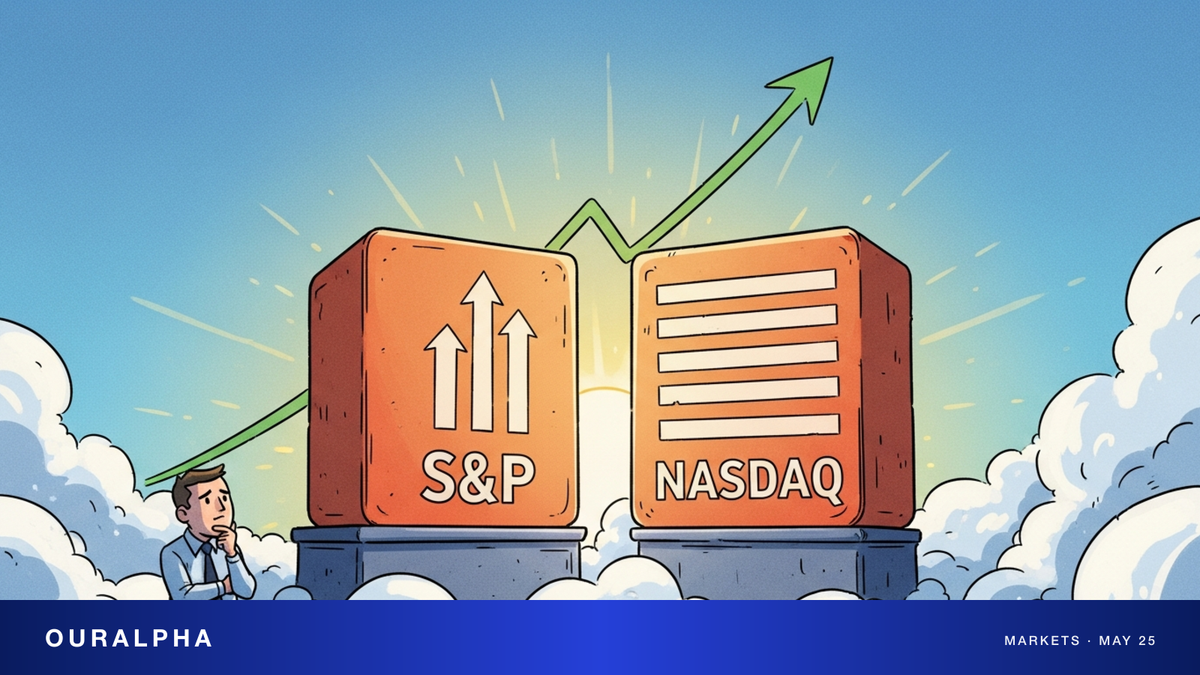
NVDA Dropped 1.94% After Earnings. So Why Did the Indexes Barely Flinch?
SPY closed at $745.64 and QQQ at $717.54, both near multi-month highs — even as Nvidia slid 5%. The AI trade isn't breaking; it's rotating. This week's PCE print and oil move will decide whether the indexes can hold.
TL;DR
SPY closed at $745.64 and QQQ at $717.54 on Friday, both hovering near multi-month highs. Nvidia fell 5% — and the indexes didn't follow. The AI trade isn't broken; it's rotating outward from Nvidia to the broader AI infrastructure stack.
- Historically, every meaningful post-earnings NVDA pullback dragged the Nasdaq 100 with it. Not this time — that's a structural signal.
- Three layers of AI infrastructure are picking up the baton: power & grid (GE Vernova, Vertiv, Eaton) + optical networking (Lumentum, Coherent, Arista) + upstream equipment (ASML, AMAT, LRCX)
- Three pillars supporting the indexes: earnings revisions still positive + WTI pulling back from $103 eases the inflation pulse + equal-weight S&P outperforming cap-weight, signaling better breadth
- Two tests this week: Tuesday's spot market reaction to the oil drop, and Friday's April PCE print
The two largest U.S. equity ETFs by AUM — SPDR S&P 500 (SPY) and Invesco QQQ — closed Friday at $745.64 and $717.54, respectively, both edging higher near multi-month highs. That price action matters: at the index level, the market is effectively looking through Nvidia's post-earnings pullback. The AI thesis isn't cracking — it's rotating internally.
The real question is whether the indexes can hold these levels through two tests this week: Tuesday's spot market reaction to the crude oil decline, and Friday's April PCE inflation data.
What the Indexes Are Telling Us
SPY at $745.64 puts the S&P 500 within 1% of its all-time high; QQQ at $717.54 sits just 2% off the Nasdaq 100's record. Over the past two weeks, both ETFs have outperformed Nvidia at the index level — and that is a structural data point worth taking seriously.
Historically, every significant post-earnings NVDA pullback has taken the Nasdaq 100 down with it. This time Nvidia fell 5% while QQQ edged higher. That divergence signals genuine rotation within AI — not a broad risk-off exit.
The composition of that rotation matters. Microsoft (MSFT), Alphabet (GOOGL), Amazon (AMZN), and Meta all held flat-to-higher over the same window — each benefiting from the "AI capex keeps expanding" narrative without needing Nvidia's quarterly print as a catalyst. The adjacent AI infrastructure layer — power & grid (GE Vernova, Vertiv, Eaton), optical networking (Lumentum, Coherent, Arista), and upstream equipment (ASML, AMAT, LRCX) — has meaningfully outperformed Nvidia over the past two weeks. They're doing the heavy lifting that, in a more concentrated market, Nvidia would have done alone.
Why the Indexes Are Holding
Three structural reasons.
First, S&P earnings revisions are still positive. Q1 2026 earnings season delivered the strongest aggregate revision in 18 months, and Q2 visibility at the index level remains constructive. Positive bottom-up revisions mean the indexes have fundamental support to absorb a pullback in any single AI name without triggering a broad repricing.
Second, the macro backdrop is marginally better — though still tight. WTI pulling back from $103 removes the most visible inflation impulse. April PCE consensus sits at +3.3% core — still well above target, but consistent with the Fed's "gradual disinflation" narrative. The labor market continues to normalize without breaking: initial jobless claims are near cycle lows, and payroll growth has slowed to a pace that supports moderating wage pressures.
Third, the recent rally has better breadth. Over the past two weeks, equal-weight S&P 500 has outperformed cap-weighted S&P 500 — meaning index returns are no longer driven by five mega-caps alone. Historically, healthier breadth correlates with more sustainable advances and makes the index less vulnerable to idiosyncratic shocks in any single name.
What This Means for Positioning
For investors using SPY or QQQ for broad U.S. equity beta, Friday's close is a clear signal: AI exposure and index exposure are no longer fully tethered. That's actually a healthy development for portfolio construction — for the first time since early 2024, investors can think about "AI exposure" and "market exposure" as separable.
Practically speaking, investors who ran AI overweights concentrated in Nvidia and just weathered the post-earnings drawdown don't have to choose between "exit the AI trade" and "sit through the NVDA pain." There's a third option: rotate within AI toward the infrastructure-adjacent names that have been doing the work. SPY and QQQ holding near highs is the index-level confirmation that this rotation is the right call.
One more tactical note: two weeks of index resilience alongside a pullback in the leading stock has historically been a setup for the next leg higher — not a precursor to a deeper drawdown. The closest historical analog is the 2017 semiconductor cycle, when the leading chip stock consolidated for two to three months while the broader index continued to make new highs before the whole cycle reaccelerated.
Three Signals That Decide Direction This Week
One: Tuesday's spot market reaction to the oil drop. SPY closing above Friday's level on solid volume would confirm that real money is following the futures narrative; a weak Tuesday suggests Friday's tape was position-driven noise.
Two: Friday's April PCE print. Core PCE at +3.2% or below clears the macro runway; +3.4% or above materially reprices Fed expectations for the June meeting.
Three: The direction of divergence within AI. If infrastructure-adjacent names keep outpacing Nvidia, the broadening is happening for the right reasons. If leadership suddenly reconcentrates back into Nvidia alone, the index's medium-term durability signal actually weakens.
The current setup leans constructive. Friday's close is a promising start — this week is the real test.
Sources
This content is for informational purposes only and does not constitute investment advice, trading advice, or any guarantee of returns.