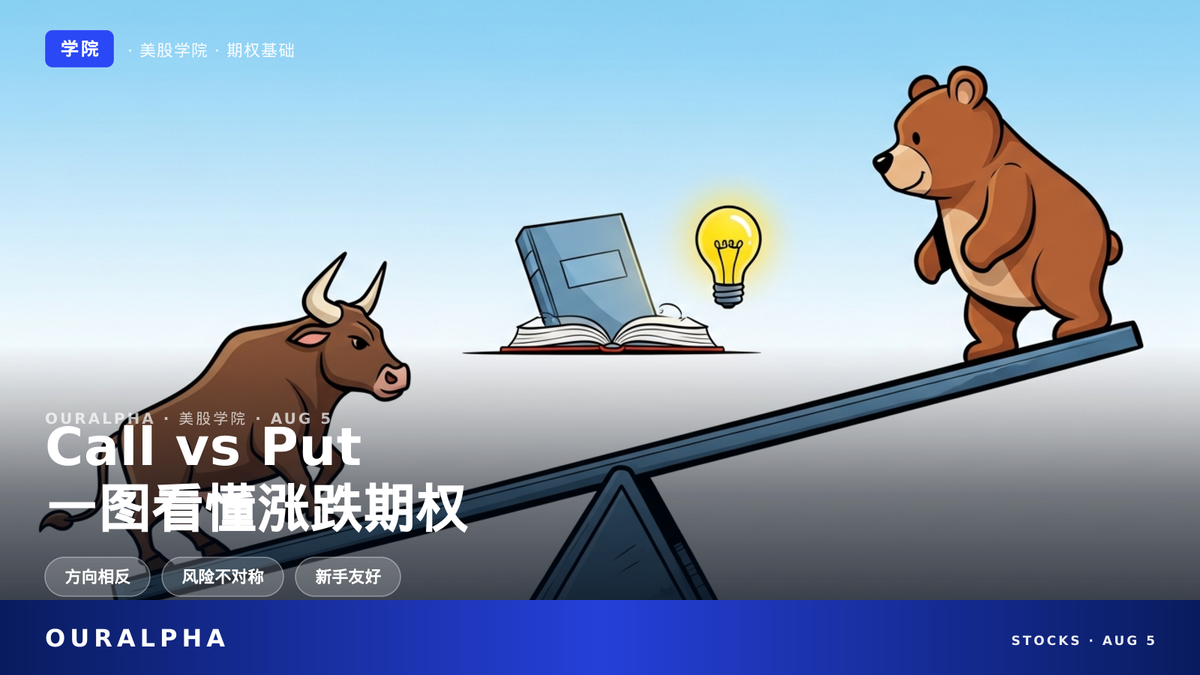
What's the Difference Between Call and Put Options? Calls vs. Puts Explained
What's the difference between Call and Put options? This article explains direction, profit/loss, risk, and practical strategies in plain English, so beginners can get it fast.
What's the Difference Between Call and Put Options?
A Simple Guide to Calls vs. Puts
New to U.S. stock options? The first terms you'll hear are Call and Put, but what's the real difference?
Simply put, a Call is a "right to buy" you purchase when you expect prices to rise, and a Put is a "right to sell" you buy when you expect prices to fall.
But the rights and obligations of buyers and sellers are exact opposites, and the risks are very different. This article will help you fully understand.
TL;DR · IN SHORT
- A Call is a "right to buy" that gives the buyer the right to buy at a set price; a Put is a "right to sell" that gives the buyer the right to sell at a set price. They move in opposite directions.
- For buyers (whether buying a Call or a Put), the maximum loss is capped at the premium paid; sellers, however, take on the obligation to fulfill the contract, so their risk is completely asymmetric.
- The riskiest position for sellers is a naked Call, because stock prices have no ceiling, so losses are theoretically unlimited; selling a Put loses at most "strike price minus premium."
KEY TERMS
Premium: The fee the buyer pays the seller for the right to the option. It's the buyer's maximum possible loss and the seller's potential maximum gain (if the option expires worthless).
Strike Price: The fixed price at which the underlying asset can be bought or sold as specified in the option contract. It's the benchmark for determining profit/loss and whether an option is in or out of the money.
Expiration & Exercise: The deadline by which the option can be exercised. American-style options can be exercised on any trading day before expiration; European-style options can only be exercised on the expiration date itself.
Intrinsic Value & Time Value: The premium consists of intrinsic value (the value if exercised immediately) and time value (the premium for expected future price movement). Time value decays as expiration approaches.
CONTENTS
- What's the Real Difference Between Call and Put Options?
- How Do the Profit/Loss Structures of Buying a Call vs. Buying a Put Differ?
- Why Are the Risks of Selling a Call vs. Selling a Put So Different?
- What Are Strike Price and Premium, and How Do They Determine Profit and Loss?
- What's the Difference Between American-Style and European-Style Options?
- What Are Protective Puts and Covered Calls?
- Should Beginners Learn to Buy or Sell Options First?
- FAQ
What's the Real Difference Between Call and Put Options?
Simply put, a Call option is a "right to buy," and a Put option is a "right to sell."[1] When you buy a Call, you're betting the price of the underlying asset will go up; when you buy a Put, you're betting it will go down.[2] More precisely, a Call gives the buyer the right to buy at a set price, while a Put gives the buyer the right to sell at a set price.[3] For example: if you think Apple's stock will rise, you might pay $5 for a Call with a strike price of $200. If the stock climbs to $220, you can buy at $200 and pocket the difference. Conversely, if you think it will fall, you'd buy a Put with a $200 strike. If the stock drops to $180, you can sell at $200 and profit from the difference.
So the core difference between Calls and Puts is direction: Calls are bullish, Puts are bearish. But the rights and obligations of buyers and sellers are exact opposites, which is where beginners often get confused.[4] Buying a Call means paying for a "right"; selling a Call means getting paid to take on an "obligation." Same for Puts: buying gives you a right, selling imposes an obligation. Think of it this way: a right means you can choose to act or not; an obligation means you must act. For example, if you buy a Call and the stock rises, you can exercise and buy; if it falls, you can let it expire and lose only the premium. But if you sell a Call and the buyer exercises, you must sell the stock at the strike price, no matter how high the stock has climbed.
How Do the Profit/Loss Structures of Buying a Call vs. Buying a Put Differ?
The profit/loss structures of buying a Call and buying a Put are mirror images.[14] When you buy a Call, your maximum loss is the premium you paid, but if the stock soars, your profit potential is theoretically unlimited—because stock prices can go to the moon. When you buy a Put, your maximum loss is also the premium, but your profit potential is limited—because a stock can only fall to zero, so your maximum gain is "strike price minus premium."
For example: you pay $5 for a Call with a $200 strike. If the stock rises to $300, you make $95 per share ($300 - $200 - $5). If it falls to $100, you lose at most $5. Buying a Put is the opposite: you pay $5 for a Put with a $200 strike. If the stock falls to $100, you make $95 per share ($200 - $100 - $5). If it rises to $300, you lose at most $5. So, buyers have limited risk but potentially large rewards (unlimited for Calls, capped for Puts).
Note that the breakeven points differ: for a Call, the stock must rise above "strike price + premium" before you profit; for a Put, it must fall below "strike price - premium."[14] In the examples above, the Call's breakeven is $205, and the Put's is $195.
Why Are the Risks of Selling a Call vs. Selling a Put So Different?
The risks of selling a Call versus selling a Put are completely different, and this is the most critical risk point in options trading.[10] When you sell a naked Call (without owning the underlying stock), if the stock surges, your losses are theoretically unlimited—because there's no ceiling on stock prices, and you're forced to sell at the strike price, potentially losing a fortune. In contrast, selling a Put has a maximum loss because a stock can only fall to zero, so your worst-case loss is "strike price minus premium."
For example: you sell a Call with a $200 strike and collect a $5 premium. If the stock rises to $500, you lose $295 per share ($200 - $500 + $5), and the higher it goes, the more you lose. But if you sell a Put with a $200 strike and collect $5, even if the stock falls to zero, you lose at most $195 per share ($200 - $0 - $5). So, naked Calls are far riskier than selling Puts.
However, the profit potential for selling either Calls or Puts is limited to the premium received.[5] If the option expires worthless, the seller keeps the entire premium. But the risk is asymmetric: selling a Call can lose unlimited, while selling a Put loses at most the strike price. That's why many beginners start with selling Puts, but beware: if the stock crashes, you may be assigned and forced to buy the stock, so you need sufficient capital.
What Are Strike Price and Premium, and How Do They Determine Profit and Loss?
The strike price is the fixed price at which the underlying asset can be bought or sold as specified in the option contract. It's the benchmark for determining profit/loss and whether an option is in or out of the money.[7] The premium is the fee the buyer pays the seller for the option right, and it's the buyer's maximum possible loss.[5] For a Call, if the underlying price is above the strike, the option is "in the money" and has intrinsic value; for a Put, it's "in the money" when the underlying price is below the strike.[8]
For example: a Call with a $70 strike, and the stock is $75 at expiration, has $5 of intrinsic value; if the stock is $65, it's worthless and expires.[7] The premium consists of intrinsic value plus time value, and time value decays as expiration approaches, so options lose value as they get closer to expiration.[8]
In the U.S. market, one standard stock option contract covers 100 shares of the underlying stock, so the quoted premium is per share, and you multiply by 100 to get the actual cost.[6] For example, a quoted premium of $5 means one contract costs $500. Beginners often overlook this and end up undercapitalized.
What's the Difference Between American-Style and European-Style Options?
American-style options (like most U.S. stock options) can be exercised on any trading day before expiration, while European-style options (like some index options such as SPX) can only be exercised on the expiration date itself.[9] This difference affects your early exercise strategy and assignment risk.
For example: if you buy an American-style Call and the stock surges, you can exercise early to lock in profits at any time; but with a European-style option, you must wait until expiration, and the price could fall in the meantime. So, American-style options are more flexible, but they usually come with higher premiums.
For sellers, American-style options carry a higher risk of early assignment, because you could be called upon to fulfill your obligation at any time; European-style options are more predictable, as long as you don't default at expiration. However, most retail traders don't actually exercise options; they close out their positions instead. So this difference may not matter much in practice, but understanding it helps you choose the right option type for your needs.
What Are Protective Puts and Covered Calls?
A protective put is when you own the underlying stock and buy a Put, which acts like "downside insurance" for your position. If the stock falls, the Put's gains offset the stock's losses, while you still keep the upside if the stock rises.[11] A covered call is when you own the stock and sell a Call, collecting a premium to boost income, but you give up gains above the strike price if the stock surges.[12]
These two strategies are the most basic option combinations: one hedges risk, the other enhances income, and they serve opposite purposes. Beginners can start by understanding these strategies to see how options are used in practice.
For example: you own 100 shares of Apple and worry about a drop. You buy a Put with a $200 strike, paying a premium. If the stock falls to $180, the Put's gains offset the stock's losses; if it rises to $220, you still enjoy the upside, just minus the premium. For a covered call, you sell a Call and collect a premium. If the stock doesn't rise above the strike, you keep the premium; if it soars, you're forced to sell at the strike, missing out on extra gains.
Should Beginners Learn to Buy or Sell Options First?
For complete beginners, it's best to start with "buying options," because the buyer's maximum loss is just the premium, which is manageable, and it's easier to understand the profit/loss logic.[5] Selling options can bring in premium income, but the risks can be huge, especially naked Calls, which have theoretically unlimited losses and require more experience and capital.[10]
Also, before trading options, your broker must provide the OCC's "Characteristics and Risks of Standardized Options" disclosure document, and you need approval for the appropriate options trading level.[13] So, beginners must understand the rules before diving in. To learn more about options basics, check out this article: What Are Options? Principles, Risks, and Examples Explained.
Finally, we recommend beginners practice with a paper trading account to get familiar with concepts like option quotes, strike prices, and expiration dates before risking real money. Options involve leverage and are risky, so proceed with caution.
常见问题 FAQ
What's the most I can lose when buying a Call?
At most, you lose the premium you paid.[5] If the option expires worthless, you lose the entire premium, but nothing more.
How risky is selling a Put? Is it more dangerous than buying a Put?
Selling a Put is much riskier than buying a Put. When you buy a Put, your max loss is the premium; when you sell a Put, your max loss is "strike price minus premium," which could be huge if the stock falls to zero.[10] But compared to selling a Call, selling a Put has limited risk.
What happens if an option expires without being exercised? Do I lose the premium?
If an option expires out of the money (no intrinsic value), it becomes worthless. The buyer loses the entire premium, and the seller keeps it.[5] So buyers should watch the expiration date and close or exercise in time.
Is the quoted premium for one option contract the price per share? How much do I actually pay?
No. In the U.S., one standard stock option contract covers 100 shares. The quoted premium is the "per-share price," so you multiply by 100 to get the actual cost.[6] For example, a quote of $5 means one contract costs $500. Beginners often overlook this and end up undercapitalized.
Can I be assigned at any time when selling American-style options?
Yes. American-style option buyers can exercise on any trading day before expiration, so sellers can be assigned (required to fulfill the contract) at any time; European-style options can only be exercised at expiration, making the seller's risk more predictable.[9] In practice, most traders close positions rather than exercise, so actual assignment is not that common.
What preparations should beginners make before trading options?
Before trading options, your broker must provide the OCC's "Characteristics and Risks of Standardized Options" disclosure, and you need approval for the appropriate options trading level—you can't just start trading after opening an account.[13] We recommend beginners understand these rules and use a paper trading account to get familiar with concepts like strike prices and expiration dates before risking real money.
SOURCES
[1] Options | Investor.gov (SEC)
[2] Investor Bulletin: An Introduction to Options — Investor.gov (SEC)
[3] Options | FINRA.org
[4] Options | FINRA.org
[5] Investor Bulletin: An Introduction to Options — Investor.gov (SEC)
[6] Equity Options Specifications | Cboe
[7] Investor Bulletin: An Introduction to Options — Investor.gov (SEC)
[8] Calculating Options Moneyness and Intrinsic Value — CME Group
[9] Understanding the Difference: European vs. American Style Options — CME Group
[10] Characteristics and Risks of Standardized Options — OCC (June 2024)
[11] Protective Put (Married Put) — Options Industry Council (OIC)
[12] Covered Call (Buy/Write) — Options Industry Council (OIC)
[13] Options | FINRA.org
[14] Investor Bulletin: An Introduction to Options — Investor.gov (SEC)
This content is for informational purposes only and does not constitute investment advice, trading advice, or any guarantee of returns.