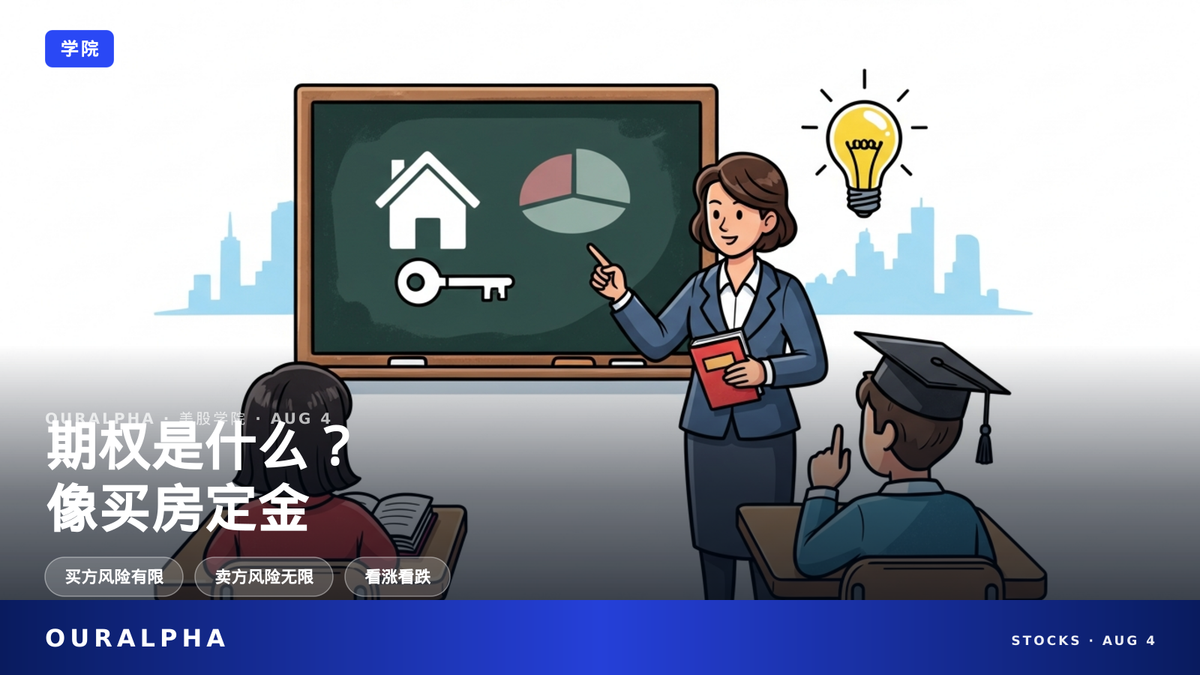
What Are Options? Basics, Risks, and Examples

Options are like a house deposit: buyers have limited risk, sellers have unlimited risk. How to choose calls and puts? Explained in one article.

What Are Options? Basics, Risks, and Examples
OURALPHA · ACADEMY

What Are Options?
Explained with a House Deposit

OurAlpha Academy · Options 101

Options are often called an 'advanced play,' but the core logic is actually simple—like putting down a deposit on a house.

To understand options, the key is to distinguish between buyer and seller: who has limited risk, and who might have unlimited risk?

This article uses everyday examples to explain the basics of options in one go.

TL;DR · IN SHORT

  • An option is a right, not the stock itself.
  • The buyer can lose at most the premium; the seller's risk can be unlimited.
  • Call options bet on a rise, put options bet on a fall.

KEY TERMS

Option: A contract that gives the buyer the right, but not the obligation, to buy or sell an underlying asset at a set price within a set period. The seller takes on the obligation to fulfill the contract.

Premium: The non-refundable fee the buyer pays upfront to the seller for this right. It is also the maximum amount the buyer can lose in the trade.

Strike Price: The fixed price at which the underlying asset can be bought or sold as specified in the option contract.

Call/Put: A call option gives the right to buy the underlying asset at a set price; a put option gives the right to sell it at a set price.

CONTENTS

  1. What are options, and how are they different from buying stocks directly?
  2. What's the most money I can lose buying an option?
  3. What's the difference between call options and put options?
  4. What happens if an option expires without being exercised? Do I lose the money?
  5. How risky is selling options (being the seller)? Is the risk really unlimited?
  6. How many shares does one option contract represent?
  7. Are U.S. stock options American-style or European-style? What's the difference?
  8. What are in-the-money, at-the-money, and out-of-the-money options?
  9. Can regular investors trade options? What conditions are needed to get approval?
  10. FAQ

What are options, and how are they different from buying stocks directly?

Simply put, an option is a contract that gives you a 'right' to buy or sell an asset (like a stock) at a set price within a set time, but you have no 'obligation' to do so[1]. It's like seeing a house you like, putting down a deposit to lock in the price, but the final decision to buy is yours.

Buying a stock directly means you actually purchase the stock with real money, becoming a shareholder, and you lose money if the stock price drops. Options are different: you're buying a 'choice,' and the cost is the premium, which is like a 'deposit' that is non-refundable[3].

Another analogy: buying a stock is like buying the house outright—you bear the gains and losses as the price moves. Buying an option is like spending a small amount on a 'letter of intent' to buy the house. If the price goes up, you can buy at the agreed price and pocket the difference; if the price drops, you can just walk away from the small deposit, limiting your loss.

Note that the option buyer has the right but not the obligation, while the seller has the obligation but not the right. The seller receives the premium and must be ready to fulfill the contract. So, the rights and obligations of buyers and sellers are not equal, which leads to different risk profiles.

What's the most money I can lose buying an option?

Many people think options are very risky, but for the buyer, the risk is limited and capped—at most, you lose the premium you paid[11]. Using the house deposit analogy: if the house price drops and you decide it's not worth it, you just lose the deposit, with no other losses.

So, buying an option is like buying insurance: you pay a premium (the option premium) for protection (the right), and the worst case is that the premium is gone, but you don't owe anything more.

This feature lets option buyers know their maximum loss upfront, helping them manage risk. For example, if you spend $200 on an option with a premium of 2 points, no matter how much the underlying stock drops, your maximum loss is that $200—unlike buying the stock directly, where a 50% drop means you lose half your investment.

But note: while the loss is limited, the probability of losing is high. Options have time value, and if they expire without intrinsic value, the premium goes to zero. So, buyers may lose small amounts frequently, so timing is important.

What's the difference between call options and put options?

A call option gives you the right to 'buy at a set price,' suitable when you think the stock price will rise[2]. For example, if you think a stock will go from $100 to $120, you can buy a call with a strike price of $100. If the price rises, you can buy at $100 and profit from the difference.

A put option gives you the right to 'sell at a set price,' suitable when you think the stock price will fall[2]. For example, if you own a stock and worry it might drop, you can buy a put. If the price falls, you can still sell at the agreed price, locking in your profit.

Another example: a call option is like pre-ordering a phone at a set price of $5,000. If the phone's price rises to $6,000, you can still buy it for $5,000, saving $1,000. If the price drops to $4,000, you don't buy, losing only the deposit. A put option is like buying 'price-drop insurance' for the phone: if the price drops, you can sell at the agreed price, avoiding the loss.

In short, calls are 'betting on a rise,' and puts are 'betting on a fall.' But note: an option's value depends not only on the stock price but also on time, volatility, and other factors. So, a call doesn't always profit when the stock rises; it also depends on the strike price and remaining time.

What happens if an option expires without being exercised? Do I lose the money?

If an option expires and exercising is not beneficial (e.g., a call expires when the stock price is below the strike price), you can choose not to exercise. Then the premium goes to the seller, and your loss is that premium[4].

It's like putting down a deposit but deciding not to buy the house—the deposit is non-refundable. So, when buying an option, be clear that the premium is the maximum loss you're willing to accept.

Also, if an option is in the money at expiration, brokers typically auto-exercise it unless you instruct otherwise. But if you don't want to exercise, you must handle it before expiration to avoid unnecessary risk. For example, if you hold a call and the stock is slightly above the strike at expiration, auto-exercise means you'll need to buy the stock at the strike price. If you don't have enough cash, you might be forced to liquidate.

So, always monitor your positions before expiration and decide whether to exercise, close, or let it expire. Don't let your options 'go to waste,' or you might face unexpected consequences.

How risky is selling options (being the seller)? Is the risk really unlimited?

The option seller (also called the 'writer') has the obligation to fulfill the contract if the buyer exercises[1]. The seller's risk depends on what type of option is sold. If you sell a 'naked' call (i.e., you don't own the underlying stock), then if the stock price rises without limit, your loss is theoretically unlimited[11].

For example, if you sell a naked call with a strike price of $100 and the stock rises to $1,000, you must sell at $100, losing $900 (minus the premium received). So, the seller's risk is huge, especially with naked calls—beginners should never try this lightly.

But sellers also have benefits: you collect the premium, and if the option expires worthless, the premium is yours. It's like an insurance company collecting premiums; if no claims are made, you keep the money. But if a claim happens, you might lose everything.

To reduce risk, sellers can use a 'covered call' strategy, where you hold the underlying stock while selling a call. That way, if the stock rises, you have the stock to deliver, making the risk more manageable. But naked selling is extremely risky, and regulators have stricter approval for such strategies.

How many shares does one option contract represent?

In the U.S. market, a standard stock option contract typically represents 100 shares of the underlying stock[5]. So, a premium quote of 1 point equals $100 (1 point × 100 shares).

For example, if an option's premium is quoted at $2.50, buying one contract costs $250 (2.5 × 100). This detail is important—don't get confused when calculating profits and losses.

Also, strike price intervals follow a standard rule: if the stock price is below $25, the interval is $2.50; between $25 and $200, it's $5; above $200, it's $10[6]. So, if the stock is at $100, strike prices might be 100, 105, 110, etc., not 101 or 102. This rule helps market liquidity and trading.

Standard monthly options expire on the third Friday of the expiration month[7]. For example, March options expire on the third Friday of March. The standard expiration cycle typically includes the two nearest months plus months in the quarterly cycle, so you might see options for near-term months and quarterly months (like March, June, September, December).

Are U.S. stock options American-style or European-style? What's the difference?

U.S. stock options are 'American-style,' meaning the holder can exercise on any trading day up to and including the expiration date[8]. This means if you hold a call and the stock price rises nicely, you can exercise early to buy the stock at the strike price and then sell at the market price to lock in profits.

But note: early exercise is usually not optimal because you lose the remaining time value. For example, if you hold a call with one month left and the stock has already risen, but you think it might rise further, exercising early wastes that potential upside. So, it's generally better to close the position (sell the option) to take profits rather than exercise.

Unlike individual stock options, index options like the S&P 500 Index (SPX) are 'European-style,' meaning they can only be exercised on the expiration date and settle in cash, without actual delivery of the underlying securities[9]. For example, if an SPX option expires in the money, it settles in cash for the difference, and you don't actually buy or sell a basket of stocks.

So, American-style options are more flexible, but European-style options may be priced slightly differently. Be aware of which type you're trading.

What are in-the-money, at-the-money, and out-of-the-money options?

Whether an option is 'in the money' depends on whether exercising immediately would be profitable: a call is in the money when the underlying price is above the strike price; a put is the opposite. An option's value consists of 'intrinsic value' and 'time value'[10].

For example, if a stock is trading at $110 and you hold a call with a strike price of $100, exercising immediately would let you buy at $100 and sell at $110, making $10. So, it's in the money, with an intrinsic value of $10. If the stock is below the strike, say $90, exercising wouldn't be worthwhile, so the option is out of the money, with an intrinsic value of $0.

At the money means the strike price equals or is very close to the underlying price. At that point, intrinsic value is $0, but time value is at its highest. Time value is the potential benefit from the remaining time until expiration, and it decays as expiration approaches.

Understanding in-the-money and out-of-the-money is important because it affects your exercise decisions and the option's price. In-the-money options are more expensive because they include intrinsic value; out-of-the-money options are cheaper but may still have some value due to time value.

Can regular investors trade options? What conditions are needed to get approval?

Yes, but you need to meet certain conditions. U.S. regulations require brokers to review and evaluate an investor's knowledge, investment experience, financial situation, etc., before approving options trading, in accordance with FINRA Rule 2360. Different approval levels are set for different strategies (e.g., buying only, covered calls, naked selling, spreads)[12].

This means you can't just start trading options. Brokers will have you fill out an application to learn about your experience, income, assets, etc., and then decide which level of permission to grant. For example, you might start with simple buying of calls or puts, and as you gain experience, you can apply for more advanced strategies.

Also, before trading options, brokers must provide you with the 'Characteristics and Risks of Standardized Options' (ODD) document, an official risk disclosure published by the OCC. Be sure to read it carefully[13]. This document details various risks, including leverage, liquidity, and exercise risks. Reading and understanding it helps you make informed decisions.

So, when you're new to options, it's advisable to start by applying for the lowest level of permission (like buying calls/puts only), read the ODD document thoroughly, and then gradually try more complex strategies—rather than jumping straight into naked selling or spreads.

常见问题 FAQ

What's the difference between options and futures?

Option buyers have the right but not the obligation; futures contracts obligate both parties. Option buyers have limited risk (max loss is the premium), while futures risk is unlimited.

How is the option premium determined?

The premium is set by market supply and demand, influenced by factors like the underlying stock price, strike price, time to expiration, and volatility.

What's the difference between a covered call and a naked call?

A covered call involves selling a call while holding the underlying stock, so if the stock rises, you have the stock to deliver, making the risk more manageable. A naked call is selling a call without owning the stock, so if the stock soars, your loss is theoretically unlimited, making it much riskier—beginners are advised not to try it.

Can I sell an option before expiration to take profits, or do I have to wait to exercise?

Yes, you can. Most option traders don't actually exercise; they close the position by selling the option before expiration to lock in profits, because early exercise would lose the remaining time value. Exercise is more common near expiration or when you actually want to buy/sell the underlying stock.

If I lose money buying an option, can I end up owing my broker money?

No. The maximum loss for an option buyer is the premium paid. Even if the option becomes worthless at expiration, you only lose the premium, and you won't face additional losses like a seller might.

What does auto-exercise at expiration mean? Do I need to do anything?

If an option is in the money at expiration, brokers typically auto-exercise it for you, so you don't need to do anything. But if you don't want to exercise, you must notify your broker before expiration to waive exercise; otherwise, you might be forced to buy or sell the underlying stock, leading to unexpected capital requirements or risks.

Do I need to pay taxes on options?

Options trading involves tax considerations, depending on the holding period and strategy. It's best to consult a tax advisor.

SOURCES

[1] SEC investor.gov 'Investor Bulletin: An Introduction to Options'
[2] SEC investor.gov Options Glossary Page
[3] SEC investor.gov 'Investor Bulletin: An Introduction to Options'
[4] SEC investor.gov 'Investor Bulletin: An Introduction to Options'
[5] OCC 'Equity Options Product Specifications'
[6] OCC 'Equity Options Product Specifications'
[7] OCC 'Equity Options Product Specifications'
[8] OCC 'Equity Options Product Specifications'
[9] Cboe 'S&P 500 Index (SPX) Options' Product Description
[10] CME Group Options Education Course 'Calculating Options Moneyness & Intrinsic Value'
[11] FINRA 'Options' Investor Education Page
[12] FINRA Rule 2360 'Options'
[13] OCC 'Options Disclosure Document'

This content is for informational purposes only and does not constitute investment advice, trading advice, or any guarantee of returns.

Keep Reading

What's the Difference Between Call and Put Options? Calls vs. Puts Explained

What's the Difference Between Call and Put Options? Calls vs. Puts Explained
OURALPHA · ACADEMY

What's the Difference Between Call and Put Options?
A Simple Guide to Calls vs. Puts

OurAlpha Academy · Options basics in plain English

New to U.S. stock options? The first terms you'll hear are Call and Put, but what's the real difference?

Simply put, a Call is a "right to buy" you purchase when you expect prices to rise, and a Put is a "right to sell" you buy when you expect prices to fall.

But the rights and obligations of buyers and

Read full story →

Stay ahead of the market — never miss a deep dive

Follow OurAlpha for AI-driven US equity research and market insight, every day.