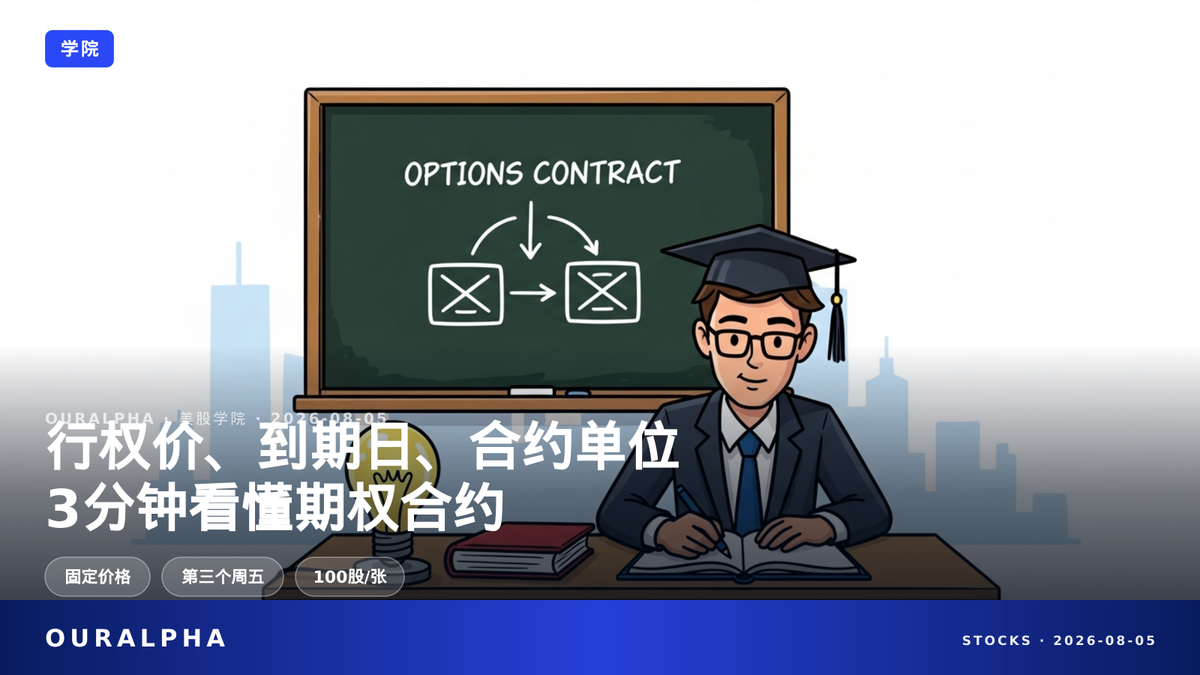
How to Understand Options Strike Price and Expiration Date? Contract Multiplier Explained
Strike price, expiration date, and contract multiplier are the three core elements of an options contract. Master them, and you'll be able to read any options contract.
Strike Price, Expiration Date, Contract Multiplier:
The Three Keys to Understanding an Options Contract
Many people get confused by terms like strike price, expiration date, and contract multiplier when they first look at an options contract.
Think of them like the price, closing date, and square footage in a home purchase contract—once you get these three, options are no longer a mystery.
This article uses everyday analogies to help you fully understand these three most misunderstood concepts.
Blue closing line: Understanding the contract terms is the first step into the world of options.
TL;DR · IN SHORT
- The strike price is the fixed buy/sell price in the contract; it doesn't change with the stock price.
- Expiration is usually the third Friday of the month; in-the-money options are automatically exercised.
- One options contract represents 100 shares, so multiply the premium by 100.
KEY TERMS
Strike Price: The fixed price in an options contract at which the buyer can buy (Call) or sell (Put) the underlying stock in the future. Once the contract is created, this price never changes.
Expiration Date: The deadline when the rights under an options contract expire. Standard stock options typically expire on the third Friday of the expiration month.
Contract Multiplier: One standard U.S. stock options contract represents 100 shares of the underlying stock. This is the default trading unit set by the OCC.
American/European Style: American-style options can be exercised at any time before expiration, while European-style options can only be exercised on the expiration date. All U.S. exchange-listed stock options are American-style, while most index options are European-style.
CONTENTS
- What is the strike price, and why doesn't it change?
- How do you tell the difference between in-the-money, out-of-the-money, and at-the-money?
- Why is the expiration date always the 'third Friday'?
- Will in-the-money options be automatically exercised at expiration? What if I don't want to exercise?
- How many shares does one options contract represent? Why 100?
- What's the difference between American-style and European-style options? Does it affect my trading?
- Why do option prices drop so fast near expiration?
- FAQ
What is the strike price, and why doesn't it change?
Simply put, the strike price is the price written in the options contract at which you can buy or sell the stock in the future[2]. For example, if you have a call option on Apple stock with a strike price of $200, then no matter whether Apple's stock price rises to $250 or falls to $150, you have the right to buy 100 shares at $200 (assuming the contract multiplier is 100). This price is fixed from the day the contract is created and does not change with stock price fluctuations[2].
You can think of it like the 'contract price' when buying a house—once you sign the contract, whether housing prices go up or down doesn't matter; you always transact at the contract price. So the strike price is the 'anchor' of the options contract; it determines whether the option is 'in the money' or 'out of the money.'
Why must the strike price be fixed? Imagine if the strike price changed with the stock price, then the rights and obligations of both parties would become ambiguous, and the market couldn't price options. A fixed strike price makes it clear to both buyer and seller: no matter how the stock price moves, you have the right to transact at this price. This is also a key difference between options and futures—in futures, both parties have the obligation to settle at the agreed price, while in options, only the buyer has the right, and the seller has only the obligation.
Another example: you buy a call option with a strike price of $100. At expiration, if the stock price rises to $120, you can exercise and buy at $100, immediately making a $20 profit (ignoring the premium cost). But if the stock price falls to $80, you can simply let the option expire, losing only the premium. The strike price is like your preset 'target price'; it doesn't change, but you can decide whether to use the right based on market conditions.
How do you tell the difference between in-the-money, out-of-the-money, and at-the-money?
These three terms describe the relative position of the 'strike price' and the 'current stock price,' not a change in the strike price itself[3]. For a call option, if the stock price is above the strike price, it's 'in the money' (ITM). For example, if the strike price is $200 and the stock price is $220, exercising would have intrinsic value. If the stock price is below the strike price, it's 'out of the money' (OTM). For example, if the stock price is $180 and the strike price is $200, exercising would result in a loss, so the intrinsic value is zero. If the stock price equals the strike price, it's 'at the money' (ATM)[3].
For put options, it's the opposite: if the stock price is below the strike price, it's in the money; if above, it's out of the money. Remember: in the money means exercising would yield a profit, while out of the money means exercising is not worthwhile.
You can think of it like buying insurance. A call option is like insurance against the stock price rising: if the stock price rises above the strike price, you have 'coverage' to buy at a low price—that's in the money. If the stock price doesn't rise to the strike price, the insurance is 'unused'—that's out of the money. At the money is when the stock price is right around the strike price, and the insurance is optional.
Understanding in-the-money and out-of-the-money is important for trading because in-the-money options typically have higher prices (including intrinsic value), while out-of-the-money options are cheaper (only time value). Beginners often like to buy cheap out-of-the-money options, but be aware that out-of-the-money options have a high probability of expiring worthless, so the risk is not low.
Why is the expiration date always the 'third Friday'?
The expiration date for standard U.S. stock options is the third Friday of the expiration month (if it's a holiday, it moves to Thursday)[6]. This rule is set by the exchanges and the clearinghouse (OCC) to standardize expiration dates for easier management and trading. For example, the third Friday of August 2026 is August 21, so standard options expiring in August end on that day.
Besides standard monthly options, there are also weekly options that expire every week and end-of-month (EOM) options. These shorter-term options give you more flexibility to position around earnings, events, etc.[7]. Additionally, each stock option is assigned to a quarterly expiration cycle (e.g., January/April/July/October), which determines the expiration schedule for longer-dated contracts[12].
Why Friday? Because after the U.S. market closes on Friday, there are two days off over the weekend, providing a buffer for clearing and settlement. If Friday is a holiday, it moves to Thursday to avoid expiration on a non-trading day.
For traders, expiration means the end of time value. If you hold options, you must decide before expiration whether to close, exercise, or let them expire. Many beginners ignore the expiration date, leading to automatic processing of their options, so be sure to mark these dates on your calendar.
Will in-the-money options be automatically exercised at expiration? What if I don't want to exercise?
This is a key misconception! Many people think they can just ignore expiration, but in reality: if an option is in the money at the close on expiration day, and the in-the-money amount is $0.01 or more, the OCC will automatically execute 'exercise by exception,' meaning it will automatically exercise for you, unless you tell your broker in advance that you want to 'do not exercise'[10].
If you don't want to exercise (for example, you don't have enough cash to buy the stock), you must submit a 'do not exercise' instruction to your broker before or on the expiration date within the specified time. Otherwise, you may be forced to buy or sell the stock at the strike price, leading to unnecessary capital tie-up or risk. So expiration is not 'ignore and nothing happens'; you need to take action.
For example: you buy a call option with a strike price of $100. At expiration, the stock closes at $100.50, in the money by $0.50. The OCC will automatically exercise, and your account will be debited to buy 100 shares. If you don't have enough cash in your account, you could face an overdraft or forced liquidation.
Therefore, before expiration, always check your positions and decide whether to close (sell the option) or exercise, or submit a do-not-exercise instruction. If you don't want to buy the stock, it's best to close the position before expiration, even at a small loss, rather than being forced to exercise.
How many shares does one options contract represent? Why 100?
The 'contract multiplier' for standard U.S. stock options is 100 shares. That means one options contract corresponds to 100 shares of the underlying stock. This is the default trading unit set by U.S. options exchanges and the OCC[4]. So when you see a premium of $2 per share, the actual cost to buy one contract is $2 × 100 = $200, not $2[4].
The benefit of this design is that you only need to pay a relatively small premium to gain exposure equivalent to 100 shares of the underlying stock, amplifying the leverage effect[5]. But leverage is a double-edged sword; both gains and risks are amplified, and beginners should be especially careful.
Why 100 shares? It's a historical industry standard that facilitates unified clearing and trading. Imagine if contract multipliers were not uniform—some 50 shares, some 200—then market quotes and trading would be chaotic. 100 shares is the size of one round lot of the underlying stock, making the conversion between options and the underlying more intuitive.
For investors, this means you need to calculate the actual cost before buying options. For example, if the premium quote is $3, buying one contract costs $300, and selling one contract receives $300 (but as a seller, you must post margin). Don't just look at the quoted number; multiply by 100 to get the real money involved.
What's the difference between American-style and European-style options? Does it affect my trading?
Options are classified by exercise style into American-style and European-style. American-style options allow you to exercise at any time before expiration, while European-style options can only be exercised on the expiration date[9]. All U.S. exchange-listed stock options are American-style, while most index options (like SPX) are European-style[9].
This difference has little impact on the average trader because most people don't exercise early; they close positions to take profits or cut losses. But if you plan to hold to expiration and exercise, you need to know which type your option is.
Why does this difference exist? American-style options are more flexible and favorable to the buyer, so they typically have slightly higher premiums. European-style options have more restrictions, but sometimes the pricing model is simpler. For stock options, exchanges use American-style for uniformity, making it easier for investors to remember.
In practice, early exercise is uncommon because options still have time value, and exercising early gives up the remaining time value, which is usually not worthwhile. So even if you hold American-style options, you often choose to close rather than exercise. But understanding this difference can help avoid misunderstandings when exercising.
Why do option prices drop so fast near expiration?
This is because option prices include 'time value,' and time value decays at an accelerating rate as expiration approaches. This effect is called Theta in Greek letter terms[13]. The closer to expiration, the faster time value disappears. Even if the stock price doesn't move, the premium will shrink, and at-the-money options are most affected[13].
So, if you buy options for short-term trading, pay special attention to time decay. Especially near expiration, the stock price may not move much, but your premium could drop significantly. This is why many options strategies avoid near-expiration contracts, or use seller strategies to earn time value.
Think of time value like the 'remaining validity' of insurance: the closer the insurance is to expiration, the less coverage, so the premium is naturally cheaper. Options are the same: the farther from expiration, the greater the uncertainty, and the higher the time value. As expiration approaches, uncertainty decreases, and time value decays at an accelerating rate.
For example, an at-the-money option with 30 days to expiration might have a time value of $2. But in the final week, the time value might be only $0.50, and the daily decay rate gets faster and faster. If you buy an option and the stock doesn't move, you lose money every day due to time decay. That's why option buyers are 'racing against time.'
常见问题 FAQ
Are strike price, exercise price, and striking price the same thing?
Yes, these terms all refer to the same thing: the fixed price in an options contract at which you can buy or sell the stock in the future, all corresponding to 'Strike Price' in English[2]. Different sources or broker platforms may use different terms, but the meaning is exactly the same, so don't get confused by the terminology.
If I'm an option seller, will I be forced to buy or sell the stock at expiration?
It's possible. If the buyer exercises an in-the-money option at expiration, the exchange will select sellers to fulfill the obligation. This process is called 'assignment'—the seller must buy or sell the corresponding stock at the strike price[11]. This is the other side of the buyer's 'automatic exercise': whenever someone exercises, a seller must be assigned. So before selling options, make sure you have the ability to fulfill the obligation.
If my option is out of the money (OTM) at expiration, do I need to do anything?
No. Out-of-the-money options expire worthless and are not automatically exercised. No assignment or extra fees will occur[3]. Your only loss is the premium you paid when buying, and your account will not be debited to buy or sell stock.
Before expiration, should I exercise or close the position?
For most average investors, closing the position (selling the option) is usually more advantageous than exercising, because closing allows you to recover the remaining time value, while exercising only gives you the intrinsic value, losing the time value[9]. Unless you really want to hold the underlying stock long-term, closing before expiration is the more common and hassle-free approach.
What are LEAPS long-term options, and how are they different from regular monthly options?
LEAPS are long-term options with expiration dates up to about 2.5 years. They have the same contract specifications as regular options, but with longer expiration cycles, suitable for medium-to-long-term positioning[8].
SOURCES
[1] SEC Investor.gov - Options (Glossary)
[2] Nasdaq Glossary - Striking Price
[3] Nasdaq Glossary - Striking Price
[4] FINRA - Options Overview
[5] FINRA - Options Overview
[6] Cboe 2026 Options Expiration Calendar
[7] Cboe - SPX/XSP End-of-Month Options Specifications
[8] OIC - LEAPS Overview
[9] OIC - American vs. European Options
[10] FINRA Information Notice - Exercise Cut-Off Time for Expiring Options
[11] FINRA - Trading Options: Understanding Assignment
[12] Nasdaq Glossary - Expiration Cycle
[13] OIC - Theta (The Greeks)
[14] SEC Investor.gov - Investor Bulletin: An Introduction to Options
This content is for informational purposes only and does not constitute investment advice, trading advice, or any guarantee of returns.