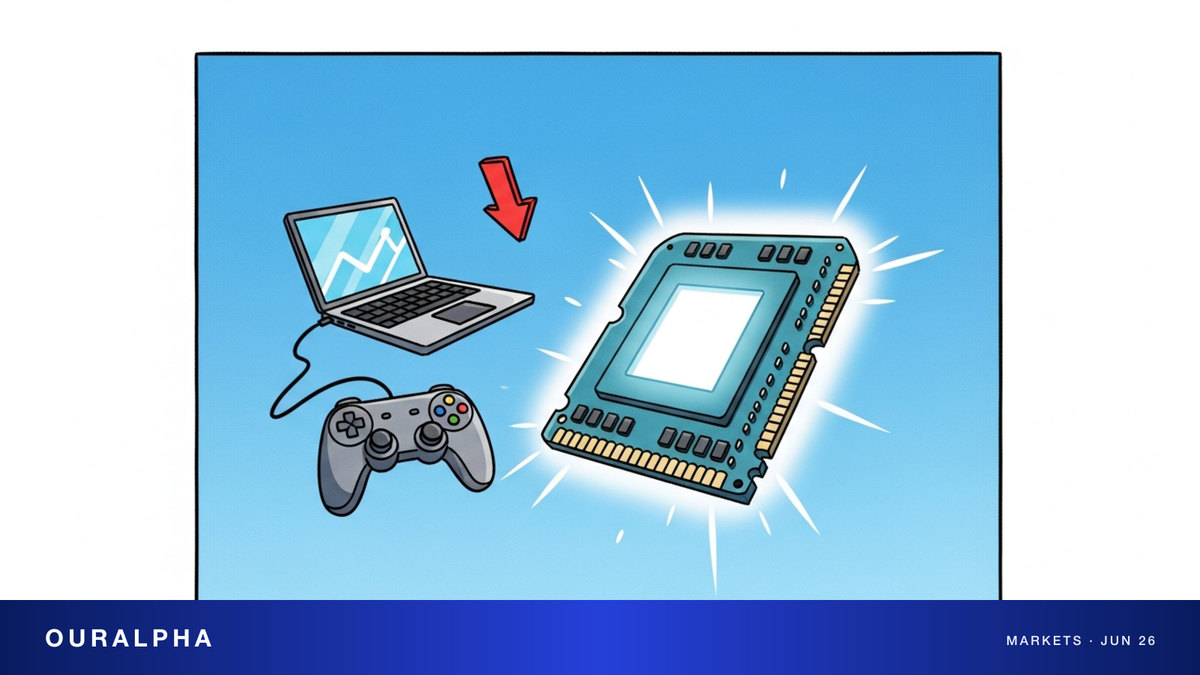
Apple and Microsoft Announce Same-Day Hardware Price Hikes; Mag7 Broadly Sells Off
Apple raised MacBook and iPad prices by up to 25%; Microsoft is hiking Xbox prices $100–$150 globally starting August 1. Both blamed AI-driven memory costs they can no longer absorb internally — and Apple's 6.12% single-day drop made clear the market is not pleased.
On June 25, Apple (AAPL) and Microsoft (MSFT) simultaneously announced price increases on their respective hardware lineups, both citing soaring memory and storage chip costs driven by AI data center demand. Mag7 stocks fell across the board, with Apple leading the decline at over 6%.
- Apple (AAPL) closed down roughly 6.12% at $275.15; MacBook and iPad prices raised by up to 25%+
- Microsoft (MSFT) closed down roughly 3.23%; Xbox consoles set to rise $100–$150 globally starting August 1
- Nvidia (NVDA) fell ~1.6%, Amazon (AMZN) fell ~3.1%, Meta fell ~2.7%
- Nasdaq Composite fell 0.46% to 25,358.60; S&P 500 essentially flat at 7,357.49
- Both companies said memory and storage chip costs from AI demand can no longer be absorbed internally
On June 25 ET, Apple (AAPL) and Microsoft (MSFT) announced hardware price hikes on the same day — Apple raising prices across MacBooks, iPads, and more, while Microsoft said Xbox consoles will get a global price increase starting August 1. Both companies pointed to the same culprit: surging memory and storage chip costs driven by AI data center demand. The news sent Mag7 stocks broadly lower, with Apple shedding over 6% and the Nasdaq Composite closing in the red.[CNBC]
Mag7 and Market Performance on June 25
U.S. equity indexes were mixed on June 25, but large-cap tech broadly sold off:
- S&P 500: essentially flat, closing at 7,357.49 (down ~0.01%)
- Nasdaq Composite: down roughly 0.46%, closing at 25,358.60
- Dow Jones Industrial Average: up roughly 0.14%, closing at 51,920.62 (up 71.72 points)
Mag7 performance on the day:
- Apple (AAPL): down roughly 6.12%, closing at $275.15
- Microsoft (MSFT): down roughly 3.23%
- Nvidia (NVDA): down roughly 1.6%
- Amazon (AMZN): down roughly 3.1%
- Meta (META): down roughly 2.7%[Trading Economics]
The session split into two distinct camps: memory chip stocks — lifted by Micron's (MU) strong earnings — rallied sharply, while large-cap tech sold off on the pricing news and cost concerns. The two forces largely offset each other, leaving the S&P 500 nearly flat on the day.
Apple: MacBook and iPad Prices Rise Across the Board
Apple updated pricing across its online store for Macs, iPads, and HomePods, with increases ranging from roughly 15% to 25% — some models up more than $300.[9to5Mac]
MacBook lineup:
- MacBook Neo: starting price rises from $599 to $699 (+$100, ~+16.7%)
- MacBook Air (13-inch): starting price rises from $1,099 to $1,299 (+$200, ~+18.2%)
- 14-inch MacBook Pro (entry): starting price rises from $1,699 to $1,999 (+$300, ~+17.6%)
iPad lineup:
- 11-inch iPad Pro: rises from $999 to $1,199 (+$200, ~+20%)
- iPad Air: rises from $599 to $749 (+$150, ~+25%)
Apple said iPhone, Apple Watch, and AirPods prices are not changing for now, but added that it "may make further adjustments to additional products depending on circumstances" — leaving the door open for more hikes down the road.[MacRumors]
Microsoft: Xbox Consoles to Rise Globally Starting August
On the same day, Microsoft announced a global Xbox price increase effective August 1, with hikes of $100 to $150 per console. In the U.S., per CNBC, the Xbox Series S will rise to $500 and the Xbox Series X will top out at $800.[TechCrunch]
Microsoft said the storage and memory components used in its consoles have "more than doubled" in price and expects them to potentially double again by fall 2027 — an explicit acknowledgment that it is passing upstream cost pressures straight through to end consumers.[CNBC]
Same Root Cause: AI's Memory Grab Is Squeezing Consumer Hardware
The simultaneous announcements were no coincidence — both trace back to the same structural shift in memory supply underway since the second half of 2025. Samsung, SK Hynix, and Micron have been steadily redirecting capacity toward high-bandwidth memory (HBM) to meet the massive demand from AI accelerators like Nvidia's GPUs. By some industry estimates, a single wafer of HBM generates several times the revenue of conventional consumer DRAM, prompting suppliers to aggressively reallocate production lines toward the higher-margin AI segment.[CBS News]
The result: contract prices for commodity DRAM and NAND flash destined for consumer electronics have climbed sharply over several consecutive quarters. Apple and Microsoft's same-day announcements are a direct manifestation of those upstream cost pressures reaching the retail shelf.
Tim Cook on the Price Hikes
Apple CEO Tim Cook, speaking to The Wall Street Journal, explained: "Supply is declining at the same time consumers want more capabilities on their devices, and the memory manufacturers are passing those big prices on." He used unusually stark language to describe the severity of the crunch: "This is a hundred-year flood. In my over 40 years in the industry, I've never seen anything like this in any sector."[Euronews]
Notably, Apple had telegraphed the move as early as June 17, when Cook publicly said price increases were "unavoidable" without disclosing specific amounts. Even so, the market's negative reaction once the hikes officially landed exceeded what some investors had anticipated.
Stock Reaction and Analyst Views
Apple closed down roughly 6.12% at $275.15 — its lowest closing price in nearly a month.[NBC News]
The market's core concern is demand destruction. The MacBook Air is one of the world's best-selling laptops, and its starting price jumping from $1,099 to $1,299 crosses a meaningful psychological threshold for price-sensitive buyers. Analysts fear extended upgrade cycles and softer unit shipments could offset a significant portion of the revenue benefit from higher average selling prices.
JPMorgan struck a more measured tone, arguing Apple's vertical integration and strategic procurement contracts will partially cushion the memory cost blow. That said, the team estimated DRAM and NAND currently account for roughly 10%–15% of iPhone bill-of-materials (BOM) costs — a figure that could climb above 45% by 2027, suggesting this is a medium-term structural headwind rather than a single-quarter anomaly.[Digital Trends]
Stepping back, the simultaneous Apple and Microsoft hikes are a vivid illustration of the AI infrastructure buildout spilling over into consumer electronics. Multiple analysts cited across media expect consumer memory prices to remain well above 2024 levels until major memory makers' new fab capacity comes online between 2027 and 2028 — which means Apple and Microsoft may not be the last hardware vendors to raise prices in this cycle. Investors should track each company's earnings reports and shipment data as the cycle unfolds.
Sources
- CNBC — Microsoft lifts price of Xbox consoles due to soaring component costs
- TechCrunch — Xbox follows Apple with price increases
- 9to5Mac — Apple announces significant price increases for MacBooks, iPads, more
- Euronews — Microsoft and Apple raise prices as AI-driven chip shortages hit Xbox, Macs and iPads
- NBC News — Apple's shares plunge after it hikes prices on iPads and laptops
- Trading Economics — United States Stock Market
This content is for informational purposes only and does not constitute investment advice, trading advice, or any guarantee of returns.