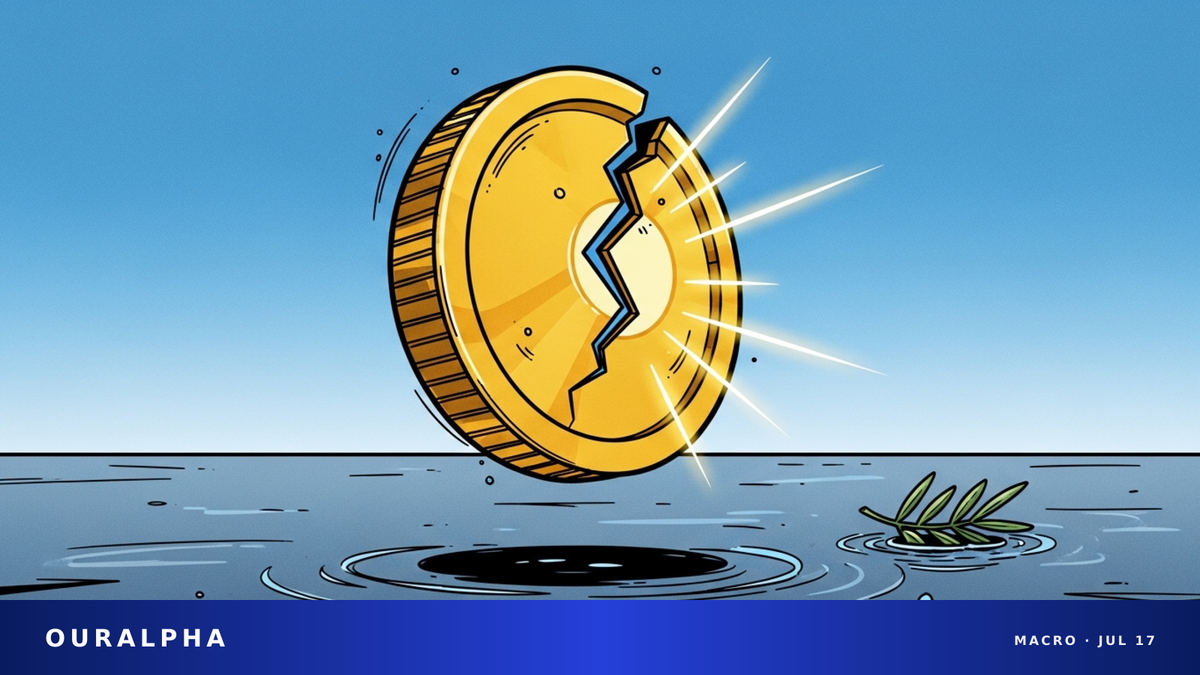
Middle East Conflict Fans Inflation Fears, Gold Heads for Biggest Weekly Loss in Six Weeks

Escalating U.S.-Iran hostilities are sending oil prices surging, reigniting inflation worries and hawkish Fed bets. Gold is down over 2% this week, on track for its steepest weekly drop in six weeks.

Middle East conflict fuels inflation fears, gold heads for biggest weekly loss in six weeks
Escalating U.S.-Iran hostilities are pushing oil prices higher and reviving rate hike bets, sending gold toward its steepest weekly drop in six weeks.

Escalating hostilities in the Middle East between the U.S. and Iran are pushing oil prices higher, stoking inflation fears and reinforcing expectations of another Fed rate hike. Gold is on track for its biggest weekly loss in six weeks.

  • As of 6:30 p.m. Beijing time (pre-market U.S. Eastern), spot gold was at $3,980.64/oz, up 0.3% on the day but down over 2% for the week — the steepest weekly decline in six weeks.
  • The U.S. launched three consecutive nights of strikes on Iran last week, hitting more than 300 targets in seven days. Iran retaliated by striking U.S. bases in five Gulf states and announcing the closure of the Strait of Hormuz.
  • Crude oil has surged more than 9% over the past five trading sessions, pushing up inflation expectations. The market now prices in roughly a two-thirds probability of a Fed rate hike in September.
  • U.S. CPI fell 0.4% month-over-month in June (the first monthly decline since 2020), bringing the annual rate to 3.5%. PPI fell 0.3% month-over-month, but the disinflationary tailwind was overwhelmed by the oil shock.
  • Spot gold is down about 27% from its all-time high of $5,589.38 on January 28. The second quarter was the metal’s worst quarterly performance in over a decade.
  • Analysts are divided: some argue the selloff is driven by fading Indian demand and central bank selling, not rate expectations; others say gold faces a “double whammy” — the war fails to generate safe-haven bids while oil prices undermine any rally.

As of 6:30 p.m. Beijing time (pre-market U.S. Eastern), spot gold was at $3,980.64/oz, up a modest 0.3% on the day but down more than 2% for the week — on pace for its biggest weekly loss in six weeks. The metal earlier touched its lowest level since July 1.[CNBC] The escalating U.S.-Iran military conflict has sent crude oil surging, stoking fears of a rebound in inflation and further Fed tightening — the core factor weighing on gold.

Oil Surge and Inflation Reversal: Gold’s ‘Double Whammy’

The dominant narrative for gold this week is how the Middle East war is transmitting through energy prices into rate expectations, crushing the metal’s safe-haven appeal. According to CNBC, the U.S. launched three consecutive nights of strikes on Iran last week, hitting more than 300 targets in seven days. Iran retaliated by striking U.S. bases in five Gulf states and announcing the closure of the Strait of Hormuz.[CNBC] That has driven crude oil up more than 9% over the past five sessions.

Kitco analyst Przemyslaw Radomski argues gold’s current decline has nothing to do with geopolitical risk-off and everything to do with “the rate story.” In a July 14 note, he wrote: “A week ago, a weak jobs report (57K added, well below the 100K+ consensus) pushed the probability of a September rate hike down to around half, giving gold a bounce. But the re-closing of the Strait of Hormuz is putting rate hike bets back on the table. The window for gold to catch its breath is closing.”[KITCO] Radomski sees a “double whammy” for gold: the market no longer treats Gulf conflict as a reason to buy gold, but as a reason to buy oil; and higher oil means higher inflation, a more hawkish Fed, and a stronger dollar — the complete chain driving gold lower.

Cooler Inflation Data, but Oil Shock Overwhelms the Tailwind

U.S. inflation data this week actually showed a cooling trend. According to Kitco, the June CPI fell 0.4% month-over-month — the first monthly decline since 2020 — pulling the annual rate down to 3.5% from 4.2% in May. The June PPI then fell 0.3% month-over-month, with the annual rate at 5.5%.[KITCO]

But the rise in inflation expectations from the oil surge completely overwhelmed that data tailwind. Fed Chair Kevin Warsh reiterated the central bank’s commitment to price stability in congressional testimony this week, saying policymakers have “zero tolerance” for persistently high inflation. According to the CME FedWatch tool, traders now price in roughly a 49% probability of a rate hike (not a cut) at the September meeting.[KITCO] Kitco analyst Gary Wagner noted in a July 15 commentary that while gold futures rose $14.30 to $4,066 that day, sellers actually outnumbered buyers once the weaker dollar was factored in. The dollar index fell 0.41% to 100.49 that day, though it remains near its highest level in over a year (it hit 101.81 on June 25).[KITCO]

Technical Pressure: $4,000 Level Becomes the Bull-Bear Line

Technically, gold sits at a critical juncture. Gary Wagner notes that gold futures remain pinned below the 100-period moving average (around $4,077) and continue to trace a downward channel that began with the current correction. Resistance sits at $4,077 and $4,090; only a sustained break above those levels opens the path to $4,140 and $4,200. To the downside, a break below the psychological $4,000 level exposes deeper support at $3,962 and $3,950.[KITCO]

Spot gold is down about 27% from its all-time high of $5,589.38 on January 28. The second quarter was the metal’s worst quarterly performance in over a decade, as an initial easing of Iran tensions and a stronger dollar weighed on the metal.[KITCO]

Przemyslaw Radomski warns that gold futures are currently holding above an uptrend line based on July lows. “Once that level is broken, the decline could accelerate. And once gold breaks below its 2026 low, the selloff will intensify further — this could happen as early as this week.”[KITCO]

Analyst Divide: Demand Shift or Rate Expectations?

There is a clear split among analysts on the root cause of gold’s decline. Kitco analyst Stewart Thomson offered a contrarian take in a July 14 commentary. He argues gold is falling not because of potential Fed rate hikes, but because “global demand of roughly 40-70 tonnes per month has disappeared due to new Indian government tariff taxes and a law encouraging citizens not to buy gold for a year.” Additionally, “some central banks have stopped buying gold, while others are selling directly — they need fiat cash to manage the economic damage from the U.S.-Iran fight for control of the Strait of Hormuz.”[KITCO]

Thomson dismisses the mainstream narrative that interest rates drive gold as “absurd,” noting that “gold doubled (from $2,000 to $4,000) while rates rose from near zero to 5%.” He cites the 1970s as a historical precedent, when both inflation and rates rose while gold “soared.” He expects a repeat, and on a larger scale.[KITCO]

Still, Thomson acknowledges that technically, the $3,900 area is a “solid buy zone.” He advises investors to “buy with a smile” in that region.[KITCO]

Meanwhile, long-term institutional forecasts remain constructive. Gary Wagner cites JPMorgan’s year-end target of $6,000/oz, based on record central bank buying led by China, India, Turkey, and Poland.[KITCO]

This content is for informational purposes only and does not constitute investment advice, trading advice, or any guarantee of returns.

Keep Reading

26 Meta Employees Sue, Alleging AI System Discriminated Against Workers on Leave in Layoffs

26 Meta Employees Sue, Alleging AI System Discriminated Against Workers on Leave in Layoffs

Twenty-six Meta employees have sued the company, alleging its AI system was used to target workers on medical, parental, or family leave for disproportionate layoffs in May. As of the July 16 close, Meta (META) was at $664.54, down 2.46% from the prior close of $681.31. U.S. markets were closed for the holiday, leaving the stock at that price.

  • 26 anonymous employees filed the lawsuit on Monday, July 14, in Oakland, California federal court, accusing Meta of using an AI system
Read full story →

Stay ahead of the market — never miss a deep dive

Follow OurAlpha for AI-driven US equity research and market insight, every day.