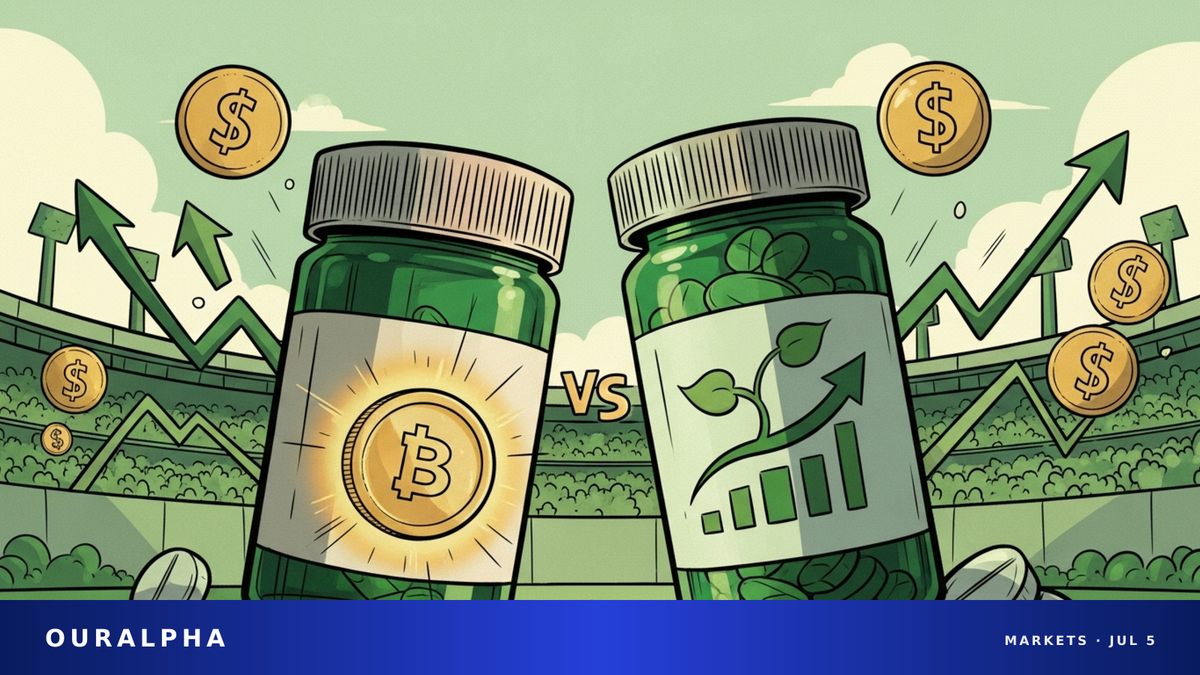
Eli Lilly vs. Johnson & Johnson: Dividend King vs. Growth Juggernaut
A new analysis pits Eli Lilly’s explosive GLP-1 growth against Johnson & Johnson’s 60-year dividend streak, highlighting two starkly different investment styles in healthcare.
As of 11:30 a.m. Beijing time on July 5 (11:30 p.m. ET on July 4, markets closed for the holiday), Eli Lilly (LLY) was at $1,213.91, up 1.86% (+$22.17) from its previous close of $1,191.74. The stock opened at $1,193.01, with a session high of $1,232 and a low of $1,180.30. A comparative analysis has cast Eli Lilly and Johnson & Johnson (JNJ) as archetypes of the "Dividend King vs. Growth Juggernaut" debate, drawing investor attention to the two healthcare giants’ divergent investment theses.
- Eli Lilly (LLY) last traded at $1,213.91, up 1.86% from the prior close (markets closed for the weekend).
- Johnson & Johnson (JNJ), the "Dividend King," boasts a dividend growth streak of over 60 years.
- Eli Lilly is cast as the "Growth Juggernaut," fueled by its GLP-1 class drugs (Mounjaro/Zepbound) driving rapid revenue expansion.
- Analysts note the two companies represent distinct investment styles: steady dividends vs. high-growth potential.
- Consensus estimates project Eli Lilly will surpass $50 billion in full-year 2026 revenue, driven primarily by its diabetes and weight-loss drug portfolio.
As of 11:30 a.m. Beijing time on July 5 (11:30 p.m. ET on July 4), U.S. equity markets were closed for the Independence Day holiday. Eli Lilly (LLY) last traded at $1,213.91, up 1.86% (+$22.17) from its prior close of $1,191.74. The stock opened at $1,193.01, with a session high of $1,232 and a low of $1,180.30. A recent market analysis has framed Eli Lilly and Johnson & Johnson (JNJ) as the quintessential "Dividend King vs. Growth Juggernaut" matchup, sparking investor debate over the two healthcare giants' contrasting investment narratives.[TheStreet]
Dividend King: Johnson & Johnson’s Steady Payout Record
Johnson & Johnson (JNJ) is widely regarded as a "Dividend King," with a record of increasing its dividend payout for over 60 consecutive years—a rarity in U.S. markets. According to analysis, J&J’s diversified mix of medical devices, pharmaceuticals, and consumer health businesses generates a powerful cash flow base that enables consistent capital return to shareholders. This stability makes it a core holding for income-focused investors, particularly those in retirement.[TheStreet]
However, J&J faces near-term headwinds. A report on a Medicare Advantage star ratings lawsuit notes the litigation could affect 2027 benefit plans, potentially impacting revenue expectations for healthcare companies like J&J.[TheStreet] The core dispute centers on how the government calculates plan star ratings, which directly determine the subsidy payments insurers receive.
Growth Juggernaut: Eli Lilly’s GLP-1 Drug Engine
Eli Lilly (LLY) is positioned as the "Growth Juggernaut," with its momentum driven primarily by GLP-1 receptor agonist drugs, including Mounjaro (tirzepatide) for type 2 diabetes and Zepbound (tirzepatide) for weight loss. These drugs have posted explosive growth in 2024 and 2025, propelling Lilly’s revenue and stock price sharply higher. Consensus estimates project Eli Lilly will surpass $50 billion in full-year 2026 revenue, driven largely by its diabetes and weight-loss drug portfolio.[TheStreet]
In contrast to J&J’s steady dividend policy, Lilly reinvests a significant portion of its profits into R&D and capacity expansion to cement its leadership in metabolic diseases. This strategy results in higher stock price volatility than J&J, but also offers investors greater upside potential.
Investment Style Comparison: Stability vs. Growth
Analysts point out that the Lilly vs. J&J comparison fundamentally reflects the investor trade-off between "stable dividend income" and "high growth potential." J&J suits risk-averse investors seeking long-term, predictable cash flows; Lilly appeals to those willing to tolerate higher volatility in exchange for greater capital appreciation.[TheStreet]
Notably, the two companies are not diametrically opposed. J&J continues to expand its pharmaceutical pipeline through acquisitions and internal R&D, while Lilly is gradually increasing its dividend payout. But in terms of current market positioning, they represent the two most archetypal investment paradigms within the healthcare sector.
Broader Market Context and Quant Performance
In the wider market, Seeking Alpha’s quant strategy team notes that as of June 29, its Top 10 Stocks for 2026 portfolio had returned nearly 70% year-to-date, vastly outpacing the S&P 500’s 8.3% gain over the same period.[Seeking Alpha] Standout names in that portfolio include Micron Technology (MU, up 267%) and AMD (up 156%), but neither Eli Lilly nor Johnson & Johnson made the cut. This suggests that in the current environment, quant models favor high-growth opportunities in tech sectors like semiconductors over the steady returns of traditional healthcare giants.
Sources
This content is for informational purposes only and does not constitute investment advice, trading advice, or any guarantee of returns.