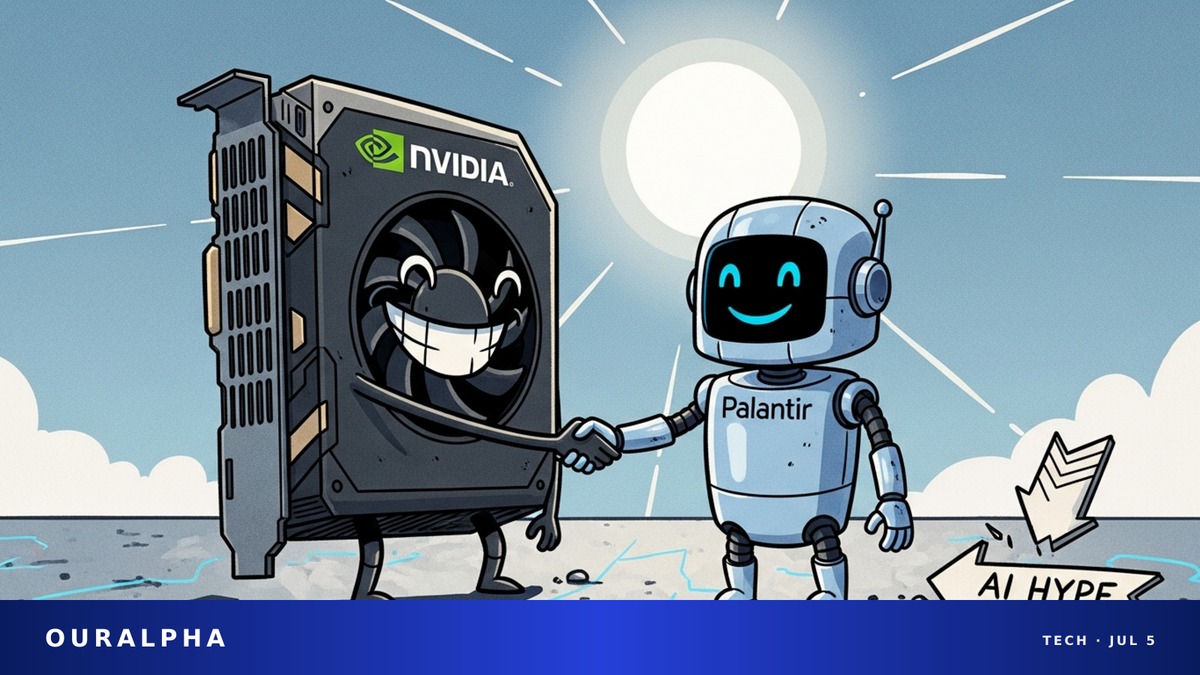
Nvidia Bets on Revenue-Share Model as Palantir CEO Blasts AI’s ‘Broken’ Business
Nvidia rolls out a revenue-sharing model for startups, swapping compute for future profits. Meanwhile, Palantir CEO Alex Karp says the generative AI sales model is “structurally broken,” warning enterprises are paying to expose their IP.
This week, two AI titans sent sharply different signals. Nvidia rolled out a revenue-sharing model for startups, offering compute in exchange for a cut of future profits. Palantir CEO Alex Karp, meanwhile, blasted the generative AI sales model as “structurally broken,” arguing that enterprises buying token-based access are “paying to expose their own intellectual property.” Chip stocks continued to slide on valuation concerns and chatter about Meta’s in-house chip push. As of the weekend close, Nvidia (NVDA) sat at $194.83, down 1.39% from the prior close.
- Nvidia said it will offer high-growth startups a “compute-for-revenue” model, with initial partners providing potential access to over 200,000 GPUs.[CNBC]
- Palantir CEO Alex Karp said generative AI sales are “structurally broken,” claiming enterprises buying token-based access are “paying to expose their IP and get almost no value in return.”[247wallst]
- Karp argues sustainable AI profit pools exist only at the “compute layer” (Nvidia) and the “application layer” (Palantir), not in token-based model access.[247wallst]
- D.A. Davidson upgraded Palantir from Neutral to Buy, hiking its price target from $115 to $175, citing an edge over Anthropic and OpenAI.[CNBC]
- Chip stocks extended their weekly slide, with Yahoo Finance reporting market anxiety over high valuations and rumors of Meta shifting to in-house chips.[Yahoo Finance]
As of 10:00 AM Beijing time on July 5, 2026 (10:00 PM ET on July 4), U.S. markets were closed for the Independence Day holiday weekend. Nvidia (NVDA) last traded at $194.83, down 1.39% (-$2.75) from the prior close of $197.58, with an intraday high of $200.055 and a low of $192.35. This week, Nvidia and the broader chip sector saw significant volatility as multiple crosscurrents weighed on sentiment.
Nvidia Launches ‘Compute-for-Revenue’ Model, Locks In Startups
According to CNBC on July 2, Nvidia announced a new partnership model for high-growth startups: companies can swap a slice of future profits or revenue for access to Nvidia’s compute resources. The revenue-sharing agreements will provide cloud-based AI firms and other enterprises with token credits to support their development work.[CNBC]
The report said Nvidia’s two initial partners will provide potential access to over 200,000 GPUs, including compute from a data center set to go live in Batam, Indonesia. The core idea: cash-strapped startups don’t have to pay upfront for expensive hardware or cloud services; instead, payment is tied to future business success. For Nvidia, it’s a way to lock in long-term customers, deepen ecosystem stickiness, and create more predictable GPU demand. Nvidia has not yet disclosed specific financial terms of the plan.
Palantir CEO Blasts AI Industry: Enterprises Are ‘Paying to Lose’
Meanwhile, Palantir Technologies (PLTR) co-founder and CEO Alex Karp fired off a series of sharp critiques this week, calling the current enterprise sales model for generative AI “structurally broken.” As reported by 247wallst, Karp said, “Something has gone completely wrong in the industry,” arguing that enterprises buying token-based access to frontier models are “paying to expose their intellectual property and ‘alpha’ while getting almost no value in return.”[247wallst]
Karp’s core thesis: sustainable profit pools in AI exist only at two ends of the tech stack—the “compute layer” (Nvidia’s accelerators) at the bottom, and the “application layer” (Palantir’s ontology and AIP platform) at the top. Token-based model access sits in the middle, he argues, because customers won’t pay real costs, leaving model labs with “terrible financials.” Karp’s pitch to enterprise CIOs: Palantir’s partnership with Nvidia lets clients control their own compute, models, and data stack—essentially “owning the means of production” rather than renting cognitive capabilities by the token from a third party.[247wallst]
Karp also framed the AI debate in national security terms. He noted that foreign adversaries and competitors can use the same frontier models as U.S. buyers, so critical infrastructure operators and warfighters need to limit trust and control their own tech stacks. That view echoes the FY2027 defense budget request, which seeks $58.5 billion for AI investments, including $46 billion for a “sovereign AI arsenal” program and $2.3 billion for the Maven Smart System and Joint Fires Network—projects where Palantir is deeply involved.[247wallst]
Palantir’s Strong Results, Analyst Bullish on Competitive Position
Karp’s comments may be provocative, but Palantir’s own financials back him up. Per 247wallst, Palantir reported Q1 2026 revenue of $1.632 billion, up 84.7% YoY, with adjusted EPS of $0.33, beating the consensus estimate of $0.28.[247wallst]
On Wall Street, some analysts are warming to Palantir’s competitive position. According to CNBC on July 2, D.A. Davidson analyst Gil Luria upgraded Palantir from Neutral to Buy, hiking the price target from $115 to $175—implying 39% upside from Wednesday’s close. Luria argued that tensions between Anthropic and the U.S. government “exactly illustrate why customers will use Palantir to orchestrate AI models.” He noted that Palantir had fallen over 29% in 2026 as investors worried about enterprises increasingly turning to OpenAI and Anthropic models, but Luria sees that fear as overblown.[CNBC]
Notably, Karp himself acknowledged the huge valuation gap between Palantir and Nvidia. Per 247wallst, Karp believes AI profits exist only at the compute and application layers, but Palantir currently trades at a forward P/E of roughly 80x, versus Nvidia’s 23x.[247wallst]
Chip Stocks Under Pressure: Valuation Fears and Meta Pivot Rumors
In the broader chip sector, the selloff continued this week. According to Yahoo Finance on July 2, chip stocks extended their decline as market anxiety centered on two factors: high valuations and rumors that Meta may shift to in-house chips.[Yahoo Finance]
The report noted that investors are uneasy about lofty chip valuations after two years of strong gains. Additionally, reports that Meta Platforms is ramping up its in-house chip efforts to reduce reliance on external suppliers like Nvidia have added to concerns about chip demand. While Nvidia dominates the AI training and inference chip market, the trend toward custom chips among large cloud customers is emerging as a long-term structural risk for the industry.
Sources
- 247wallst — Palantir CEO: "Something Has Gone Completely Wrong" In AI. Alex Karp Says Enterprises Are Paying To Lose Their Competitive Edge
- Yahoo Finance — Chip stocks selloff extends on valuation, Meta’s pivot fears
- CNBC — Palantir shares have struggled this year. D.A. Davidson says buy the dip
- CNBC — Nvidia offers start-up customers chance to swap compute power for revenue share
- Investor's Business Daily — Palantir Stock Gets Analyst Upgrade Amid Anthropic, OpenAI Rivalry
This content is for informational purposes only and does not constitute investment advice, trading advice, or any guarantee of returns.