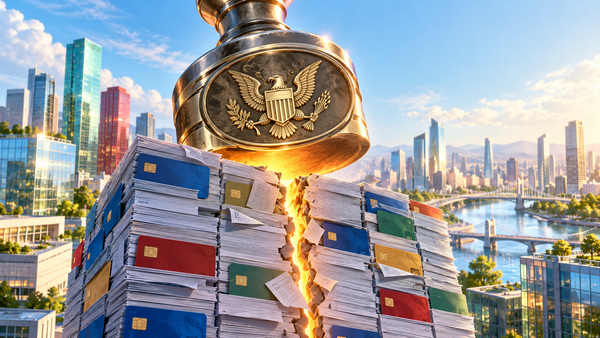
OpenAI Offers U.S. Government a 5% Stake Worth $42.6 Billion to Ease Political Heat

OpenAI is proposing to hand the U.S. government a 5% equity stake valued at roughly $42.6 billion, a move seen as a bid to defuse Washington pressure. The talks are still early-stage, with no formal response from the White House.

OpenAI U.S. government equity stake $42.6 billion AI regulation
OpenAI proposes transferring a 5% stake to the U.S. government, valued at $42.6 billion, sparking market attention.

OpenAI is in talks with the Trump administration over a proposal to transfer 5% of the company’s equity to the U.S. government — a move widely seen as a strategy to ease political pressure in Washington. As of Friday’s close, Intel (INTC) was at $120.35, down 5.25% from its prior close.

  • According to a July 2 report from the Financial Times, OpenAI has proposed transferring 5% of its equity to the U.S. government. Based on the company’s $852 billion post-money valuation from its March 2026 funding round, that stake is worth roughly $42.6 billion.[CNBC]
  • OpenAI CEO Sam Altman told Trump administration officials that giving the public a financial stake in the company is the best way to share the benefits of AI development.[Let's Data Science]
  • The idea dates back to early 2025, when Altman first pitched the concept to Trump. Discussions have continued since.[Time]
  • The Trump administration has precedent for such deals: in August 2025, it invested $8.9 billion for a 10% stake in Intel, and it takes a 15%-25% revenue cut from Nvidia and AMD on AI chip sales to China.[The Verge]
  • The proposal is still in early stages. Neither the White House nor OpenAI has formally responded. Axios, citing a source familiar with the matter, called the talks "very preliminary."[Time]
  • The plan also envisions bringing other U.S. AI companies into a similar framework, though Anthropic has said it has not discussed equity with the government.[Time]

OpenAI is engaged in unprecedented talks with the Trump administration: a proposal to transfer 5% of the company’s equity to the U.S. government. According to a July 2 report from the Financial Times, based on OpenAI’s $852 billion post-money valuation from its March 2026 funding round, that stake is worth roughly $42.6 billion.[CNBC] The news drew wide attention ahead of July 4 (U.S. Independence Day), but by Friday’s close, the stock reactions were mixed. Intel (INTC) was at $120.35, down 5.25% from its prior close of $127.02, after hitting an intraday low of $117.63. The chipmaker had already received a 10% equity investment from the U.S. government in August 2025.[Let's Data Science]

Proposal Background and Talks

According to multiple people familiar with the matter, OpenAI CEO Sam Altman has been discussing government equity with Trump administration officials for over a year. President Trump himself told reporters aboard Air Force One that such a stake would be "almost like a partnership with the American public."[Let's Data Science] The Financial Times reported that Altman has argued in talks that giving the public a financial stake in OpenAI is the best way to share the benefits of AI development.[CNBC]

The specific government officials involved in the talks include Trump himself, Treasury Secretary Scott Bessent, and Commerce Secretary Howard Lutnick.[Time] Axios, citing a source familiar with the matter, said the proposal is "at a very early stage."[Time] Neither the White House nor OpenAI immediately responded to CNBC’s requests for comment.[CNBC]

Precedent and Framework for Government Stakes

This proposal is not an isolated event. The Trump administration has taken similar actions before: in August 2025, the U.S. government invested $8.9 billion for a 10% stake in Intel; it also takes a 15% and 25% revenue cut from Nvidia and AMD, respectively, on AI chip sales to China.[Let's Data Science] The government also holds stakes in IBM and other quantum computing companies.[Time]

OpenAI’s proposal builds on a concept outlined in an April 2026 white paper that proposed a government-funded "Public Wealth Fund," with OpenAI equity placed into a sovereign investment vehicle.[Let's Data Science] This concept is similar in spirit to Trump’s February 2026 executive order on establishing a federal sovereign wealth fund.[Let's Data Science]

Industry and Political Reaction

The proposal has sparked debate about potential conflicts of interest. Nat Purser of the public interest group Public Knowledge warned that such an arrangement could make the government "less willing to implement or enforce safety rules, because doing so could reduce the value of its own investment."[Let's Data Science]

Meanwhile, independent Senator Bernie Sanders has introduced legislation that would impose a one-time 50% equity tax on major U.S. AI companies, depositing the shares into a sovereign wealth fund.[Time] Sanders wrote in the New York Times: "Since AI is built on the collective knowledge of humanity, the wealth it generates must benefit humanity."[CNET]

Anthropic also expressed support for similar policies in a paper published last month, arguing for "giving every American a direct financial stake in the economy at a time when AI is driving economic growth" and calling for "universal pre-distribution capital accounts."[Time] However, an anonymous source told Reuters that the Trump administration has not discussed government equity with Anthropic.[Time]

Potential Impact and What to Watch

If the deal goes through, it would mark the first time the U.S. government has taken a direct financial position in a frontier AI lab, and by far the largest and most direct government equity stake to date.[Let's Data Science] CNET noted the move could provide OpenAI with a much-needed financial and reputational boost, while helping the company ease political and regulatory pressure as it prepares for an IPO.[CNET]

Market watchers are watching for whether the White House or OpenAI formally accepts, rejects, or modifies the 5% stake, and whether other frontier AI labs — such as Anthropic, Google DeepMind, and xAI — will be asked to make similar equity arrangements.[Let's Data Science] The Verge noted the proposal comes as the Trump administration takes an unusually hands-on approach to AI, having previously designated Anthropic as a supply chain risk and last month imposing export controls on its latest model.[The Verge]

This content is for informational purposes only and does not constitute investment advice, trading advice, or any guarantee of returns.

Keep Reading

Eli Lilly vs. Johnson & Johnson: Dividend King vs. Growth Juggernaut

Eli Lilly vs. Johnson & Johnson: Dividend King vs. Growth Juggernaut

As of 11:30 a.m. Beijing time on July 5 (11:30 p.m. ET on July 4, markets closed for the holiday), Eli Lilly (LLY) was at $1,213.91, up 1.86% (+$22.17) from its previous close of $1,191.74. The stock opened at $1,193.01, with a session high of $1,232 and a low of $1,180.30. A comparative analysis has cast Eli Lilly and Johnson & Johnson (JNJ) as archetypes of the "Dividend King vs.

Read full story →

Stay ahead of the market — never miss a deep dive

Follow OurAlpha for AI-driven US equity research and market insight, every day.