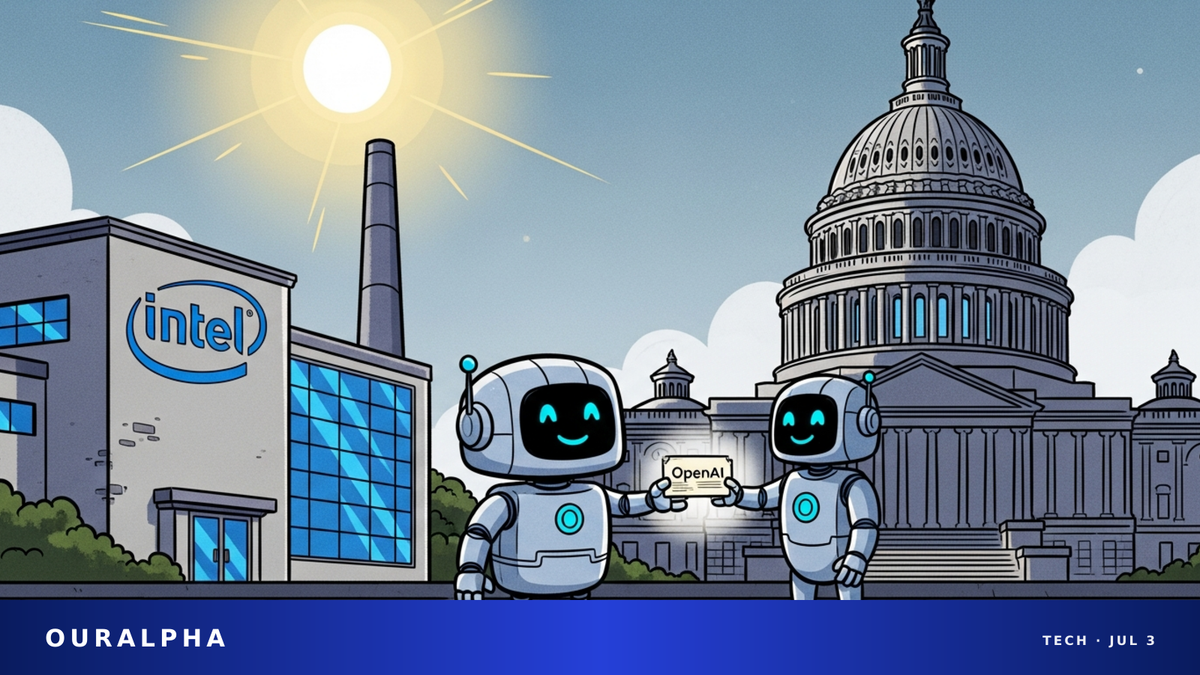
OpenAI Pitches 5% Stake to U.S. Government; Intel Tumbles Over 5%
OpenAI has proposed granting the U.S. government a 5% equity stake, valued at roughly $42.6 billion, in a bid to ease political pressure in Washington. Intel shares slid 5.25% in after-hours trading on the news.
OpenAI has floated an initial proposal to the Trump administration to transfer a 5% equity stake to the U.S. government, aiming to ease political pressure from Washington and let the public share in the AI boom, according to multiple media reports. The news sent shares of Intel (INTC), which had rallied on its own government stake, sharply lower in after-hours trading.
- 5% stake value: Based on OpenAI's $852 billion valuation in its March 2026 funding round, the 5% stake is worth roughly $42.6 billion.CNBC
- Intel's move today: As of 8:00 p.m. ET on July 2 (after-hours), Intel (INTC) traded at $120.35, down 5.25% (-$6.67) from its prior close of $127.02. The stock hit an intraday low of $117.63.Finnhub
- Negotiation stage: The proposal remains in very early, "conceptual" discussions, according to people familiar with the matter.Axios
- Scope: The plan isn't limited to OpenAI — it also calls on other U.S. AI labs to transfer a similar stake to the government.Forbes
- Government precedent: The U.S. government already holds a 10% stake in Intel via the CHIPS Act and takes a 15% to 25% revenue cut from Nvidia and AMD on AI chip sales to China.Axios
- Market reaction: Investors and analysts are split on the move, with some viewing it more as a "political PR" play to curry favor with the administration than a genuine public benefit.Axios
OpenAI has pitched the Trump administration on an initial plan to transfer a 5% stake in the company to the U.S. government, the Financial Times reported on July 2. The move is widely seen as an effort to ease mounting political pressure from Washington and address public fears that AI could trigger mass job displacement. As of 8:00 p.m. ET on July 2 (after-hours), shares of Intel (INTC) — which had been in the spotlight due to its own government stake — traded at $120.35, down 5.25% from its prior close of $127.02, after hitting an intraday low of $117.63. The decline tracks the stock's pre-market and intraday moves, reflecting an immediate market reaction to the news.
Plan Details: A $42.6 Billion 'Public Wealth Fund' in the Making
OpenAI CEO Sam Altman has directly laid out the concept to President Trump, Commerce Secretary Howard Lutnick, and Treasury Secretary Scott Bessent, according to the Financial Times.Forbes Altman believes giving the public a financial stake in OpenAI is the best way to share the spoils of AI development, the report said.CNBC
Based on OpenAI's $852 billion valuation in its March 2026 funding round, the 5% stake is worth roughly $42.6 billion.CNBC Forbes reports the plan is modeled on the Alaska Permanent Fund, a state-managed wealth fund that pays annual dividends to residents.Forbes Axios adds that the proposal could involve funneling the stake into a "Trump Account" or similar vehicle, giving American households exposure to AI investments.Axios
Notably, the pitch isn't limited to OpenAI. The Financial Times reports the plan also calls on other U.S. AI companies to transfer a similar stake to the government, though it's unclear if any others are willing.Forbes CNN's report confirms this, noting OpenAI's main rivals include Anthropic, Google, and Meta.CNN
Background and Motives: Easing Regulatory Pressure and Public Fears
Axios frames the move against the backdrop of the White House still deciding when OpenAI can broadly release its most powerful models — a regulatory process Altman himself has described as less than "optimal."Axios If the Trump administration accepts the offer, it would have a vested interest in weighing whether to restrict OpenAI's model releases.Axios
Forbes notes the proposal comes as the White House increasingly intervenes in regulating advanced model releases, such as imposing export controls on Anthropic's Mythos model and OpenAI's GPT-5.6.Forbes Altman has previously proposed a U.S.-led international forum to set AI regulatory standards, which could be a way to allow government investment without heavy-handed regulation.Axios
Separately, Anthropic recently endorsed a similar policy in a research paper, advocating for "universal pre-distribution capital accounts" that prioritize groups whose jobs face disruption from AI.Axios This suggests the idea of channeling AI wealth back to the public has some industry consensus.
Market and Analyst Reaction: Mixed Reviews, Skepticism Mounts
Reaction to the proposal is mixed. Axios quotes an investor who says the idea of giving the government equity reads more like a "PR stunt" to make the public feel they can benefit from an AI boom that threatens their jobs.Axios
One investor who has backed both Anthropic and OpenAI told Axios the proposal feels more like a "political move" to win government favor than a genuine effort to create shared value for the American public.Axios
David Sherman, AI and financial inclusion strategist at decentralized cloud network io.net, told Axios via email that government ownership would be a "disturbing milestone" that hurts competition among labs. He added it "puts a government seal of approval on one AI company, while millions of developers, researchers, and businesses are locked out by soaring token prices and endless GPU queues."Axios
Intel Shares Tumble Today: Market Fears Government Stake Model Spreading
Intel (INTC) shares fell sharply today. As of 8:00 p.m. ET on July 2 (after-hours), the stock traded at $120.35, down 5.25% from its prior close of $127.02. The stock opened at $128.915, hit an intraday high of $130.74, and a low of $117.63.
Axios notes the U.S. government acquired a 9.9% stake in Intel in August 2025 via the CHIPS Act, and since then, Intel shares have surged nearly 400%.Axios However, the report also notes that rally has coincided with a broad chip-stock boom. The Verge confirms the U.S. government holds a 10% stake in Intel and takes a 15% to 25% revenue cut from Nvidia and AMD on AI chip sales to China.The Verge
The broad market read is that OpenAI's proposal could signal wider government intervention in tech company equity, fueling investor fears that similar models could be replicated at other companies — putting pressure on stocks like Intel that already have a government stake. Today's decline in Intel partly reflects negative sentiment around this potential trend.
Legal and Political Hurdles: Needs Congressional Approval, Outlook Uncertain
While the proposal is now public, Axios points out that unlike the Intel stake, which came via the CHIPS Act, any deal with AI labs would likely require an act of Congress.Axios It's unclear what a government stake would achieve beyond forging closer ties between AI labs and the government, which is currently one of their biggest obstacles.Axios
Forbes reports that talks between OpenAI and the government remain at a "conceptual" stage.Forbes The White House and OpenAI did not immediately respond to CNBC's requests for comment.CNBC
Sources
- Axios — OpenAI courts Trump administration as its latest investor
- CNBC — OpenAI proposes 5% stake to Trump administration to ease Washington pressure: report
- The Verge — OpenAI floats giving Trump administration 5 percent cut of AI boom
- Forbes — OpenAI Reportedly Pitches Granting U.S. Government 5% Stake
- CNN — OpenAI in talks to give Trump administration a 5% stake in the company
This content is for informational purposes only and does not constitute investment advice, trading advice, or any guarantee of returns.