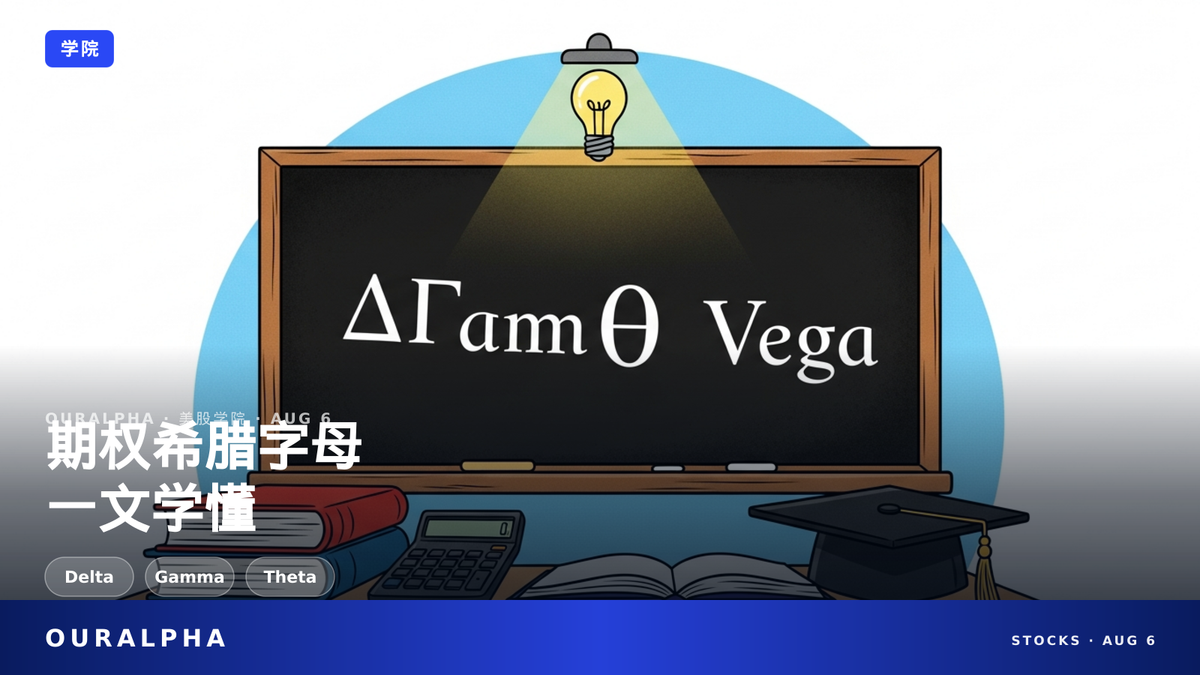
What Are Options Greeks? Delta, Gamma, Theta, and Vega Explained

What are the options Greeks Delta, Gamma, Theta, and Vega? Explained in plain English to help you avoid beginner pitfalls like IV Crush.

What Are Options Greeks? Delta, Gamma, Theta, and Vega Explained
OURALPHA · ACADEMY

What Are Options Greeks?
A Plain-English Guide to Delta, Gamma, Theta, and Vega

OurAlpha Academy · Options risk metrics in plain English

In options trading, you often hear about Delta, Gamma, Theta, and Vega. What are they? They're not magic—they're like a dashboard that helps you measure how an option's price moves.

Many beginners mistake Delta for the probability of winning, or treat the Greeks as price guarantees, only to get blindsided by IV Crush during earnings season.

This article uses everyday analogies to explain the four main Greeks from scratch, helping you avoid the most common beginner misconceptions.

TL;DR · IN SHORT

  • Greeks are risk sensitivity measures for option prices, not precise predictions.
  • Delta ≈ probability of expiring in the money; Gamma measures how fast Delta itself changes.
  • Theta is time decay, which accelerates near expiration and hurts option buyers.
  • Vega relates to volatility; after earnings, IV Crush can make option prices fall even when the stock moves in your favor.

KEY TERMS

Delta: Measures how much an option's price theoretically changes for every $1 move in the underlying asset. It's also loosely used as an estimate of the probability that the option will expire in the money.

Gamma: Measures how much Delta itself changes for every $1 move in the underlying asset. It's the 'Delta of Delta,' reflecting how stable Delta is.

Theta: Measures how much an option's price theoretically decreases each day due to the passage of time, assuming all else stays the same. It's the 'time value decay,' and it speeds up as expiration approaches.

Vega: Measures how much an option's price theoretically changes for every 1 percentage point move in implied volatility. It shows how sensitive an option is to market uncertainty.

CONTENTS

  1. What exactly are options Greeks?
  2. What does Delta mean? Can you treat it as the probability of winning?
  3. What's the difference between Gamma and Delta?
  4. Why do options lose value faster near expiration? What's Theta got to do with it?
  5. How are Vega and implied volatility related?
  6. Why do options drop after earnings? Is Vega involved?
  7. Does Rho have a big impact on option prices? Why is it rarely mentioned?
  8. Are Greeks accurate? Can I trade based on these numbers 100%?
  9. FAQ

What exactly are options Greeks?

In simple terms, options Greeks are a set of 'risk sensitivity' metrics that measure how an option's price responds to changes in factors like the underlying asset's price, time, and volatility. They come from options pricing models (like Black-Scholes) by taking partial derivatives of the option price. The five most common are Delta, Gamma, Theta, Vega, and Rho.[1]

Think of an option's price as a car, and the Greeks as the dashboard gauges: speedometer, fuel gauge, temperature gauge. They tell you, 'If this condition changes, the option price will likely move this way.' But remember, these are theoretical estimates, not precise predictions.[13]

Another analogy: when you drive, the speedometer shows your current speed, but you don't expect to stay at 60 forever because road conditions, gas, and brakes all change it. Similarly, Greeks are just a snapshot based on current market conditions. When the market changes, they change too. So, understanding Greeks helps you grasp the logic behind option price movements, but don't expect them to give you a 100% accurate answer.

What does Delta mean? Can you treat it as the probability of winning?

Delta measures: for every $1 move in the underlying asset's price, how much the option's price theoretically changes. For example, a call option with a Delta of 0.70 would see its price rise by about $0.70 if the stock rises by $1. Call options you buy have Deltas between 0 and 1.00, while put options you buy have Deltas between 0 and -1.00.[2]

Many traders use Delta as a rough estimate of the probability that the option will expire in the money (ITM). For instance, a Delta of 0.70 suggests about a 70% chance of expiring ITM. But this is only a theoretical approximation, not an exact probability.[3] At-the-money (ATM) call options typically have Deltas near 0.50, and puts near -0.50, because the odds of up or down are roughly even. As options go deeper ITM, Delta approaches 1 (or -1); as they go further out of the money, it approaches 0.[4]

Here's a key caveat: Delta as a probability estimate has limitations. It's calculated under model assumptions like the underlying following a lognormal distribution, but real markets often have 'fat tails,' meaning extreme moves happen more often than models predict. So, a Delta of 0.70 doesn't guarantee a 70% chance of profit at expiration; it's just a reference. Also, Delta is dynamic—it changes as the stock moves, so you can't treat today's Delta as tomorrow's probability.

What's the difference between Gamma and Delta?

Gamma measures: for every $1 move in the underlying, how much Delta itself changes. That's why it's called the 'Delta of Delta'—it reflects Delta's stability. The higher the Gamma, the more violently Delta changes.[5]

For example, you buy an option with a Delta of 0.50. If Gamma is 0.10, then a $1 rise in the stock would push Delta to 0.60. If Gamma is 0.20, Delta would jump to 0.70. Gamma is highest for at-the-money (ATM) options, and it gets even larger as expiration nears. This means short-term ATM options have Deltas that are extremely sensitive to price moves, concentrating risk.[6]

You can think of Delta as speed and Gamma as acceleration. Speed tells you how fast you're going; acceleration tells you how quickly speed changes. If a car has high acceleration, a slight tap on the gas makes speed soar. Similarly, with high Gamma, a small stock move causes Delta to swing wildly, making the option price very 'jumpy.' For buyers, high Gamma can lead to quick profits, but it also means huge risk—if you're wrong on direction, losses get amplified.

Why do options lose value faster near expiration? What's Theta got to do with it?

Theta measures: how much an option's price theoretically decreases each day due to time passing, assuming all other factors stay the same. It's the 'time value decay.'[7] Time decay isn't linear—it accelerates as expiration approaches. Theta is highest for ATM options and decreases for deep ITM or OTM options.[8]

So, if you buy an ATM option and hold it close to expiration, you'll notice it loses more and more value each day. That's Theta at work. In short, time is the enemy of options, especially for buyers.

Imagine you buy a movie ticket. Two hours before the show, you feel you have plenty of time. But ten minutes before, time seems to fly because the ticket is about to expire. Option time value works the same way—the closer to expiration, the faster it decays. For option sellers, Theta is a friend because they can collect time value. But for buyers, Theta is a constant cost. So, if you plan to buy options and hold them for a while, choose contracts with longer expirations to slow down Theta's erosion.

How are Vega and implied volatility related?

Vega measures: how much an option's price theoretically changes for every 1 percentage point move in implied volatility (IV). Vega is also highest near ATM options.[9] Options with longer time to expiration have higher Vega—the more time remaining, the greater the potential impact of volatility changes on option value. That's why long-term options (LEAPS) are more sensitive to IV changes.[10]

Implied volatility can be thought of as the market's expectation of how much the underlying asset's price will fluctuate in the future. When the market expects more volatility (like before earnings), IV rises, pushing option prices up. Conversely, when IV falls, option prices drop.

Think of implied volatility like the 'chance of rain' in a weather forecast. If the chance jumps from 20% to 80%, you're more likely to carry an umbrella because uncertainty has increased. Similarly, when IV rises, it means the market expects more 'bumpy' price action ahead, so options—as insurance—become more expensive. Vega tells you how much the option price changes for each 1 percentage point move in IV. For example, if Vega is 0.05 and IV goes from 20% to 21%, the option price would rise by about $0.05.

Why do options drop after earnings? Is Vega involved?

Before major events like earnings, the market builds uncertainty into implied volatility, pushing option prices up. Once the event passes and uncertainty is resolved, IV often drops sharply. Even if the stock moves in your favor, the option price might fall due to Vega—this is called 'IV Crush.'[11]

For example, you buy a call option before earnings. After the report, the stock rises, but IV plunges, and the option price might actually drop. That's Vega's 'bite.' So, beginners trading options around earnings must be wary of IV Crush.

It's like buying a lottery ticket. Before the draw, you think your chances are good, and the ticket price is inflated. But after the draw, whether you win or lose, the ticket's value plummets because uncertainty is gone. Before earnings, IV is often elevated because the market doesn't know if the results will be good or bad, so option prices include a 'surprise premium.' Once earnings are out, that premium evaporates quickly. So, even if the stock moves in your favor, if the drop in IV outweighs the Delta gain from the stock move, the option price can still fall.

Does Rho have a big impact on option prices? Why is it rarely mentioned?

Rho measures: how much an option's price theoretically changes for every 1 percentage point move in the risk-free interest rate. Long calls have positive Rho (option value rises when rates rise), and long puts have negative Rho.[12]

Compared to other Greeks, Rho's impact on typical options is usually small because interest rates change slowly and by small amounts. That's why few traders pay close attention to it. But in times of sharp rate moves or for long-term options, Rho's effect can be more noticeable.

You can think of Rho as 'interest rate sensitivity.' Interest rates are like the cost of money. If rates rise, the opportunity cost of holding cash increases, so call options (which lock in a future purchase price) become more valuable because you could earn more interest on the money you'd otherwise spend. But rate changes are usually measured in basis points and may only happen a few times a year, so for short-term options, Rho's impact is negligible. For long-term options (like LEAPS), the longer time frame means rate changes accumulate, making Rho more relevant.

Are Greeks accurate? Can I trade based on these numbers 100%?

Greeks are theoretical estimates from options pricing models, not guarantees of actual price moves. Inputs like implied volatility and the underlying stock price change constantly, so Greeks update continuously. Investors should treat them as guidance, not precise predictions.[13]

So, don't mechanically rely on Greeks for trading decisions. They're more like a weather forecast—they tell you what's likely, but actual conditions can change. Also, under SEC Rule 9b-1, brokers must provide investors with the OCC's 'Characteristics and Risks of Standardized Options' disclosure document before opening an options account. It contains official explanations of options pricing and various risks.[14] Beginners should read it carefully before trading.

Greeks depend on pricing models, which are simplifications of reality. For instance, the Black-Scholes model assumes constant volatility, but in practice, IV changes. It also assumes continuous price movement, but real markets have gaps. So, Greeks only give you a 'theoretical approximation.' In actual trading, you might find that market option prices differ from what Greeks suggest—that's normal. Therefore, use Greeks as risk management tools, not prediction tools. And be sure to read the OCC disclosure document to understand the risks of options.

常见问题 FAQ

Do call and put options have the same Delta range?

No. Long calls have Deltas between 0 and 1.00, while long puts have Deltas between 0 and -1.00. ATM calls typically have Deltas near 0.50, and ATM puts near -0.50.[2][4]

Why is Gamma especially large for ATM options near expiration?

Gamma is already highest for ATM options, and as expiration approaches, Gamma for ATM options gets even larger. This means short-term ATM options have Deltas that are extremely sensitive to price moves, concentrating risk.[6]

Do option sellers need to care about Theta?

Yes, but in the opposite direction: for buyers, Theta is a cost that erodes daily; for sellers, Theta is time value they can collect, making it a 'friend' rather than an 'enemy.'[7][8]

Why are long-term options (LEAPS) more sensitive to Vega?

Options with longer time to expiration have higher Vega because the longer the remaining time, the greater the potential impact of implied volatility changes on option value. So LEAPS are especially sensitive to IV swings.[10]

Should average investors worry about Rho?

In most cases, no. Rho reflects how interest rate changes affect option prices. Since rates usually change slowly and by small amounts, Rho has little impact on short-term options. But for longer-dated options (like LEAPS), Rho's effect can be more noticeable.[12]

Is there an official document that explains these risks before trading options?

Yes. Under SEC Rule 9b-1, brokers must provide investors with the OCC's 'Characteristics and Risks of Standardized Options' disclosure document before opening an options account. It contains official explanations of options pricing and risks, and beginners should read it carefully.[14]

Does IV Crush only happen after earnings?

No. Any major event that resolves market uncertainty can cause implied volatility to drop sharply, even if the stock moves in your favor. The option price may fall due to Vega, not just after earnings.[11]

SOURCES

[1] CME Group - Options Premium and the Greeks
[2] Options Industry Council (OIC) - Delta
[3] Charles Schwab - Options Delta, Probability and Other Risk Analytics
[4] Options Industry Council (OIC) - Delta
[5] CME Group - Options Gamma, The Greeks
[6] CME Group - Options Gamma, The Greeks
[7] Options Industry Council (OIC) - Theta
[8] CME Group - Options Theta, The Greeks
[9] CME Group - Options Vega, The Greeks
[10] CME Group - Options Vega, The Greeks
[11] Charles Schwab - Tools for Trading Options Around Earnings
[12] Options Industry Council (OIC) - Rho
[13] Options Industry Council (OIC) - Understanding Options Greeks
[14] The Options Clearing Corporation (OCC) - Characteristics and Risks of Standardized Options

This content is for informational purposes only and does not constitute investment advice, trading advice, or any guarantee of returns.

Keep Reading

Option Pricing Explained: Intrinsic Value and Time Value in Plain English

Option Pricing Explained: Intrinsic Value and Time Value in Plain English
OURALPHA · ACADEMY

What Determines an Option's Price?
Intrinsic Value + Time Value

OurAlpha Academy · Breaking Down Option Prices in Simple Terms

Many people think an option's price is just an amplified version of the underlying asset's moves, but volatility and time are the real drivers.

Option price = Intrinsic value + Time value. This formula hides two completely different concepts.

Understand these two terms, and you've taken your first step into option pricing.

TL;DR · IN SHORT

  • Option price = intrinsic value + time value. Intrinsic value is what you'd
Read full story →

Stay ahead of the market — never miss a deep dive

Follow OurAlpha for AI-driven US equity research and market insight, every day.