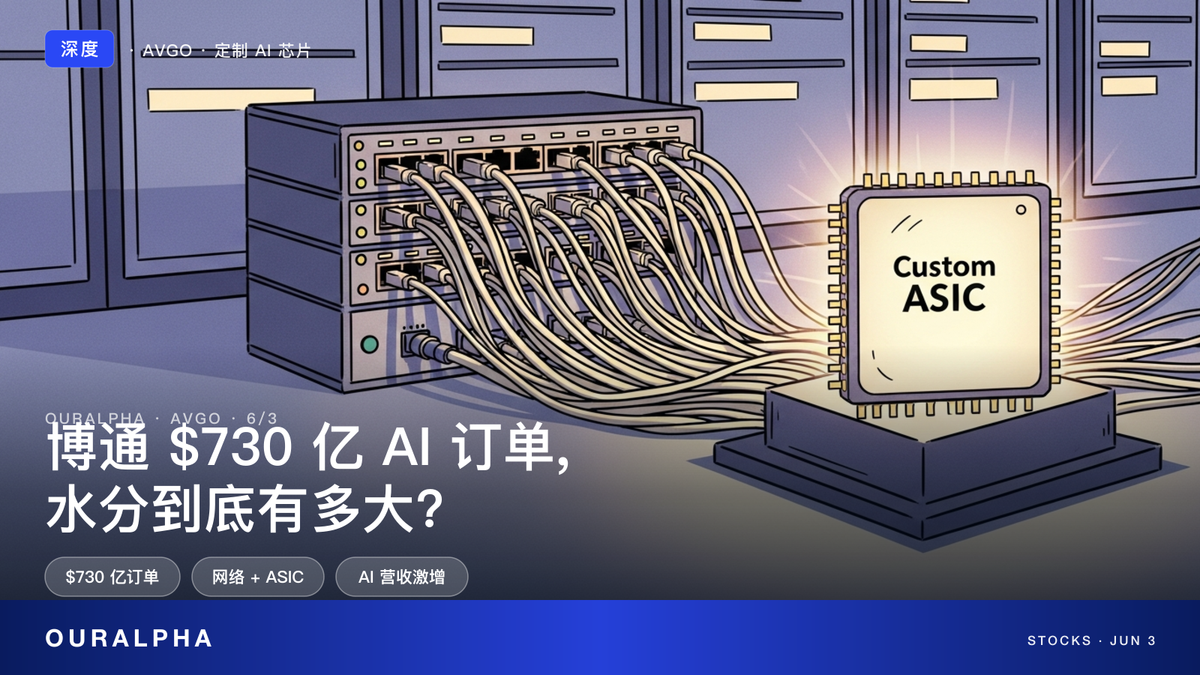
Broadcom's $73B Backlog: How Much of the AI Story Is Real?

Broadcom drops Q2 earnings after the bell on June 3. We run the math on the $73B backlog, the 2027 $100B AI roadmap, and TSMC's capacity ceiling — because tonight the supply-side commentary matters more than the headline number.

TL;DR

Wall Street is still debating whether AI ASIC economics can justify trillion-dollar valuations. Broadcom is already asking a harder question: whether TSMC has enough capacity to go around.

  • Q2 earnings drop after the bell on 6/3 ET: revenue consensus $22B (+47% YoY), AI semiconductor consensus $10.7B (+140% YoY)
  • Last quarter AI revenue was +106% YoY — consensus expects further acceleration, meaning hyperscalers are still adding orders at the silicon level
  • Management's long-range anchor: 2027 AI chip revenue path >$100B; current backlog $73B, deliverable within 18 months (through mid-2027), some orders extending into 2028
  • Customer roster: Google (Alphabet, GOOGL) TPU, Meta MTIA, OpenAI, Anthropic, Fujitsu, ByteDance — Q1 FY26 disclosed 6 XPU customers, plus one unnamed client with a $10B inaugural order
  • Broadcom (AVGO) isn't the brand — it's the implementation partner. That's both the moat and the ceiling.
  • Known constraints: TSMC capacity, HBM4 supply, high customer concentration (top 4 account for the bulk of AI revenue); China exposure has dropped from a ~35% peak to ~17% (FY2025 10-K, vs. 20% in FY2024)
  • Market cap at $2.28T (7th largest globally), PE already stretched; over the past 8 quarters, average single-day post-earnings move is +4.09% — the normal beat script is +3% to +8%, any AI semi QoQ deceleration triggers -5% or worse

Tonight (after the bell, 6/3 ET), Broadcom gets to reset the AI semiconductor narrative — again.

Over the past 18 months, the market's read on this company has shifted three times: from a legacy comms-chip house surviving on iPhone RF and enterprise networking, to a software-plus-hardware play digesting the VMware acquisition reasonably well, to what it is now — the company that physically builds the custom AI chips that Google, Meta, OpenAI, and Anthropic design in-house. The market cap has roughly quadrupled over two years, from ~$600B to $2.28T. AI semiconductor quarterly revenue has gone from under $5B in the year-ago period to a consensus of $10.7B this quarter.

But tonight's print isn't just about validating a growth rate. It has to answer two harder questions: How much of the AI ASIC opportunity has already been priced in? And is Broadcom's relationship with Nvidia a substitution story or a coexistence story?

1. Consensus Numbers and Where the Stock Sits

Sell-side consensus for Q2 fiscal 2026: $22B revenue, +47% YoY. AI semiconductor revenue: $10.7B, +140% YoY. Last quarter that number was +106% YoY. In other words, the market expects Broadcom's AI growth rate to keep accelerating from Q1 into Q2 — not to start fading.

Non-AI semiconductor businesses (wireless, broadband, enterprise storage) are tracking flat to low single-digit declines. The VMware software segment — acquired for $69B in November 2023 — steadily contributes recurring revenue and high margins, and the market treats it as ballast. But everyone is watching that $10.7B number.

AVGO was up 5% on 6/2 as the broader semiconductor sector rallied alongside TSMC. Going into tonight's print, expectations are already skewed bullish — which means:

  • Beat + upward full-year guidance revision → the stock most likely stays in the +3% to +8% post-earnings script it's followed for the past 8 quarters (individual quarters have swung higher and lower)
  • Beat consensus but cautious guidance → likely fades after the open, because expectations are already priced in full
  • Any "AI semi QoQ deceleration" language → -5% floor, potentially worse

Trillion-dollar-club membership comes with a shared characteristic: the valuation has already priced in "sustained high growth," so every earnings call becomes a story-verification exercise, not a performance review. Broadcom is doing this from $2.28T — the 7th-largest market cap on earth.

2. Who Broadcom Actually Works For

The market often calls Broadcom an "AI chip company." That label is imprecise. More accurately, Broadcom is the physical implementation partner for AI chips. The distinction is critical.

Google (GOOGL) TPU: Broadcom handles the physical design of Google's custom AI chips on TSMC's advanced process nodes — CoWoS packaging integration, silicon yield, the works. Google is Broadcom's single largest AI customer; outside estimates put it at 40%+ of AI semiconductor revenue. TPU v7 (Ironwood) is now generally available on Google Cloud; v8 (Sunfish/Zebrafish) is still in preview, targeting TSMC's 2nm node, with volume production expected late 2027.

Meta MTIA: Meta's proprietary inference chip, now in its second generation, handles a meaningful share of Meta's recommendation-system and large-model inference workloads in-house. Broadcom is the implementation partner here too, and the ramp is accelerating through 2025–2026.

OpenAI: In 2025, OpenAI publicly acknowledged working with Broadcom to design its own inference chip — a landmark signal of the shift from "buy all your compute from Nvidia" toward "build custom ASICs to complement GPU clusters." First-generation chips are targeting 2026–2027 production.

Anthropic: Similar path to OpenAI — the primary compute stack still runs on GPUs (with significant training on AWS Trainium), but a custom ASIC program is underway with Broadcom's involvement.

Fujitsu + ByteDance: On the Q1 FY26 earnings call, Broadcom disclosed its XPU customer count had grown to six. Fujitsu's AI server roadmap and ByteDance's internal inference chip are both on Broadcom's implementation list. There is also an unnamed customer that placed a $10B inaugural order.

What all these customers share: they want to build their own AI chips but don't have a fab or a volume production team. What Broadcom sells them is a bundle — chip design expertise, preferred capacity access at TSMC, CoWoS packaging integration, and high-end networking (the Tomahawk switching silicon that interconnects these ASICs inside the datacenter).

That's a fundamentally different business model from Nvidia's:

  • Nvidia sells general-purpose GPUs + the CUDA software ecosystem + DGX system-level solutions. Customers are buying a ready-to-run AI training and inference platform.
  • Broadcom sells custom ASIC implementation + high-end networking. Customers are paying Broadcom to build the chip they designed themselves.

Both businesses feed off hyperscaler capex. But Broadcom's slice grows specifically when hyperscalers decide to source more AI compute in-house instead of buying Nvidia hardware. That's a separate growth curve.

3. The Math: From Q2's $10.7B to the 2027 $100B Target

Management has laid out a clear long-range anchor across the past two earnings calls: AI chip revenue >$100B in fiscal 2027. Current backlog stands at $73B, deliverable within 18 months — covering through mid-2027, with some orders extending into 2028.

Those numbers look compelling in isolation. They need to be stress-tested against the total addressable pool of hyperscaler custom-silicon spending — and that pool needs to be recalculated with the latest 2026 capex guidance, because every major hyperscaler has revised upward significantly over the past six months.

2026 publicly disclosed capex guidance from the four major US hyperscalers:

  • Google: $180–190B
  • Meta: $125–145B (revised upward)
  • Microsoft (MSFT): $190B
  • Amazon (AMZN): $180–200B

Combined 2026 hyperscaler capex: ~$700–725B. Of that, "AI infrastructure" is typically estimated at 50–60%, putting ~$350–440B in AI-related spend. Strip out power, land, cooling, networking fabric, and server chassis, and the slice landing on "AI chips + accelerators" is likely in the ~$200–260B range.

Running through the math on that revised base: Broadcom's 2027 target of $100B implies roughly 40–50% share of the ~$200–260B AI chip and accelerator market. To be clear, that's not saying Broadcom captures half the total AI chip market — Nvidia dominates that. The $200–260B is the total AI chip and accelerator pie; the non-Nvidia accelerator slice is where Broadcom is the clear leader.

Working backward from Q2's $10.7B and a run-rate of ~$40B+ annually: Broadcom has already captured a very large share of the non-Nvidia accelerator market. The path to $100B in 2027 hinges on two things happening simultaneously: hyperscaler capex continuing to rise (it's been revised up from the ~$500B range to the ~$700B range over the past nine months), and the custom-ASIC share of the accelerator mix continuing to expand. Both are in motion right now, which makes the $100B anchor more achievable than it would have looked six months ago.

In the past six months, hyperscaler executives have increasingly cited the TCO advantages of custom silicon on public calls. Google already runs 60%+ of its internal training compute on TPUs, and external Cloud customers are now gaining access. Meta has pushed MTIA deployment to a high share of its inference workload. These are structural shifts, not cyclical ones.

But there is a hard physical constraint: TSMC's CoWoS capacity.

Broadcom has said it explicitly in recent meetings: CoWoS capacity is fully stretched. HBM4 is also in short supply. This means from 2026 H2 through 2027 H1, how much AI silicon Broadcom can actually deliver isn't a function of orders (the backlog is already $73B) — it's a function of how much CoWoS capacity TSMC allocates to Broadcom. That's a hard ceiling.

Which is why the supply-side commentary tonight may matter more than the revenue number itself.

4. Five Risks, None of Them Small

1. China exposure. Broadcom's China revenue share has fallen from a peak of ~35% two to three years ago to ~17% (FY2025 10-K; FY2024 was 20%). The trend is structurally downward, driven mainly by share loss in storage and networking chips in the Chinese market. The core AI business is largely insulated from export controls — all key customers are US-based — but the remaining 17% will get priced into the stock during any US-China tension cycle. The weight is considerably lighter than two years ago, but it hasn't disappeared.

2. Customer dependency risk. Broadcom is Google's and Meta's implementation partner, not the owner of those chip roadmaps. Google could move the next TPU generation to a different design partner — Marvell is the obvious alternative — or pull more physical design capability in-house. The same logic applies to the model companies: OpenAI's first custom ASIC runs through Broadcom; the second generation isn't guaranteed to. This is the inherent tension in the fabless implementation model: the better you are at helping a customer build their chip, the more capable they become of doing it themselves.

3. Concentration. Top 3–5 customers account for the bulk of AI revenue; outside estimates put Google alone at 40%+. Any single large customer slowing capex or switching design partners would be a visible P&L hit within a quarter. The addition of Fujitsu, ByteDance, and the unnamed $10B first-order customer will dilute concentration at the margin, but the top-heavy structure remains.

4. TSMC capacity. Already covered above — CoWoS is Broadcom's AI revenue ceiling. Whether TSMC's Arizona and Japan fabs come online on schedule to add capacity is the critical swing factor for Broadcom's AI revenue trajectory beyond 2026 H2. Broadcom has almost no control over this variable.

5. Valuation absorption. At a $2.28T market cap, the TTM PE is already expensive. The market has priced in sustained high growth through 2026–2028. Any quarter where guidance misses will trigger multiple compression.

5. Three Signals to Watch Over the Next Three Quarters

Once the print lands, don't let the single-day stock move drive your decisions. The three quantifiable signals that actually matter:

Signal 1: Q3 revenue guidance — specifically AI semi QoQ. If Q3 AI semiconductor guidance is +10% or more QoQ vs. Q2, the capacity bottleneck hasn't fully kicked in yet and the 2027 $100B path remains on track. If QoQ growth goes flat or slightly negative, TSMC's CoWoS ceiling is already binding — not necessarily bearish on the long-run story (the $73B backlog is still there), but the growth curve becomes a staircase rather than an exponential, and the multiple needs to reset accordingly.

Signal 2: Management commentary on the 2027 path. If the call maintains or raises the $100B anchor, the thesis is intact. If language starts going fuzzy ("dependent on supply-side factors," "some customers are reassessing timing"), the market will reprice immediately.

Signal 3: Broadcom's TSMC capacity allocation. This number won't be disclosed directly, but two proxies get you there: the pace at which Broadcom is working down its $73B backlog (how fast is it converting to revenue?), and TSMC's own July earnings call commentary on CoWoS capacity allocation. TSMC won't name names, but the relative split between Broadcom and Nvidia is an actively traded market inference.

Decision framework:

  • All three signals positive → among trillion-dollar-club members, AVGO at $2.28T is the cleanest non-Nvidia AI compute beta outside Nvidia itself — hold or add makes sense
  • Signal 1 decelerates, Signal 2 turns cautious, Signal 3 unclear → valuation absorption phase begins; wait for a pullback
  • Any signal pointing to a customer switching design partners → reduce, because that's a structural change, not a temporary blip

The OurAlpha editorial view: Broadcom's moat — fabless implementation capability, TSMC relationship, high-end networking — is not easily replicated in the near term. But the ceiling is visible too: capacity constraints, customer dependency, and valuation. Tonight's print isn't really about whether Broadcom beats the number. It's about what the supply-side commentary tells you about whether the $100B AI chip roadmap is still on rails. One big bite of the AI ASIC opportunity has already been taken. Whether the next bite can be just as large — tonight delivers the first clear signal.

Sources

This content is for informational purposes only and does not constitute investment advice, trading advice, or any guarantee of returns.

Keep Reading

The AI Gold Rush: Who's Quietly Getting Rich Across the Semiconductor Supply Chain?

OURALPHA · US EQUITIES IN DEPTH · SUPPLY CHAIN PANORAMA
US Semiconductor Supply Chain: A Full Breakdown
In the AI Gold Rush, Who's Quietly Printing Money?
From EDA software and lithography machines to GPUs, foundries, and memory — we trace the complete journey from a grain of sand to an AI chip, peeling back every layer of the supply chain that is minting trillion-dollar giants by the dozen.

The market tends to talk about "AI" as a single trade. Look closely, though, and you'll find AI is not

Read full story →

Stay ahead of the market — never miss a deep dive

Follow OurAlpha for AI-driven US equity research and market insight, every day.