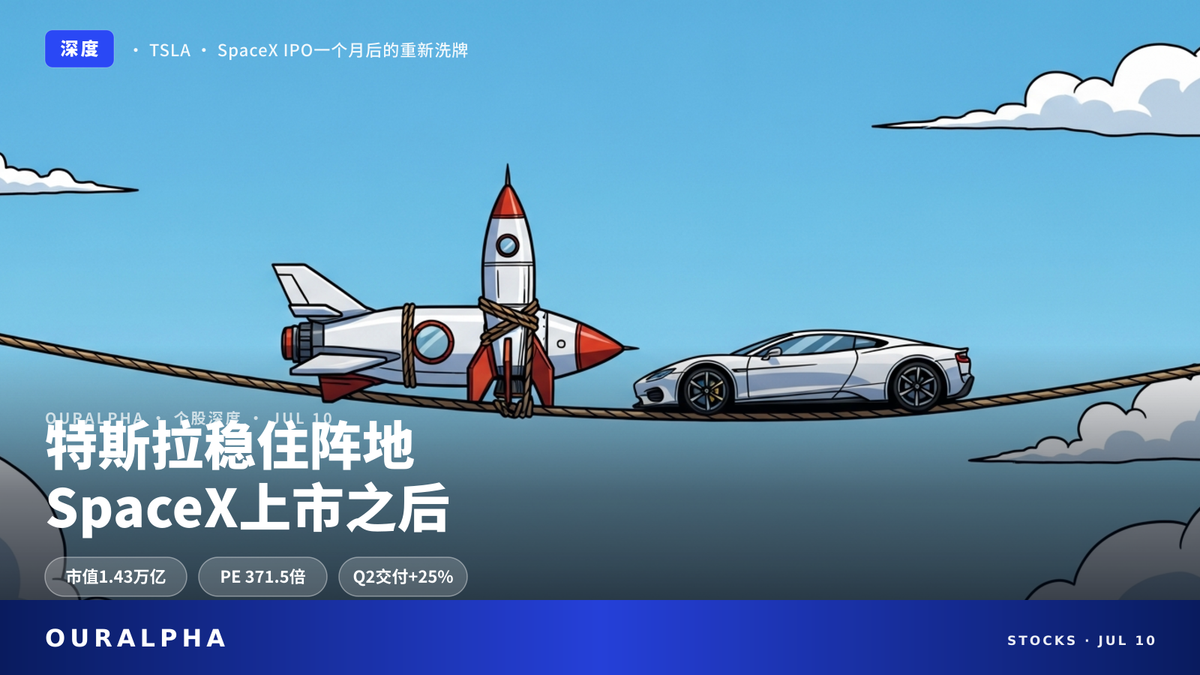
One Month After SpaceX: Tesla Holds Steady, but at the Cost of a 371x P/E

One month after SpaceX IPO, its stock holds steady around $150, while Tesla stabilizes on delivery recovery and merger narrative, but a 371x P/E bets everything on July 22 earnings.

One Month After SpaceX: Tesla Holds Steady, but at the Cost of a 371x P/E
OURALPHA · 个股深度

After SpaceX IPO
Tesla's 371x Bet

Tesla (TSLA) · A Month of Reversal from 'Drained' to 'Merger Fantasy'

Wall Street once feared that SpaceX's largest-ever IPO would drain Tesla of capital and attention.

One month later, SpaceX's stock has held steady around $150, while Tesla has stabilized on Q2 delivery recovery and merger narrative.

But at roughly 371x trailing P/E, everything hinges on the July 22 earnings report and the pace of autonomous driving delivery.

TSLA · Key Data

$406.55

Current Price (Jul 10)

+3.17%

Change from Prior Close

≈1.43万亿美元

Market Cap

≈371.5倍

Trailing P/E (TTM)

480,126辆

Q2 Deliveries (YoY +25%)

$424

Analyst Average Target Price

01 One Month Later, the Script Reverses

One of Wall Street's biggest fears in June was that SpaceX's record IPO would drain capital and attention from Tesla. This concern was not unfounded—in traditional capital market logic, when the same investors and institutional funds face a highly correlated new issue, incremental capital is often limited, and strong demand for one can be interpreted as 'draining' the other. SpaceX priced at $135, raising approximately $75 billion[2], with a valuation of about $1.8 trillion. It opened at $150 on June 12, surging about 19% on the first day[2]. Such heat would pressure any listed company deeply tied to it, especially since Tesla and SpaceX are not only both under Musk's umbrella but also heavily overlap in AI, robotics, energy, and other dimensions. But a month later, Bloomberg's review shows the script unfolded far from those fears[1]: SpaceX closed at $152.16 on Thursday, briefly dipping below $150[1], while Tesla's stock has edged higher since the IPO, holding its ground[1]. In other words, the feared 'zero-sum game' did not materialize; the two stocks have shown a pattern of 'each going its own way' or even reinforcing each other over the month, rather than one rising at the expense of the other.

During regular trading on July 10, Tesla closed at $406.55, up 3.17% from the prior close of $394.06, with an intraday range of $390.86–$407.86 and a market cap of approximately $1.43 trillion. The resilience of this move is enough to invalidate the earlier 'drainage theory,' and echoes the sentiment in Musk's SpaceX Stock Slips to Post-IPO Low, Analysts Still Say Buy—capital does not appear to be flowing unidirectionally from Tesla to SpaceX as expected. From a broader perspective, this phenomenon also suggests that market perception of 'Musk-linked' assets is shifting: investors may not view SpaceX and Tesla as simple competitors for capital, but as complementary pieces of the same narrative, setting the stage for the merger fantasy discussed later.

02 Record Q2 Deliveries, Yet Stock Plunges—Two Realities in the Same Week

Tesla delivered 480,126 vehicles in Q2 2026, up 25% year-over-year, beating the Wall Street consensus of about 406,000 by roughly 18% (about 74,000 units). This was the strongest second quarter in history, ending two consecutive years of delivery declines[3]. The data itself is compelling: both the year-over-year growth rate and the magnitude of the beat make it one of Tesla's best reports in nearly two years, suggesting that earlier market concerns about peak demand and declining competitiveness were at least addressed in this quarter.

But the market reaction was disconnected from the data: on the day of the delivery report, Tesla's stock plunged about 7.49%, its worst single-day performance in nearly a year, marking the third consecutive quarter of declines following a delivery report[4]. This 'buy the rumor, sell the news' phenomenon is not uncommon in growth stock investing—when the market has already priced in or front-run an expected beat, the actual data release becomes a window for profit-taking. CNBC cited market interpretations that this was more about profit-taking after a pre-earnings rally, competitive pressure from BYD reclaiming the global EV sales crown, and stretched valuations at roughly 200x forward P/E[4]. These three factors combined paint a picture far more complex than the delivery numbers alone: on one hand, Tesla's product and production are indeed recovering; on the other, the global EV competitive landscape has not fundamentally changed with this delivery report. BYD's recapture of the sales crown reminds the market that Tesla's growth must still be repeatedly validated in fierce global competition. This paradox highlights Tesla's current predicament: a fundamental recovery is no longer sufficient to support the stock alone; valuation and narrative weight are becoming equally important—and at times, marginal changes in narrative can move the stock more than financial data itself.

03 July 22 Earnings: Gross Margin and FSD Are the Real Test

Tesla will report Q2 earnings after the close on July 22. The market consensus is for revenue of approximately $25.4 billion and EPS of about $0.48[5]. According to The Motley Fool, what investors really care about is not the delivery number itself, but whether auto gross margin excluding regulatory credits can hold in the 18%–20% range, and the progress of FSD and Robotaxi[5]—consistent with the analysis in Tesla Earnings Eve: Why Wall Street Is Betting on a 'Big Beat'. The reason gross margin, not deliveries, is the focus is that deliveries reflect short-term demand fluctuations, while gross margin directly maps structural changes in cost control, production ramp, pricing strategy, and subsidy dependence—key indicators of whether long-term profitability is sustainable. If gross margin excluding credits stabilizes in the 18%–20% range or moves higher, it would strongly rebut market concerns about 'price cuts for volume' and deteriorating earnings quality; conversely, even stellar delivery numbers would struggle to convince the market of sustainable growth.

This earnings report also coincides with the backdrop of Wall Street Q2 Earnings Season Kicks Off, S&P 500 Profit Growth Expectations Hit Four-Year High. Whether Tesla can justify its valuation with gross margin data in an environment of rising overall earnings expectations will be the market's focus in the second half of July. In a broader sector comparison, if the overall market earnings growth hits a four-year high while Tesla delivers a disappointing gross margin, the relative pressure on its stock could be more pronounced than in a weak market environment—because the market will more readily compare Tesla's performance with other growth stocks in the same period, and any relative underperformance could be magnified.

04 Robotaxi Expansion Accelerates, but Musk Himself Says 'Real Revenue Won't Come Until 2027'

The autonomous driving narrative remains the core variable supporting Tesla's valuation. Robotaxi launched in Austin, Texas in June and has expanded to Miami, marking Tesla's first market outside Texas and California[6]. Morgan Stanley expects Tesla to further expand to Phoenix, Orlando, Tampa, and Las Vegas by year-end, with fleet size reaching about 1,500 vehicles by end-2026 and 30,000 by 2030[6]. This expansion pace itself is a noteworthy signal: moving from a single-city pilot to multi-city deployment suggests that Tesla has accumulated experience in regulatory approval, technology validation, and operational models, laying the groundwork for scalable expansion—a key reason the market is willing to give it a valuation premium for long-term autonomous driving markets.

But there remains a clear gap between vision and reality: the Austin autonomous fleet currently has only about 14 vehicles[6], and Musk himself has said that meaningful Robotaxi revenue won't arrive until 2027[6]. This time lag means that if the market continues to value Tesla based on the size of the long-term autonomous driving market, it must tolerate a considerable waiting period for delivery. From an investment logic perspective, this is a classic 'narrative first, earnings later' valuation model—the stock price has already partially priced in revenue that may not materialize for years. If the expansion pace disappoints or regulatory approvals hit snags, the risk of a sentiment-driven pullback is significant. Meanwhile, the huge gap between the actual fleet of about 14 vehicles and Morgan Stanley's projected 1,500 and 30,000 targets also reminds investors to carefully assess the distance between 'storytelling' and 'real delivery' at this stage.

05 From 'Rivals' to 'Merger Fantasy': The Tied Narrative of SpaceX and Tesla

More interesting than Wall Street's initial concern about capital competition is the rising narrative of a potential merger between SpaceX and Tesla. JPMorgan believes the two companies have significant overlap in AI, robotics, energy, transportation, and space businesses, and a merger would be 'strategically coherent on paper,' but warns that the deal would involve multi-jurisdictional approvals, especially Chinese regulatory and antitrust risks, making the process quite complex[7]. This assessment of 'strategically coherent but difficult to execute' is itself tension-filled—it acknowledges the logic of a merger while cautioning investors not to underestimate real-world hurdles, especially the complexity of cross-border regulatory coordination, which often exceeds market optimism.

Wolfe Research analyst Emmanuel Rosner, after discussions with institutional investors, said that expectations of a potential Tesla/SpaceX merger 'have increasingly entered the mainstream,' with some investors even citing it as the primary reason for holding Tesla stock. Drivers include Musk consolidating voting power, the combination of AI computing power and real-world data, and a larger capital base[8]. This statement itself is a signal: when merger expectations shift from fringe speculation to a primary reason for holding the stock, it means the market's valuation anchor for Tesla is quietly shifting from traditional auto manufacturing logic to a more imaginative tech platform narrative. This narrative is not baseless: according to the SpaceX prospectus, Tesla holds about 18.99 million shares of SpaceX (worth about $2.56 billion at the $135 IPO price), and in 2025, SpaceX purchased over $500 million in Megapack storage and about $130 million in Cybertrucks from Tesla. The two companies are also jointly building a Terafab chip factory with Intel to supply chips for Tesla's Optimus robot and SpaceX's orbital data centers—Morningstar believes this is enough to refute the old narrative of 'one suppressing the other'[12]. This real equity holding and commercial procurement relationship gives the merger fantasy a more solid foundation than mere speculation—after all, shareholding percentages, procurement amounts, and joint factory construction are direct evidence of deep interest alignment, not just conceptual associations. This is another logical chain supporting Tesla's stock, beyond Spacex Gets Dense Wall Street Bullishness, 80% of Analysts Give Buy Ratings. RBC Capital, based on Robotaxi's addressable market of about $4.2 trillion and the potential merger fantasy, raised its Tesla price target to $500, making it one of the more aggressive bull targets on Wall Street[9]. Notably, the valuation assumptions implicit in this target price effectively combine Robotaxi's long-term market space with the strategic imagination of a SpaceX merger—if either assumption fails to materialize, the target price's validity will be challenged.

06 The 371x P/E Bet: On Narrative or Fundamentals?

Putting all the clues together, Tesla's current price corresponds to TTM EPS of $1.09, a trailing P/E of about 371.5x, a price-to-sales ratio of about 15.6x, and a gross margin of about 19.1%—valuation at extreme levels[10]. Such multiples, even compared to the broader tech growth stock sector, are exceptionally high—meaning the market's pricing of Tesla has long exceeded what its current earnings power can explain, instead heavily incorporating far-off narratives like Robotaxi, merger fantasy, and AI computing power. According to S&P Global, about 47 analysts give Tesla a 'Buy' consensus rating, with an average target price of about $424[10]; UBS recently raised its target from $364 to $442 but maintained a Neutral rating[10]—even relatively bullish institutions are signaling that valuation has run ahead of fundamentals. This combination of 'raising target but not upgrading rating' is itself a cautious signal: analysts acknowledge upside potential but are not willing to give more aggressive trading recommendations at current valuation levels.

Risks are equally notable: retail investors hold about 40% of Tesla shares, and BNP Paribas analyst James Picariello gives it an Underperform rating[11]. The Future Fund's Gary Black believes some retail investors are selling Tesla to subscribe to SpaceX's 'first-day pop,' potentially creating additional selling pressure on TSLA, and says Tesla is 'fully valued' at roughly 200x 2026 P/E[11]. A high retail ownership ratio often means the stock is more sensitive to market sentiment, and in the event of negative news or profit-taking waves, volatility could be amplified—part of the reason Tesla's stock plunged on positive delivery data. One month after the SpaceX IPO, the reality is that Tesla has not been 'drained,' but has instead stabilized on delivery recovery and merger fantasy. However, the price of this stability is that almost all hopes are pinned on the July 22 gross margin number and Robotaxi revenue that won't materialize until 2027. In other words, the high valuation the market gives Tesla is essentially a collective bet on the pace of future narrative delivery, and the next key verification point for this bet is the upcoming Q2 earnings report. This article presents only facts and the views of various parties, and does not constitute investment advice.

SOURCES

[1] A Month After SpaceX IPO, Tesla's Stock Keeps Holding Its Ground - Bloomberg
[2] SpaceX IPO takeaways: SPCX closes at $161, jumping 19% after record debut - CNBC
[3] Tesla (TSLA) Q2 2026 deliveries jump 25% to 480,126 - Electrek
[4] Tesla stock sinks 7% despite strong deliveries report, posting worst day in nearly a year - CNBC
[5] Should You Buy Tesla Stock Before July 22? - The Motley Fool
[6] Tesla Rises 6% on Robotaxi and Delivery Momentum - Yahoo Finance
[7] JPMorgan calls the possibility of a SpaceX-Tesla merger 'strategically coherent' - CNBC
[8] Potential implications from SpaceX IPO for Tesla? - Yahoo Finance
[9] RBC Capital Raises its Price Target on Tesla (TSLA) - Insider Monkey
[10] Tesla (TSLA) Stock Forecast & Analyst Price Targets - StockAnalysis
[11] TSLA Stock Sinks As SpaceX IPO Nears — Analyst Says Investors Are Selling Tesla - Yahoo Finance
[12] What Happens If Tesla and SpaceX Merge? - Morningstar

This content is for informational purposes only and does not constitute investment advice, trading advice, or any guarantee of returns.

Keep Reading

Cramer Says Cheap, Market Says Expensive: Oracle's AI Gamble

Cramer Says Cheap, Market Says Expensive: Oracle's AI Gamble
OURALPHA · 个股深度

With $638 Billion in Orders,
Why Is Oracle Still Cut in Half?

Oracle (ORCL) · AI Cloud Infrastructure vs. Debt Tug-of-War

The same stock: Cramer calls it 'scary debt' on one hand, yet says forward earnings make it 'look cheap.'

$638 billion in AI orders waiting to be fulfilled, yet the stock is cut in half from its peak.

The market is betting: Can Oracle turn negative $23.7 billion in free cash flow into $8.05 EPS by fiscal 2027?

ORCL · Key

Read full story →

Stay ahead of the market — never miss a deep dive

Follow OurAlpha for AI-driven US equity research and market insight, every day.