Cramer Says Cheap, Market Says Expensive: Oracle's AI Gamble
With $638 billion in AI orders but the stock cut in half: Cramer says cheap, market says expensive, Oracle's debt vs. growth tug-of-war.
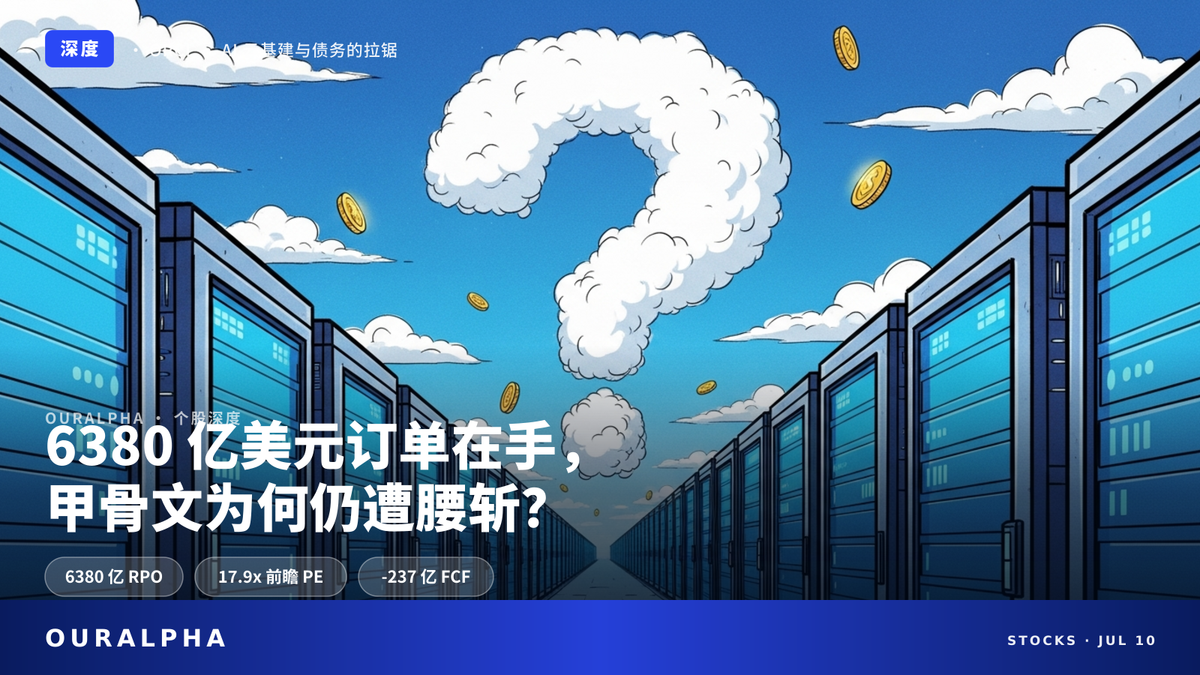
With $638 Billion in Orders,
Why Is Oracle Still Cut in Half?
The same stock: Cramer calls it 'scary debt' on one hand, yet says forward earnings make it 'look cheap.'
$638 billion in AI orders waiting to be fulfilled, yet the stock is cut in half from its peak.
The market is betting: Can Oracle turn negative $23.7 billion in free cash flow into $8.05 EPS by fiscal 2027?
ORCL · Key Data
01 Cramer's 'Cheap' Argument: Forward P/E of Just 17.9x
On July 9, Jim Cramer on Mad Money's neocloud segment grouped Oracle with CoreWeave and Nebius as 'new hyperscale cloud providers of the AI era,' citing analysts' future earnings projections to call its valuation 'look cheap'[1]. The core support for this view comes from Oracle's FY2026 Q4 earnings released on June 10: the company confirmed FY2027 total revenue guidance of $90 billion and raised non-GAAP EPS guidance to $8.05 (up 18% YoY)[5]. Based on the intraday price of $144.22, the forward P/E is only about 17.9x, well below the trailing P/E of 24.6x based on TTM EPS of $5.86[5]. This means that if the company can deliver on its future earnings targets, the current valuation is relatively low by historical standards, offering a so-called 'margin of safety' for value investors. On CNBC's Squawk on the Street, Cramer further called Oracle perhaps the 'most interesting contrarian play' in the group, directly addressing the core controversy behind its roughly 42% plunge from $244.58 on June 2—whether the massive spending on data centers can ever pay off[2]. After the sell-off, market sentiment is deeply pessimistic, but Cramer believes the decline may have overreacted to risks, creating a contrarian opportunity.
However, Cramer's stance has not been consistently bullish. Just on June 17, he listed Oracle as 'one of the stocks I'm most worried about,' bluntly stating 'too much debt… CoreWeave and Oracle are the two outliers,' but also adding 'Oracle is fine' and could be a choice if one wants some elasticity[12]. This tug-of-war between bullish and bearish precisely reflects the market's deep divide over Oracle's AI bet. On one hand, the forward P/E appeal is hard to ignore; on the other, the debt burden and capital expenditure uncertainty leave investors wary. Cramer's contradictory views are a microcosm of market sentiment—optimists see growth potential, pessimists see financial risk. From a valuation perspective, a forward P/E of 17.9x is not extremely cheap among tech stocks, but given the company's rapid cloud business growth, this multiple may be undervalued. However, market concerns over debt and cash flow have suppressed the stock price, making the forward P/E look attractive. Investors must weigh: if the company fails to achieve $8.05 EPS, is there further downside from current levels?
02 $638 Billion in Orders: The 'Super Engine' of AI Cloud Business
The most staggering number in Oracle's Q4 earnings was Remaining Performance Obligations (RPO) of $638 billion, surging 363% YoY and increasing by $85 billion sequentially[3]. Management stated that the Q3 and Q4 RPO growth came overwhelmingly from large-scale AI contracts, with customers prepaying for GPU purchases or bringing their own GPUs[3]. This flood of orders directly drove cloud infrastructure (OCI) revenue up 93% YoY to roughly $5.8 billion, fueled by AI training and inference compute demand[4]. The surge in RPO implies extremely high visibility into future revenue, which is the source of confidence behind the company's $90 billion FY2027 revenue guidance. Notably, the 363% YoY growth in RPO is not linear but driven by a few mega-deals, which brings both high certainty and the risk of customer concentration.
The biggest driver behind the orders is the 'Stargate' project: a 4.5 GW collaboration between Oracle, OpenAI, and SoftBank, described externally as roughly a $300 billion compute deal[10]. This project not only contributes massive RPO but also explains why capital expenditures are so enormous—building hyperscale data centers requires huge upfront investment. The company guided for Q1 FY2027: total revenue growth of 27%–29%, total cloud revenue growth of 58%–64%, and non-GAAP EPS of $1.72–$1.76[6]. Rapid cloud revenue growth is a key indicator to verify whether AI demand is sustainable. If Q1 cloud revenue growth hits the high end of guidance, it will further strengthen confidence in AI compute demand; conversely, if growth disappoints, it may raise questions about order conversion efficiency. For related coverage, see Oracle Rises Over 4% Intraday as Analysts See AI Cloud Potential. Moreover, the scale of RPO means the company must continue to invest heavily to fulfill contracts, explaining why free cash flow is negative—there is a time lag between order growth and capital expenditure, with upfront spending needed to secure future revenue recognition.
03 Cash Burn Black Hole: Negative $23.7 Billion Free Cash Flow and $130 Billion Debt
The price of orders is staggering capital expenditure. FY2026 full-year operating cash flow hit a record $32 billion (up 54%), but due to continuous investment in cloud infrastructure, free cash flow was negative $23.7 billion; capital expenditure reached $55.66 billion, exceeding the $50 billion target[7]. Management plans FY2027 net cash capital expenditure of about $70 billion and will raise an additional $40 billion through debt/equity financing[8]. According to a CNBC report on June 26, the company carries roughly $130 billion in debt, and the stock fell as much as 11% on June 11, the day after earnings[8]. Negative free cash flow means the company relies on external financing to support operations, increasing financial risk in a high-interest-rate environment. Although operating cash flow hit a record, most of it was consumed by capital expenditure, widening the free cash flow gap. If financing conditions tighten or interest rates rise further, interest expenses will erode profits.
Management argues that steady-state ROIC can reach 'high-20s%' and that new contract structures with prepayments are designed to protect margins[8]. But the market's core concern is customer concentration: the stock has fallen sharply from its 52-week high of $345.72 to a low range near $134.57, with investors worried about Oracle's heavy reliance on a few large AI customers and whether debt-fueled AI investments will pay off[9]. If key customers reduce orders or delay payments, the company's cash flow pressure will intensify. Moreover, persistently high capital expenditure means near-term profitability is unlikely to improve, and the market must wait longer to see returns on investment. Compared to traditional software companies, Oracle's business model is shifting from high-margin, low-capital-expenditure to asset-heavy, high-leverage cloud infrastructure, altering its risk-return profile. Investors need to assess: after the capital expenditure peak passes, can the company achieve management's expected ROIC? If AI demand slows, excess compute capacity could lead to asset impairment risk.
04 Analyst Divergence: $300 Price Target vs. $225
Despite the stock's pressure, some analysts remain firmly bullish. KeyBanc maintains an Overweight rating and a $300 price target, citing the company's strong positioning in high-growth areas such as AI workload deployment, agent operation, and work automation[11]. DA Davidson raised its target from $200 to $225 after FY2026 Q4 earnings and maintained a Buy rating[11]. Optimists believe that the gradual recognition of $638 billion in orders will drive accelerating revenue growth, while the forward P/E of 17.9x provides a margin of safety. KeyBanc's target price implies roughly double the current stock price, suggesting significant upside potential, based on assumptions of sustained high growth in AI business. If the company can meet its FY2027 EPS guidance and market sentiment recovers, valuation could revert to historical averages.
However, bearish arguments are equally compelling: persistently negative free cash flow, high debt levels, and uncertainty around the payback period for AI capital expenditure. Cramer, in his market rotation picks on July 8, did not list Oracle as a top choice, highlighting his caution. A similar story plays out with Micron's $250 billion bet, also selling forward P/E, where the market's pricing logic for asset-heavy AI investments is being tested. The analyst divide essentially reflects differing judgments on the return on AI infrastructure investment: optimists see demand continuing to explode, while pessimists worry about overinvestment leading to capacity glut. KeyBanc's recent rating adjustments on software stocks (e.g., Salesforce downgraded) show that market preferences for cloud spending are tilting toward infrastructure, but whether Oracle benefits depends on its execution. The divergence in price targets also reflects different views on risk premiums: the $300 target implies a lower discount rate, while $225 is more conservative.
05 The Endgame: Can FY2027 EPS of $8.05 Be Delivered?
Oracle's value hinges on its FY2027 earnings guidance. If the company can achieve $90 billion in revenue and $8.05 EPS, the current stock's forward P/E would be highly attractive. But achieving this target requires: smooth conversion of AI orders into revenue, capital expenditure efficiency meeting expectations, and manageable customer concentration risk. The Q1 guidance of 58%–64% cloud revenue growth is a near-term validation point[6]. If cloud revenue growth remains strong, it will boost confidence in the company's long-term profitability. However, revenue growth does not directly translate to profit growth, as depreciation from capital expenditure and interest expenses will weigh on net income. The company must demonstrate that operating leverage can kick in as revenue scales, allowing EPS growth to outpace revenue growth.
Cramer's contradictory stance—worried about debt yet acknowledging valuation—neatly sums up Oracle's current state. KeyBanc's recent rating adjustments on software stocks (e.g., Salesforce downgraded) show that market preferences for cloud spending are tilting toward infrastructure. Whether Oracle can become the 'new hyperscale cloud provider' of the AI era may be answered in the coming quarters by signs of cash flow improvement. If free cash flow turns positive, it would greatly alleviate debt concerns; conversely, if capital expenditure continues to drag on cash flow, the stock may remain under pressure. Investors should closely monitor quarterly RPO conversion rates and cash flow performance to gauge the direction of this bet. Additionally, is management's FY2027 EPS guidance too optimistic? If AI demand growth slows or customers delay orders, revenue targets may be missed. Another key variable is the interest rate environment: high rates increase debt costs and compress profit margins. Thus, delivering FY2027 EPS depends not only on the company's execution but also on macroeconomic factors.
06 Conclusion
Oracle's story is a microcosm of the current AI infrastructure frenzy—betting today's massive capital expenditure and debt on tomorrow's cloud leadership. The $638 billion in orders gives it confidence, while the halved stock price reflects market skepticism. Cramer sees an undervalued future; bears see a cash-burning present. The real answer will unfold over the next few quarters as free cash flow reveals its hand. Until then, this is both a high-stakes gamble on AI demand and a test of 'how much growth is worth paying for.'
This article presents only facts and the views of various parties, and does not constitute investment advice.
SOURCES
[1] Jim Cramer Highlights Future Earnings Projections that Make Oracle Look Cheap - Insider Monkey
[2] Jim Cramer Sees Tech Rebound And Oracle Upside as Data Center Spending Reshapes Market - 24/7 Wall St.
[3] Oracle Announces Record Q4 and FY 2026 Results - Oracle IR
[4] ORCL Stock Cloud Backlog Decline - ECIKS
[5] Oracle Announces Record Q4 and FY 2026 Results - Oracle IR
[6] Oracle Announces Record Q4 and FY 2026 Results - Oracle IR
[7] Oracle Announces Record Q4 and FY 2026 Results - Oracle IR
[8] Oracle expects 34% FY27 revenue growth as it plans $70B net cash capex outlay - Seeking Alpha
[9] Oracle AI Debt Market Turmoil - IBTimes
[10] Stargate advances with 4.5 GW partnership with Oracle - OpenAI
[11] Jim Cramer Discusses Oracle (ORCL) & Short Squeeze - Insider Monkey
[12] Jim Cramer Says Oracle Is One of the Stocks He Is Most Worried About - Insider Monkey
This content is for informational purposes only and does not constitute investment advice, trading advice, or any guarantee of returns.