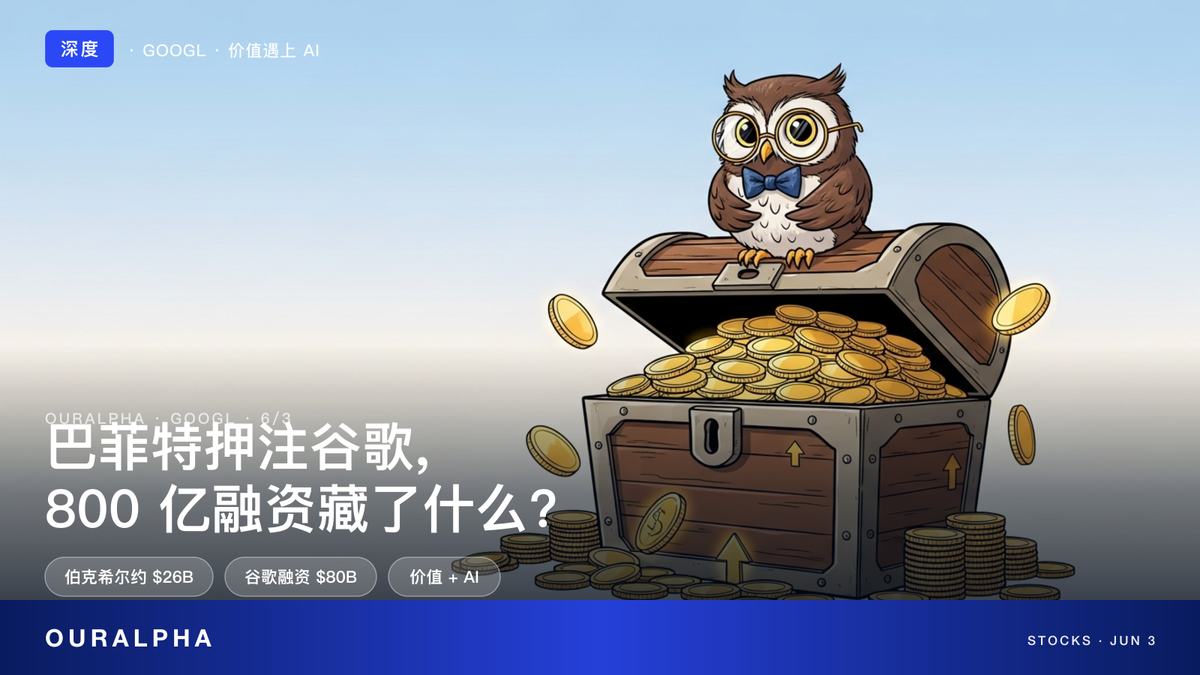
Berkshire Quietly Built a $16.6B Alphabet Stake — Then Added $10B the Same Night Google Raised $80B
Berkshire has been stealthily accumulating Alphabet since Q3 2025, making it the firm's 5th-largest holding. On June 1, it added another $10B in a private placement — the same night Alphabet launched an $80B equity offering and raised its 2026 capex guidance to $180–190B.
TL;DR · The One-Line Take
Starting in Q3 2025, Berkshire quietly built Alphabet (GOOGL, Google's parent) into its 5th-largest position at roughly $16.6 billion, then stacked on another $10 billion on June 1 — Berkshire's first major position built under Greg Abel's tenure as CEO (effective Jan 1, 2026). That same evening, Alphabet launched an $80 billion equity offering and raised its 2026 Capex guidance to $180–190 billion. The AI compute arms race has entered a "spend until your rivals can't keep up" phase.
- The $80B offering has three tranches: $30B public underwriting ($15B mandatory convertible preferred + $15B Class A/C common) + $40B ATM + $10B private placement to Berkshire
- 2026 Capex guidance raised to $180–190B; Capex-to-revenue ratio is the highest in the Mag 7, though not the highest in absolute terms — Amazon's 2026 Capex is ~$200B, Microsoft's ~$190B, and the three are converging fast
- This isn't Buffett's first buy — the Q1 2026 13F already showed Berkshire holding ~57.8 million shares of Alphabet worth ~$16.6B, ranked 5th; this $10B is an incremental add
- The private placement was priced essentially at market: $5B of Class A @ $351.81 + $5B of Class C @ $348.20 (no meaningful premium or discount)
- GOOGL fell nearly 4% on 6/2 — briefly erasing $100B in market cap intraday; the stock had been up +28.4% YTD in 2026 heading into the announcement, best in the Mag 7
- Dilution: $80B / ~$4.34T current market cap ≈ 1.8% (well below the 3%+ the market initially feared); the ATM program means ongoing dilution rather than a one-time hit
- Historical parallels: Amazon (AMZN) faced years of market skepticism over AWS Capex and was ultimately vindicated; Microsoft (MSFT) betting ~$13B on OpenAI (10+10+30) plus Azure build-out follows the same playbook — but Meta's metaverse, which burned ~$88B over 7 years, is the cautionary counter-example (not the often-cited $100B+)
- Where the money goes: data centers + in-house TPUs (Tensor Processing Units, fabbed by Broadcom) + Cloud + DeepMind + Waymo; Alphabet's 2025 FCF was ~$73.3B, OCF ~$164.7B
The $80B equity offering isn't that large on its own — it's only ~1.8% dilution against Alphabet's ~$4.34T market cap. What shifts the narrative is both moves happening simultaneously: issuing equity while raising Capex guidance to $190B — signaling that management believes ~$73.3B in FCF can no longer keep pace with compute demand, and that external equity financing is now necessary. That's a posture major tech companies have rarely adopted over the past decade.
The real signal on the Berkshire side is the timing layered on top of a management transition. Building the position starting Q3 2025, already at 5th-largest by the Q1 2026 13F, then adding $10B on 6/2 after Greg Abel took the CEO chair on Jan 1, 2026 — this isn't a one-off bet; it's the first wave of systematic, large-scale conviction positioning in the Abel era. AOL's headline already reads "Berkshire doubles down on Alphabet under Greg Abel."
But retail investors should stay clear-eyed: historically, the "high Capex + equity issuance" playbook worked for AWS and for Azure + OpenAI — and failed for Meta's metaverse. Figuring out which side Alphabet lands on, the next 3 quarters of Cloud growth, TPU customer backlog, and FCF resilience will matter 10x more than stock price volatility.
OurAlpha Scorecard
| Dimension | Score | Notes |
|---|---|---|
| Event Magnitude | 9/10 | $80B offering + Berkshire's $10B placement + the $16.6B hidden stake surfacing in one day — an unusually dense concentration of capital moves for any Mag 7 name |
| Signal Direction | 7/10 | Abel-era first major position is a strong positive signal, but the simultaneous Capex raise extends the payback timeline |
| Retail Risk | 6/10 | 1.8% dilution isn't large, but the ATM program means ongoing dilution; near-term price volatility will be amplified |
| Long-Term Sustainability | 7/10 | ~$73.3B FCF against $190B Capex is already stretched; buyback pace may be constrained |
Overall 7.25/10 — the single most consequential AI Capex event of 2026 so far, but near-term volatility will outrun the long-term thesis.
Key terms up front (each defined again on first mention):
- Capex (capital expenditure): money spent building data centers, buying chips, and expanding server infrastructure
- ATM (at-the-market): a flexible equity issuance mechanism where a company sells shares incrementally at prevailing market prices, unlike a traditional underwritten deal priced all at once
- Mandatory convertible preferred stock: preferred shares that must convert into common stock at maturity (typically 3 years) at a preset formula; they don't count toward float dilution until the conversion date
- FCF (free cash flow): OCF minus Capex — the cash actually available for buybacks, dividends, and debt repayment
- OCF (operating cash flow): the real cash generated by the core business, before deducting Capex
- DCF (discounted cash flow): a valuation method that discounts projected future FCF back to present value using a given discount rate
- TPU (Tensor Processing Unit): Google's in-house AI accelerator, competing with Nvidia's (NVDA) GPUs, with packaging and manufacturing handled by Broadcom (AVGO)
- Hyperscaler: cloud providers — Google, Microsoft (MSFT), Amazon (AMZN) — that own and operate massive proprietary data center infrastructure
- ROIC (return on invested capital): a core metric for how much return a company generates for every dollar deployed
- 13F: the SEC-mandated quarterly holdings disclosure required of institutions managing over $100M; Berkshire files on time every quarter
Financing Structure Breakdown: The 300 + 400 + 100 Three Tranches Are Not Created Equal
In Alphabet's $80 billion equity raise announced after the close on June 1, the easiest mistake retail investors make is assuming this $80 billion goes out the door all at once. It doesn't — it's structured in three tranches, each with a different dilution timeline, market impact cadence, and signaling value.
Tranche 1: $30 Billion Underwritten Public Offering
This tranche has its own split — it's not a straight common stock issuance but a combination of $15 billion mandatory convertible preferred stock + $15 billion Class A/C common stock.
The common stock piece is the most vanilla approach — underwriters buy the new shares at a discount (typically 2–5% below the day's price) and place them with institutional investors in one shot. Cash arrives immediately, dilution hits immediately.
Mandatory convertible preferred stock works differently — $15 billion in cash comes in right away, but it doesn't increase shares outstanding in the near term. Conversion happens at a set maturity date (typically three years out) based on a predetermined formula. The implication: near-term EPS dilution is deferred, dividend costs are front-loaded, and the dilution hit lands in one shot three years from now. Alphabet almost certainly chose this structure to make near-term EPS look less painful.
Tranche 2: $40 Billion At-the-Market (ATM) Program
This is the largest tranche of the $80 billion raise and the one with the most nuanced market impact. Under an ATM program, the company authorizes one or more banks to sell new shares incrementally over future quarters at prevailing market prices — how much gets sold each day, and at what price, follows secondary market conditions in real time.
The upside for the company is flexibility: sell more when the stock is up, pull back when it's down. The downside is that the market lives under a persistent dilution overhang — as long as any portion of that $40 billion remains unsold, every rally gets capped by ATM selling pressure, because the banks have every incentive to sell heavier into strength.
This is the real reason the stock dropped nearly 4% on June 2 (briefly erasing $100 billion in market cap). It wasn't the $10 billion Berkshire investment (that's a positive), and it wasn't primarily the $15 billion mandatory convertible (that's near-term non-dilutive). It was the market recognizing that a $40 billion "sell at market" sword will be hanging overhead for the next 6–12 months.
Tranche 3: $10 Billion Private Placement to Berkshire
The smallest tranche by size, but the loudest signal. $10 billion is roughly 0.23% of Alphabet's $4.34 trillion market cap — but Berkshire's name is an endorsement in itself, particularly as this represents Greg Abel's first major position since taking over as CEO on January 1, 2026.
Pricing has been disclosed: $5 billion Class A @ $351.81 + $5 billion Class C @ $348.20 — essentially at market (near the June 1 close), with no meaningful premium or discount. That at-market pricing signals Berkshire isn't here for a financial arb; it's taking a strategic position at a fair price. Lock-up terms and other details are still pending the full 8-K filing.
Dilution summary across all three tranches:
- Near term (within 1–2 weeks): $15B common stock offering + $10B Berkshire placement settle immediately — approximately 0.6% dilution done
- Medium term (3–12 months): $40B ATM program sells down gradually, potentially 0.2–0.4% dilution per quarter
- Three years out: $15B mandatory convertible preferred converts — one-time dilution of approximately 0.3%
- Cumulative: $80B ÷ $4.34T ≈ 1.8% total dilution
- Key context: Alphabet bought back roughly $70–80 billion of stock over the past 12 months — this $80 billion raise is essentially giving back one full year of buybacks
II. The Berkshire Thread: Not a First Buy — The Abel Era's Opening Position
Much of Chinese social media has framed this as "Buffett's first purchase of Alphabet" — that's wrong. Berkshire began building its Alphabet position as early as Q3 2025.
The public paper trail:
- Q3 2025 13F: Berkshire's initial disclosure of an Alphabet position
- Q4 2025 13F: continued additions
- Q1 2026 13F (disclosed May 15): ~57.8 million shares / ~$16.6B market value / Berkshire's 5th-largest holding
- June 1 after-hours: an additional $10B private placement on top
The critical point in this timeline — Buffett officially stepped down as CEO on January 1, 2026; Greg Abel now holds that role. Both the $16.6B stealth stake disclosed in the Q1 2026 13F and the $10B add-on on June 2 are Abel-era decisions (even though Buffett remains chairman, day-to-day investment calls are now driven by Abel, Todd Combs, and Ted Weschler). AOL's June 2 headline put it plainly: "Berkshire doubles down on Alphabet under Greg Abel."
This is nothing like the Apple (AAPL) playbook. Apple was a position Berkshire built gradually from 2016, accumulating over several years into its largest holding at roughly $150B — a slow, multi-year grind with repeated add-ons. Alphabet, by contrast, went from zero to a $16.6B stealth stake plus a $10B public add-on within a single year, with the timing landing squarely in the first year of a CEO transition. The structure itself is sending a message to the market: this isn't Buffett's last stand — it's Abel's opening move.
Why Berkshire Made an Exception
Berkshire's investment philosophy over the past 60 years has been clear: low-P/E, solid FCF, high-ROIC, capital-light "money-printer" businesses. Apple is Buffett's largest tech holding, and it's the textbook example — high ROIC, low capex, with Apple's capex-to-revenue ratio running just 3–4% in recent years.
Alphabet today is doing the opposite:
- 2026 capex guidance: $180–190B
- 2026 revenue estimate: ~$400B
- Capex/revenue ≈ 45–48% — a level of capital intensity rarely seen among large-cap tech over the past two decades
Under Berkshire's traditional screening framework, Alphabet shouldn't be on the buy list. Three possible readings:
Reading 1: They're not buying capex — they're buying a suppressed-moat valuation
The sum-of-the-parts value of Alphabet's five business lines — Search, YouTube, Cloud, Waymo, and DeepMind — far exceeds the current $4.34T market cap, but the market has applied a discount over the past two years on twin fears: "AI will cannibalize Search ad revenue" and "high capex is burning cash."
If Berkshire has concluded that "AI Overviews have proved they won't cannibalize Search advertising" — a thesis Alphabet's last five quarterly results have consistently validated — then the current valuation looks like a mispricing.
Reading 2: Combs/Weschler drove the thesis, Abel signed off
Berkshire's investment decisions are increasingly led by portfolio managers Todd Combs and Ted Weschler, both of whom have a significantly higher tolerance for tech than Buffett himself — the initial Apple position is widely attributed to Combs. That dynamic will only intensify under Greg Abel. If Combs/Weschler led the conviction here, the $16.6B stealth stake plus $10B add-on may represent a thematic beta allocation to AI infrastructure rather than classic Buffett-style deep value.
Reading 3: The private placement terms may have hidden guardrails
Large private placements typically come with anti-dilution provisions, conversion rights, and board observer seats. The full 8-K details have yet to be disclosed. If Berkshire negotiated preferred-stock-like downside protection through deal terms, this is less a "pure common-equity position" and more "secured AI infrastructure credit."
OurAlpha Take: Whichever reading is correct, the market should treat this event as "Berkshire's first systematic participation in the AI infrastructure cycle under Abel" — and not as "Buffett endorsing Alphabet's long-term value." The difference between those two framings is enormous.
III. The Math: Where Does $190B in Capex Actually Go
$190B in capex is an abstract number. To make sense of where the money goes, it helps to break it down into specific buckets.
Mag 7 Capex Comparison (2026 Guidance):
| Company | 2026 Capex Guidance | Capex / Revenue |
|---|---|---|
| Alphabet | $180–190B | ~45–48% |
| Amazon | ~$200B | ~14–16% |
| Microsoft | ~$190B | ~32% |
| Meta | $125–145B | ~22–25% |
| Total (Top 4 Mag 7) | ~$725B | — |
Note — Alphabet does not have the highest absolute capex in the Mag 7; Amazon's ~$200B does, with Microsoft's ~$190B roughly tied with Alphabet. Where Alphabet truly leads is capex-to-revenue ratio — at 45–48%, it is the only Mag 7 member in the 40%+ range. In absolute terms, the three hyperscalers are converging.
Five Capex Categories (Inferred from Historical Filings and Management Commentary):
- Data Center Expansion (Largest Bucket): Likely ~50–55% of total. Covers land, construction, power infrastructure (substations, backup power), and cooling systems. AI data centers cost 3–5× more per unit than traditional ones, primarily because per-rack power density has jumped from 10kW to 50–100kW, requiring a complete redesign of thermal and power delivery systems.
- Custom TPUs + Broadcom Foundry (AVGO): Likely ~20–25%. TPU v7/v8 is physically implemented and packaged by Broadcom (AVGO), giving Alphabet a way to reduce dependence on Nvidia (NVDA) GPUs. Each TPU generation carries R&D, tape-out, and foundry costs in the tens of billions of dollars.
- Google Cloud Customer Compute Deployment: Likely ~10–15%. Cloud customers are queued for TPU capacity; this capex directly maps to Cloud order backlog.
- DeepMind + Gemini Training Compute: Likely ~5–8%. A single training run for Gemini 2.5 / 3.0 is estimated to cost $500M–$1.5B.
- Waymo + Other: Under 5%. Waymo is expanding across 5 cities (SF / Phoenix / LA / Austin / Atlanta), but its capex is a rounding error relative to the first four categories.
The Core Math: $190B Capex vs. $73.3B FCF
From Alphabet's 2025 financials — OCF ~$164.7B, Capex ~$91.4B, FCF ~$73.3B. If 2026 capex rises to $190B, capex alone would be more than 2.5× Alphabet's full-year 2025 FCF — meaning Alphabet cannot simultaneously fund capex, buybacks, and dividends without external financing.
The $80B equity raise is essentially plugging this gap. Working through the numbers — against ~$165B OCF, $190B capex leaves an OCF-level shortfall of ~$25B; against ~$73.3B FCF, the total external funding gap for the expansion exceeds $110B. The $80B raise covers roughly one to one-and-a-half years of incremental expansion needs, but if 2027 capex does indeed rise "meaningfully" above $220B as management has guided, another round of financing in 2027 is highly likely.
Implied ROIC Hurdle
At a 10-year depreciation schedule, $190B in annual capex implies ~$19B in incremental annual D&A. To keep ROIC from declining (Alphabet's current ROIC is ~25–28%), the new investment must generate ~$25–30B in incremental operating income per year — which, at Google Cloud's Q1 2026 operating margin of 32.9%, translates to ~$80–100B in incremental annual revenue.
Put differently — Alphabet is betting that its AI Cloud + AI Search businesses can generate $80–100B in new revenue per year over the next 3–5 years. That is a very high embedded assumption. Q1 2026 Google Cloud quarterly revenue came in at $20B (+63% YoY), annualizing to ~$80–90B; at the current growth rate, the business could add $40–50B in incremental annual revenue — still short of the $80B target, but the growth rate itself is accelerating.
IV. Historical Precedents: AWS and Azure Proved Out — the Metaverse Didn't
The "high capex + equity financing + long-term payoff" playbook has run several times throughout tech history, with wildly different outcomes.
2010–2013: Amazon's AWS High-Capex Phase (Proved Out)
During those years, Amazon's annual capex jumped from $2B to $6–8B while operating margins were held down at 1–2% for years on end. Wall Street and analysts kept asking "what is Bezos actually building?" — the stock's P/E was essentially unreadable because the denominator (net income) was too small to matter.
In hindsight, virtually every dollar of capex in that period went into AWS data centers and logistics infrastructure. When AWS broke out its standalone financials for the first time in 2015, it was already doing $5B in revenue at 20%+ operating margins — and from that moment, Amazon's entire valuation framework was repriced.
2019–2024: Microsoft + OpenAI + Azure (Proved Out)
Microsoft made its first $1B investment in OpenAI in 2019, followed by another $1B tranche in between, then a $10B commitment in 2023, for a cumulative ~$13B (three tranches totaling $13B on a blended basis) — alongside Azure capex ramping to a ~$50B/year run rate. Azure AI revenue went from zero to an annualized run rate of roughly $40–50B by 2025. With the benefit of hindsight, this was an epic winning play: Satya Nadella paid $13B to lock in the most important AI strategic partner of the next decade.
2019–2025: Meta's Metaverse (Didn't Prove Out)
Reality Labs' cumulative spend, per Morning Brew's public tally — 2019: $4.5B / 2020: $6.6B / 2021: $10.2B / 2022: $13.7B / 2023: $16.1B / 2024: $17.7B / 2025: $19.2B — adds up to roughly $88B over seven years (the $100B+ figure widely cited is incorrect; 2022 alone was $13.7B, not $10B). Reality Labs still accounts for under 1% of Meta's revenue. Meta eventually rescued investor sentiment by pivoting the narrative to AI (Llama + data center capex), but the metaverse investment is almost certainly unrecoverable.
Where Does Alphabet Land?
The right analytical framework isn't "AI will definitely work" or "AI is definitely a bubble" — it's three specific, observable delivery milestones:
- Can Google Cloud sustain 50%+ revenue growth for three or more consecutive quarters — AWS also needed multiple back-to-back quarters above 50% before it reached escape velocity
- Can Cloud backlog show sustained sequential increases quarter over quarter — Q1 2026, Alphabet disclosed Cloud backlog exceeding $460B, nearly doubling sequentially, a very strong leading indicator
- Can proprietary TPU chips expand from internal use to external customers — On April 24, 2026, Anthropic officially announced a cumulative 5GW TPU capacity commitment (3.5GW via Broadcom), coming online from 2027 onward; Google's total investment in Anthropic stands at $40B ($10B initial + up to $30B milestone-based). If one or two more leading AI companies sign long-term TPU contracts over the next one to two years, this path is essentially validated
If all three deliver over the next four quarters, Alphabet's script is AWS 2.0. If all three start slipping, it drifts toward the Meta metaverse playbook.
V. Risk Checklist + What It Means for Retail Investors
5 Concrete, Observable Risks:
- AI Demand Delivery vs. Guidance Gap——A $460B Cloud backlog is an enormous number, but the pace at which backlog converts to revenue is uncertain. If Cloud growth decelerates from +63% to below +40% in Q3/Q4 2026, the market will start questioning the Capex payback timeline.
- AI Cannibalization of Search Advertising——AI Overviews has yet to disclose standalone CTR or monetization rates — Alphabet is using the "Search overall +19%" headline to mask structural shifts. If Search growth suddenly drops to single digits in any given quarter, the AI bear thesis will make a full comeback.
- DOJ Antitrust——Judge Mehta's September 2025 ruling plus Alphabet's January 2026 appeal means an appellate court argument isn't expected until late 2026/early 2027. A final ruling requiring Chrome divestiture or the unbundling of default search agreements would have significant long-term consequences for Search cash flows.
- Cumulative Dilution Effect——Once the current $80B raise closes, a follow-on of $100B+ in 2027 could push cumulative dilution to 4%–6% over three years — a meaningful drag on long-term shareholder returns. (Note: the $15B mandatory convertible preferred doesn't convert for three years, so that dilution is deferred.)
- Cloud Growth Deceleration——The +63% Cloud growth is built on AI workload customers waiting in line for compute. Once supply catches up to demand — which is precisely the point of the $190B Capex program — growth may shift from supply-constrained to demand-constrained, and the growth profile will change.
Retail Investor Decision Signals:
- Retail investors currently holding: No need to panic-sell on the ~4% June 2 drop. The $80B raise represents only ~1.8% dilution; the selloff more likely reflects the overhang of ongoing ATM dilution. Focus on the 5 indicators above over the next 3 quarters.
- Retail investors considering adding: Better to wait for Q2 earnings (late July) to confirm Cloud growth and FCF resilience before adding. Ongoing ATM dilution will cap near-term upside — there's no rush.
- Retail investors considering trimming: If your thesis was "Alphabet is a low-Capex cash cow," this development has falsified that premise — trim accordingly. If your thesis is "AI infrastructure + full-stack player," the same events are actually a positive reinforcement.
What to Watch Over the Next 3 Quarters:
| Time Window | Key Event | Metrics to Watch |
|---|---|---|
| June–July | Q2 2026 Earnings | Cloud growth / FCF / buyback size / Capex execution pace |
| Mid-August | Berkshire Q2 2026 13F | Whether Abel's team continues buying Alphabet common stock in the open market |
| Q3–Q4 2026 | ATM Program Progress Disclosure | How much of the $40B ATM has been sold / how much remains |
| Q4 2026–Q1 2027 | Antitrust Appellate Court Arguments | Appellate court leanings / whether DOJ continues pushing Chrome divestiture |
| Q4 2026–Q1 2027 | 2027 Capex Formal Guidance | Whether it comes in at $200–220B or $220–250B |
| 2027 | Anthropic TPU capacity online | Whether the first 5GW batch comes online on schedule / whether new TPU customers are signed |
OurAlpha Editorial View:
The real takeaway here isn't "should I buy Alphabet" — it's that the capital structure of the entire AI compute sector is undergoing a structural shift. For the past two years, the Mag 7 have self-funded Capex through FCF recycling. Starting June 1, at least one company has turned to external equity financing. If Microsoft or Amazon follows with a comparable large-scale equity raise in the next 6–12 months, it signals that the AI Capex cycle has entered a phase where FCF alone can no longer carry the load — a structural headwind for the valuations of all Mag 7 companies.
For retail investors, the most important question isn't which way any single stock moves — it's understanding where we are in the Capex supercycle. Does the current moment more closely resemble the early innings of AWS (2010–2013), or the midpoint of the Metaverse (2022)? The answer to that question shapes not just the Alphabet trade, but the entire AI infrastructure allocation thesis.
Sources
- Alphabet Investor Relations · Official $80B raise announcement (three-tranche structure + Berkshire private placement pricing)
- CNBC · Details on Alphabet's $80B equity offering
- AOL · Berkshire doubles down on Alphabet under Greg Abel
- SEC EDGAR · Berkshire Hathaway 13F filings (Alphabet position build-up from Q3 2025 through Q1 2026)
- Anthropic · 5GW TPU compute partnership + 2027 go-live announcement (2026/4/24)
- Alphabet 2025 10-K / Q1 2026 10-Q · OCF $164.7B / Capex $91.4B / FCF $73.3B / Cloud Q1 2026 revenue $20B (+63%) / Cloud backlog $460B+ / Cloud margin 32.9%
- Morning Brew · Reality Labs seven-year cumulative spend tally (~$88B)
- TechCrunch · Breakdown of the three-tranche structure (including $15B mandatory convertible preferred + $15B common stock split-off)
This content is for informational purposes only and does not constitute investment advice, trading advice, or any guarantee of returns.