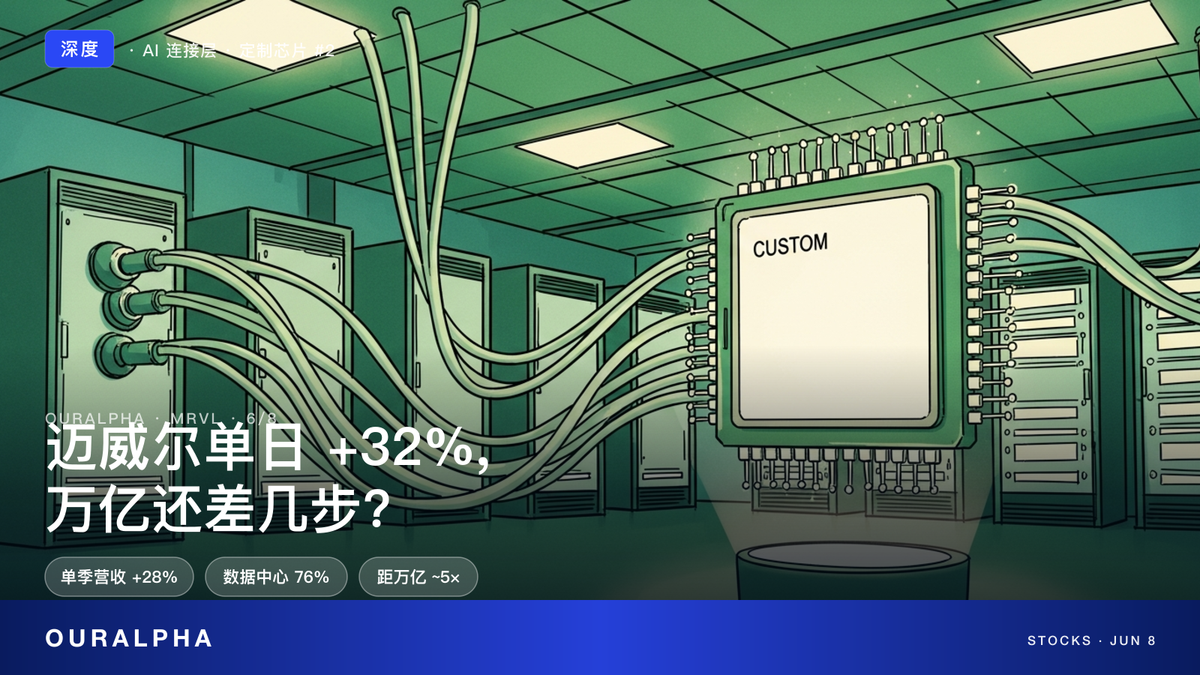
Huang's One Line Sent Marvell Up 32% — How Far Is the Trillion-Dollar Club?
Jensen Huang called Marvell "the next trillion-dollar company" at Computex, triggering its biggest-ever single-day surge. Now the question is whether the fundamentals can actually back the valuation.
TL;DR · The One-Sentence Narrative
At Computex in Taipei on June 2, Jensen Huang told the Marvell (MRVL) CEO to his face: "The next trillion-dollar company is right here." The stock surged +32.52% that day — its largest single-day gain on record. Three days later (6/5), a broad chip selloff erased 8% of that gain. The move and the reversal both ask the same question: do the fundamentals justify the valuation?
- Fundamentals are genuinely accelerating: Q1 FY2027 (reported 5/27) revenue $2.418B, +28% YoY, a record; data center revenue $1.833B, 76% of mix; Q2 guidance $2.7B (+35% YoY) with explicit "sequential acceleration" language[SEC 8-K]
- But this isn't "the next Nvidia" — the right comp is Broadcom (AVGO): together the two control ~95% of the custom AI ASIC co-design market; Broadcom holds ~70% and Marvell is a solid #2[Tom's Hardware]
- The trillion-dollar thesis lives or dies on margins: Broadcom's non-GAAP operating margin is ~60%; Marvell's is currently in the high-20s to low-30s. Getting from ~$200B to $1T (4–5x) requires AI revenue to multiply several times over, margins to converge toward Broadcom's, or — ideally — both
- Jensen's comment moved sentiment, not fundamentals: Nvidia already made a $2B investment + NVLink Fusion partnership in March. Sell-side targets range from Stifel's Street-high $321 to $650–700 under a "Broadcom-parity re-rating" scenario — the spread itself tells you: $1T is an option, not a base case
On June 2, one sentence from Jensen Huang re-priced Marvell from "AI networking/optical interconnect supplier" to "the next Broadcom." What Jensen was praising — Marvell's connectivity chips (networking + optical interconnect) being indispensable to AI data centers — is true. But "$1 trillion" requires something else: Marvell needs to pull operating margins from ~30% up toward Broadcom's ~60%, while holding or gaining #2 share in a market Broadcom owns 70% of.
The question isn't whether Jensen is a bull — it's whether this company's earnings quality can match the scale of its AI revenue. Q1 +28%, data center at 76%, Q2 guidance +35% with sequential acceleration — these are A-grade facts that confirm the revenue story is real. But the GAAP operating margin (GAAP net income just $34.5M, EPS $0.04 this quarter) says Marvell is currently high-growth, thin-margin. The trillion thesis is a bet on the profit side catching up. That's the real source of the $321 vs. $650 target price divergence.
OurAlpha Ratings
| Dimension | Score | Notes |
|---|---|---|
| News Intensity | 9/10 | Jensen's trillion-dollar call + record single-day +32.52% + record Q1 earnings + Nvidia's $2B investment — all stacking at once |
| Market Sentiment | 6/10 | Sell-side consensus Strong Buy (26 Buy / 4 Hold), but the 8% reversal on 6/5 after the 6/2 surge shows amplified sentiment and heightened volatility |
| Trend | 8/10 | Data center at 76% and sequentially accelerating; growth will naturally moderate as the base scales |
| Retail Risk | 6/10 | A name that can gap 32% on one sentence can reverse on one sentence too; GAAP profits are razor-thin and the valuation rests entirely on future margin expansion |
Composite 7.25/10 — the revenue story is real, but "$1 trillion" is an option not a fact; this isn't a spot to chase blindly.
A few terms upfront (each will be flagged again on first use):
- ASIC (Application-Specific Integrated Circuit): a chip custom-built for a specific customer and workload. Unlike Nvidia's general-purpose GPU accelerators, an ASIC is something like "Amazon's proprietary AI chip built only for Amazon." Marvell and Broadcom handle the design and fab coordination for cloud customers.
- Custom AI ASIC co-design (custom silicon / ASIC co-design): Cloud providers (Amazon, Google, Microsoft, Meta) define the requirements; Marvell/Broadcom supply the design expertise and interface with TSMC's fabs. This is the core of Marvell's data center business.
- Optical interconnect / electro-optics: Thousands of accelerators inside an AI data center communicate via optical signals. Marvell's optical DSPs and 800G/1.6T optical module chips are key suppliers here; the February acquisition of Celestial AI fills the co-packaged optics (CPO) gap.
- NVLink Fusion: Nvidia's program to open its high-speed NVLink interconnect to third-party partners, allowing custom chips to plug into the Nvidia AI factory ecosystem. Marvell's March partnership with Nvidia uses this pathway.
- Non-GAAP operating margin: Operating margin after stripping out stock-based compensation, M&A amortization, and other non-recurring items — the standard lens for assessing semiconductor profitability. Broadcom ~60%; Marvell ~high-20s to low-30s.
- FY2027 / Q1 FY2027: Marvell's fiscal year runs roughly 11 months ahead of the calendar year — FY2027 spans approximately February 2026 to January 2027. Q1 FY2027 covers February–April 2026, reported May 27; Q2 FY2027 ends August 1, 2026.
I. June 2 — That One Quote: How a Single Day's +32% Happened
The event itself is straightforward — but it's worth separating the sentiment-driven move from the fundamentals.
At Computex 2026 in Taipei on June 2, Nvidia CEO Jensen Huang made the remark onstage, directly in front of Marvell's Chairman and CEO Matt Murphy: "The next trillion-dollar company, ladies and gentlemen."[CNBC]
The market's reaction was a textbook case of sentiment-driven repricing:
| Metric | Value | Notes |
|---|---|---|
| 6/2 Single-Day Gain | +32.52% | Marvell's largest single-day gain on record (per CNBC) |
| 6/2 Closing Price | ~$291 | Briefly touched nearly $300 intraday |
| Market Cap | ~$190–250B | Varies by timing/methodology; CNBC's 6/2 article cited ~$191B[CNBC] |
| Distance to $1T | ~4–5× | Depends on market cap methodology |
Why Jensen Huang's remark carried such weight:
- This wasn't idle praise — it was an insider endorsement backed by a real business relationship. In March, Nvidia had just taken a $2B stake in Marvell and brought it into the NVLink Fusion ecosystem (see Section VI for details). Huang was endorsing a company Nvidia had both invested in and partnered with; the market read it as a double confirmation — money plus a public seal of approval.
- He called out the underappreciated interconnect layer. Huang emphasized that Marvell's networking and connectivity chips are indispensable in data centers where compute is distributed across tens of thousands of chips. That shifted market attention from "single-GPU performance" to "how those GPUs talk to each other."
- The comment landed squarely on 2026's hottest secondary narrative: custom AI chips (ASICs) + optical interconnects — a core answer to the question of who else is monetizing AI infrastructure beyond Nvidia.
But the three-day reversal matters just as much: on June 5, Broadcom's earnings triggered a broad chip selloff — the Nasdaq dropped 4% on the day — and Marvell gave back roughly 8%. Within the same week, a single quote could send it up 32% and someone else's earnings report could knock it down 8%. That tells you sentiment carries an outsized weight in the current valuation.
OurAlpha Take: The June 2 surge wasn't a fundamental shift — Marvell's earnings had already dropped on May 27. It was a sentiment-driven repricing of "what Marvell is worth." These single-event repricings move fast in both directions. To judge whether the new level holds, you have to go back to the fundamentals — which is exactly what the next few sections do.
II. Q1 FY2027 Earnings: Revenue Backs Up the Story
Start with the hard data. Marvell's Q1 FY2027 results (period ending early May 2026), reported May 27, are the foundation underpinning the entire thesis.
Key Metrics (per SEC 8-K):
| Metric | Q1 FY2027 | YoY | Notes |
|---|---|---|---|
| Total Revenue | $2.418B | +28% | Record high |
| Data Center Revenue | $1.833B | — | 76% of revenue |
| Carrier & Other | $585M | — | 24% of revenue |
| GAAP Gross Margin | 52.1% | — | — |
| Non-GAAP Gross Margin | 58.9% | — | — |
| GAAP Net Income | $34.5M | — | GAAP EPS $0.04 |
| Non-GAAP Net Income | $718M | — | Non-GAAP EPS $0.80 |
| Operating Cash Flow | $639M | — | Record |
Source: Marvell Q1 FY2027 8-K / press release[SEC EDGAR].
Three takeaways:
- Data center at 76% and still expanding — three years ago Marvell was a diversified comms chip company with a hand in everything (5G, automotive, enterprise networking, storage). Data center now accounts for three-quarters of revenue; the company has effectively re-platformed as an AI infrastructure chipmaker. That is the root cause of the valuation re-rating.
- The GAAP / non-GAAP spread is enormous — GAAP net income is just $34.5M (EPS $0.04); non-GAAP net income is $718M (EPS $0.80). A 20x gap. The delta is primarily stock-based compensation plus amortization from two acquisitions (Celestial AI, XConn). This is the setup for the trillion-dollar question: Marvell is high-growth but nearly break-even on a GAAP basis.
- Q2 guidance explicitly signals sequential acceleration — management guided Q2 FY2027 revenue to $2.7B (±5%), +35% YoY, with non-GAAP gross margin ~58.25% and non-GAAP EPS of $0.93, explicitly stating they expect "revenue growth to accelerate sequentially throughout FY2027, driven by continued strength in data center"[SEC 8-K]. The step-up from +28% to +35% is a strong signal.
OurAlpha take: The revenue story is real — +28% accelerating to +35%, data center at 76%: these are Grade-A facts, not narrative. But keep point two in mind: GAAP profitability is razor-thin. The market is currently paying for the belief that margins will expand. Whether that bet holds up is what Sections IV and V address.
三、What Marvell Actually Sells: The "Plumbing" That Connects AI Data Centers
Before buying into the trillion-dollar narrative, you need to understand exactly where Marvell sits in the AI supply chain.
Nvidia sells GPUs — the "brains" of AI data centers. Marvell doesn't sell brains. It sells the pipes and blueprints that let thousands of brains talk to each other, and helps cloud hyperscalers build their own custom brains. Three business lines:
① Custom AI Silicon (ASIC co-design) — the fastest-growing engine
Hyperscalers don't want to be permanently dependent on Nvidia's general-purpose GPUs (expensive and a single point of supplier risk), so they're designing their own AI chips. But they lack world-class chip design capability and TSMC tape-out expertise, so they outsource the design and bring-up to Marvell and Broadcom. Marvell's key customers:
- Amazon Trainium — the single largest contributor to Marvell's data center ASIC revenue, with visibility extending to Trainium3 in 2026 and beyond[HeyGoTrade]
- Microsoft Maia — Marvell provides silicon IP and back-end design services for Microsoft's Maia AI accelerator
- Google — reportedly in talks with Marvell to bring it into a new AI inference chip program, running in parallel with Broadcom's TPU engagement[TNW]
② Optical Interconnect / Electro-Optics — the link Jensen Huang called out by name
Inside an AI cluster, GPUs communicate with each other and rack-to-rack via high-speed optical signals. Marvell's optical DSPs and 800G/1.6T optical module chipsets make it one of the leaders here. The February 2 close of the Celestial AI acquisition (co-packaged optics / CPO technology) is the move to bring photonics from outside the rack to right next to the die — the critical bottleneck for next-generation AI data centers.
③ Networking & Switching (Ethernet / switch silicon)
Intra-data-center Ethernet switching and network interface chips. The February 10 acquisition of XConn (CXL interconnect technology) fills in the "memory-compute disaggregation" piece of the stack.
OurAlpha Take: Marvell's positioning is "connectivity layer + custom silicon foundry for AI data centers." The advantage of this seat is that as long as AI capex keeps climbing, Marvell gets paid regardless of whether Nvidia wins or hyperscalers' in-house designs win — it's supplying both the "build-your-own" camp (Amazon) and the "Nvidia ecosystem" camp simultaneously. The downside: this position carries structurally weaker pricing power than Nvidia, which is the root cause of the margin ceiling.
四、博通的影子:#2 的天花板,也是 #2 的机会
Marvell's true benchmark isn't Nvidia — it's Broadcom. This section covers the most critical competitive dynamics in the entire piece.
Custom AI chip market structure (third-party research estimates):
| Vendor | Custom AI Accelerator Market Share | Key Customers |
|---|---|---|
| Broadcom (AVGO) | ~70% | Google TPU, Meta MTIA |
| Marvell (MRVL) | Entrenched #2 | Amazon Trainium, Microsoft Maia |
| Combined | ~95% of the ASIC design market | — |
Source: Tom's Hardware May 2026 custom ASIC landscape overview[Tom's Hardware]. Share figures are industry channel estimates, not company-disclosed data.
Scale comparison (the sobering part):
- Marvell's AI ASIC revenue is projected to reach up to ~$11B in 2026
- Broadcom's AI segment alone carries a $73B backlog and is targeting $100B in annual AI chip revenue by 2027[Tom's Hardware]
In other words: Broadcom's AI business is roughly 10x the size of Marvell's. The "next Broadcom" narrative implicitly requires Marvell to multiply several times over just to reach where Broadcom stands today.
So where does the #2 opportunity lie:
- A growing pie feeds #2 too — the custom AI chip market is expanding rapidly through 2026–2028; even with no share shift, Marvell's absolute revenue can keep doubling
- Multi-sourcing is a hard requirement for hyperscalers — Amazon and Google have no interest in single-vendor dependency on Broadcom, locking in committed order flow for Marvell
- Margin re-rating potential (see Section 5) — precisely because Marvell's margins lag, the upside optionality if it closes the gap with Broadcom is that much larger; this is the core of the bull case
OurAlpha take: Framing Marvell as "the #2 custom AI chip player + a leader in optical interconnect" is a more grounded read than "the next trillion-dollar company." In a fast-growing, duopoly-dominated market where two players control 95% of share, holding the #2 spot is a strong position — but between #2 and the trillion-dollar club stands one entire Broadcom.
V. Margins: The Trillion-Dollar Narrative's Real Achilles Heel
Section II left a thread dangling: Marvell's GAAP net margin is razor-thin. This section pulls on it — because that gap is the root cause of the spread between the $321 and $650 price targets.
Earnings quality: a side-by-side:
| Metric | Marvell (MRVL) | Broadcom (AVGO) |
|---|---|---|
| Non-GAAP Gross Margin | ~58.9% (Q1 FY2027) | Higher |
| Non-GAAP Operating Margin | ~High-20s to Low-30s% | ~60% |
| GAAP Net Margin | Razor-thin (GAAP EPS $0.04 this quarter) | Materially higher |
Sources: Marvell gross margin from SEC 8-K; operating margin comparison from HeyGoTrade industry analysis[HeyGoTrade], estimated on an adjusted basis.
Why the gap is so wide:
- Broadcom has pricing power and scale — its AI business is nearly 10x Marvell's in revenue, spreading fixed R&D over a far larger base; its software segment (VMware) also provides a high-margin ballast
- Marvell is still in "invest-for-growth" mode — heavy R&D spend, integration costs from two acquisitions, and aggressive pricing to win share
- Custom ASIC design inherently carries thinner margins than selling off-the-shelf GPUs — that's a structural feature of the business model: when you build a chip for a customer's own use, your negotiating leverage is structurally weaker than Nvidia's selling general-purpose silicon
What this means for the trillion-dollar narrative:
A trillion-dollar market cap ≈ 4–5x from here. There are only two paths — and ideally both happen at once:
- Path A (revenue multiplication): AI ASIC revenue scales from ~$11B toward $30–40B — requiring share gains from Broadcom, or a 3–4x expansion of the total addressable market
- Path B (margin convergence): Operating margins climb from ~30% toward ~60% — which would roughly double earnings on the same revenue base and re-rate the valuation multiple
The bull case ($650–700) bets on A+B simultaneously: rapid revenue scaling paired with a margin re-rating to Broadcom's tier. The bear/base case (~$321) bets on partial A, slow B: revenue continues to double, but margins stay suppressed by Marvell's #2 position and competitive dynamics — never quite reaching Broadcom's level.
OurAlpha's take: The revenue story (Path A) is credible — data center up 76% and accelerating each quarter speaks for itself. But the margin story (Path B) is a bet, not a given. Historically, for a #2 player to match a #1's margins, market structure usually has to shift in its favor — the leader stumbles, or the challenger lands a defining anchor client. Until that happens, treating margin re-rating as inevitable is a dangerous assumption. This is the core reason we score Marvell 7.25 rather than higher.
VI. Nvidia's $2B Stake: Ally or Dependency
Jensen Huang's remarks weren't an isolated event — they reflect a deeper structural tie. To judge whether that tie is a tailwind or a risk, the structure needs to be understood clearly.
Three dimensions of the tie:
- March 2026: Nvidia invested $2B in Marvell and integrated Marvell into its AI factory and AI-RAN ecosystem via NVLink Fusion[CNBC]
- June 2, Huang publicly endorsed the "trillion-dollar" thesis — effectively giving Marvell a double endorsement of capital and credibility
- At the business level: Marvell's optical interconnects and networking chips are already integral to Nvidia's AI cluster stack
The bull case:
- Nvidia is the undisputed center of AI compute — being named its "strategic partner and investment target" is effectively a ticket into the ecosystem
- NVLink Fusion lets Marvell's custom silicon plug into the Nvidia stack, expanding its addressable market
The risks (easy for the market to overlook):
- Aligning with Nvidia means partially ceding neutrality — Marvell also serves hyperscalers pursuing in-house silicon (Amazon, Google looking to route around Nvidia). Deep alignment with Nvidia could compromise its image as a neutral supplier in the "anti-Nvidia" camp
- Reflexivity of the endorsement — a single comment that can send the stock up 32% means any shift in Nvidia's tone (even just going quiet) will be amplified into a negative catalyst
- The $2B stake is not a controlling position relative to Marvell's scale — it's a strategic signal, not an operational takeover. Avoid over-reading this as "Nvidia taking over Marvell"
OurAlpha's take: Nvidia's alignment is a net positive for now — it provides order visibility and a valuation catalyst. But stay clear-eyed: this is a relationship where getting name-dropped sends the stock up and being ignored sends it down. Treating Nvidia's endorsement as part of Marvell's fundamentals is a mistake; it's a sentiment catalyst. The real foundation is still ASIC order flow and margins from Amazon, Microsoft, and Google.
VII. Wall Street Price Targets: The $321 Street High and the $650 "Re-rating Dream"
Sell-side upgrades flooded in after Computex, but the wide dispersion is itself the signal.
Selected sell-side moves post-Computex:
| Firm | New Target | Prior Target | Rationale |
|---|---|---|---|
| Stifel (Tore Svanberg) | $321 (Street high) | $230 | Market increasingly receptive to MRVL's positioning within the data center / AI supercycle[TipRanks] |
| Unnamed firm (near-term) | $400 | — | ~+30% vs. 6/2 close[MarketWise] |
| Unnamed firm (long-term) | $650–700 | — | Assumes Marvell re-rates to Broadcom-tier industry leader status (~+130%) |
| Another firm | $375 | — | Higher growth estimates + multiple expansion on EV/EBITDA |
⚠️ The targets above are Tier-D estimates (sell-side report basis) and will shift across sources and dates. Consensus "average price targets" on aggregator platforms will be revised upward quickly following 6/2 — always note the query date when citing any average.
Two things to keep in mind when consuming these numbers:
- Consensus is Strong Buy (26 Buy / 4 Hold) — the street is broadly bullish, but "bullish" and "trillion-dollar bull" are not the same thing. Most targets cluster in the $300–400 range, well below the levels implied by a $1T market cap
- $650–700 is explicitly conditional — it rests on the premise that Marvell re-rates to Broadcom-tier status. That maps directly to Section V: the trillion-dollar narrative is an option on a margin/status re-rating, not the base case
OurAlpha Take: The distribution of price targets tells you everything — the mainstream is clustered at $300–400 (fair value for the revenue story), while $650+ prices in "what if it becomes Broadcom." Retail investors should focus not on the highest number, but on the shape of the distribution: most analysts are buying the revenue story; a few are betting on a re-rating option.
八、From $200B to $1T: What Needs to Happen
Breaking the trillion-dollar thesis into verifiable conditions is far more useful than remembering "Jensen Huang is bullish." Buying Marvell means betting on all of the following simultaneously:
- AI capex stays elevated through 2026–2028 — this is the foundation; any sign of hyperscaler capex deceleration will hit Marvell first, given its high-beta exposure
- The custom AI chip (ASIC) market keeps expanding rapidly — the pie needs to be large enough for a #2 player to eat well
- Marvell holds or grows its #2 share — Amazon Trainium and Microsoft Maia orders don't walk, and ideally Marvell wins Google inference silicon too
- Operating margins converge from ~30% toward Broadcom's ~60% — the hardest piece of the trillion-dollar thesis, and the most critical
- Optical interconnects (Celestial AI / CPO) become a second growth curve — monetizing the value of the "connectivity layer" into actual revenue
- The Nvidia relationship stays net positive — no forced side-taking as "in-house silicon" customers proliferate
- Valuation multiples hold — the AI narrative doesn't deflate, and the market keeps paying a premium
Not all seven need to go right — but condition #4 (margins) is the on/off switch for the trillion-dollar thesis. The first three (revenue) will likely materialize, which supports a reasonable range of $300–400; condition #4 is what unlocks $650–700 and the trillion-dollar threshold.
IX. Bearish Setups: What Could Break the Thesis
Every thesis needs its bear case. Scenarios that could unwind Marvell's current valuation:
- A meaningful deceleration in data center growth — if guidance shifts from "accelerating quarter-over-quarter" to "flat sequentially," the market will immediately question the AI ASIC ceiling, implying a 15–25% near-term pullback
- Broadcom further squeezes the #2 slot — if Amazon or Microsoft shift more share to Broadcom, or Broadcom poaches Marvell's existing customers, the "stable duopoly" narrative cracks
- Margin expansion stalls — if non-GAAP operating margins remain stuck around 30% for several quarters, the market will reprice to zero the option value of "re-rating to Broadcom's level," and the $650 ceiling disappears
- Signs of a hyperscaler capex peak — a systemic risk for the entire AI infrastructure chain; Marvell, with its higher beta, would be first in the line of fire
- The Nvidia relationship sours — even if Jensen Huang simply stops mentioning Marvell publicly, or Marvell faces subtle pushback for serving "anti-Nvidia" customers, the sentiment premium reverses
- Lock-up expiry / valuation digestion — after a 32% single-session gain, any profit-taking or broader risk-off move will hit high-multiple names first
- Integration disappointments on the two acquisitions (Celestial AI / XConn) — dragging out the timeline for margin improvement
OurAlpha View: Marvell is not a "bubble" — it has real, accelerating AI revenue. But its current price already pays for part of a story that hasn't happened yet: becoming the next Broadcom. That means high volatility in both directions: good news (winning Google, a margin step-up) can push it further; bad news (growth slowdown, margins stuck) can snap it back just as fast.
十、回到原点:买迈威尔等于在押什么
At current levels (closed $291 on 6/2, gave back 8% on 6/5) with a market cap just north of $200B, buying Marvell is essentially a bet on:
- The high-conviction part: AI datacenter interconnect + custom silicon #2 revenue continues to double — this supports a fair value of $300–400
- The speculative part: margins converge with Broadcom's and share approaches the industry leader — this supports a $650–700 or higher "trillion-dollar option"
Bottom line: Marvell's revenue story is real; the trillion-dollar story is an option. Jensen Huang's comment lit a fire under the latter, but cashing in on it requires margin expansion — and margins are the thinnest link in this company's chain right now. Until there's an answer to "can the #2 player achieve #1-level margins," Marvell will remain a stock with solid fundamentals but violent volatility, propped up by future optionality. Chasing it means living with a name that can rip or crater on a single soundbite.
About Data Sourcing
This article uses OurAlpha's four-tier data reliability framework:
- Tier A (Official Disclosures): Marvell Q1 FY2027 press release / SEC 8-K — all revenue figures ($2.418B), data center revenue ($1.833B, 76%), gross margins (GAAP 52.1% / non-GAAP 58.9%), EPS, operating cash flow, and Q2 guidance ($2.7B / +35% / sequential acceleration) are sourced from this tier
- Tier B (Management Commentary): Direct quotes from Matt Murphy on the earnings call — "FY2027 sequential acceleration driven by data center" falls under this tier
- Tier C (Mainstream Financial Media + Industry Trackers): CNBC (Huang's remarks / +32.52% / $2B stake / market cap figures), Tom's Hardware (70% / 95% share, $11B vs $73B backlog), TNW (Google negotiations) — used to present events and industry landscape
- Tier D (Sell-Side Reports / Analyst Estimates): Stifel price targets of $321, $400 / $650–700 / $375; Broadcom vs. Marvell operating margin estimates — all "sell-side price targets" and "margin ~X%" figures in this article fall under this tier and do not underpin core conclusions
Core conclusions (revenue acceleration, data center mix, Q2 guidance) are supported by Tier A/B data; competitive share figures, price targets, and margin comparisons are Tier C/D, presented to illustrate the challenges behind the "trillion-dollar narrative." Readers should clearly distinguish between hard numbers and analyst assumptions.
Sources
- Marvell Technology Reports First Quarter of Fiscal Year 2027 Financial Results — SEC EDGAR 8-K
- Nvidia's Jensen Huang says Marvell could be the next trillion-dollar company; stock jumps — CNBC
- The custom AI ASIC state of play (May 2026) — Broadcom deals, Google TPUs, Meta MTIA — Tom's Hardware
- Broadcom vs Marvell: Custom AI Silicon Battle 2026 — HeyGoTrade
- Marvell (MRVL): The Custom AI Silicon Story Beyond NVDA and AVGO — HeyGoTrade
- Google in talks with Marvell to build new AI inference chips alongside Broadcom TPU programme — TNW
- Top Stifel Analyst Lifts Marvell Price Target to Street-High of $321 after Computex — TipRanks
- My Marvell Stock Price Target After Jensen Huang's Trillion-Dollar Call — MarketWise
This content is for informational purposes only and does not constitute investment advice, trading advice, or any guarantee of returns.