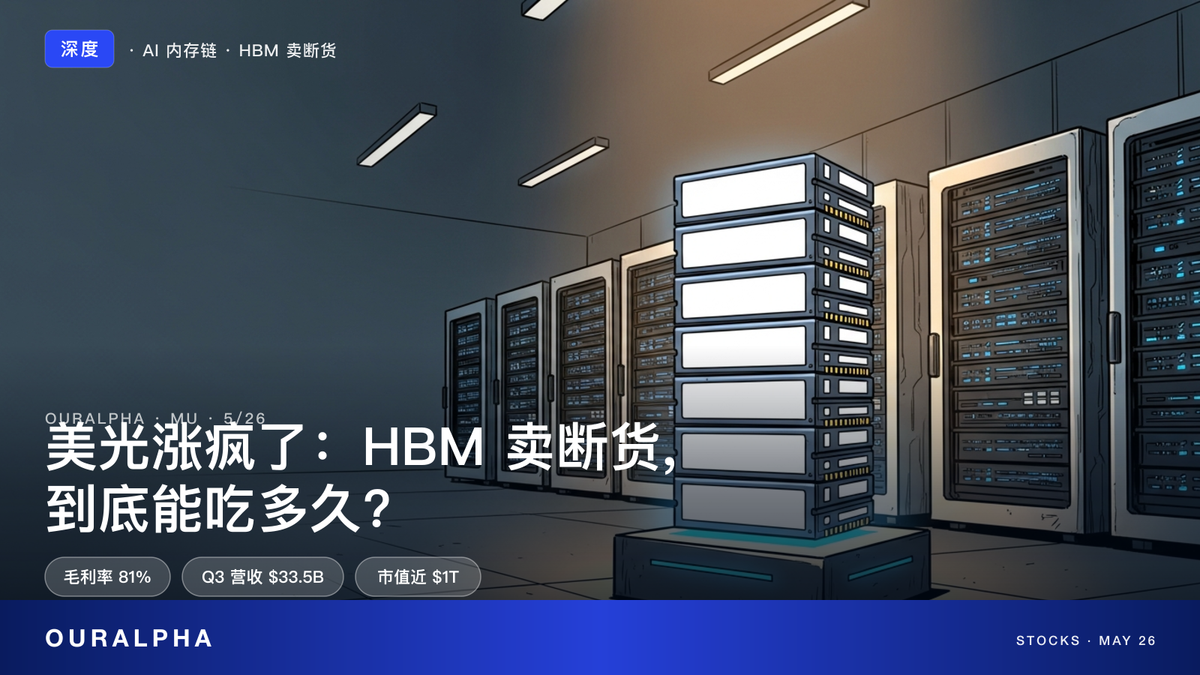
Micron's Wild Ride: HBM Is Sold Out — But How Long Can the Boom Last?
Micron's stock is up 189% YTD with gross margins surging toward 81% — but with UBS targeting $1,625 and Citi at $840, Wall Street can't agree on how long the good times roll. The real story isn't beating SK Hynix; it's riding an 18–24 month DRAM supply vacuum.
TL;DR · The One-Line Narrative
Two months. Micron (MU) up +189% YTD, market cap closing in on $1T; gross margin has run from ~40% last year all the way to Q3 guidance of 81%. But UBS is at $1,625 and Citi at $840——a near-2x spread, and the debate is entirely about sustainability.
- Q3 FY26 Guidance: Revenue $33.5B (QoQ +40%), gross margin ~81%, EPS $19.15——a rare beat-and-raise of historic proportions for the semiconductor industry[SEC 8-K]
- Macro Backdrop: TrendForce revised its Q1 2026 conventional DRAM price-hike forecast up from 55–60% to 90–95% in February, with PC DRAM at +100%+——HBM consuming wafer capacity + simultaneous shortages across server, PC, and mobile[TrendForce]
- But the real story isn't "beating SK Hynix"——it's catching the windfall of being the #2 player sold out in an 18–24 month supply vacuum. HBM share (third-party estimates): SK Hynix ~62% / Micron ~21% / Samsung ~17%
- Current Pricing: $853.98 intraday on 5/26 (+13.71%), market cap ~$957B; UBS $1,625 (5/26) / Citi $840 (5/19) / HSBC $1,100 / Melius $1,100——top analysts nearly a 2x apart
What's actually re-rating Micron isn't "landing NVDA Rubin as primary HBM supplier"——that battle is almost certainly lost for HBM4. What's re-rating it is that the entire DRAM industry has no capacity relief for the next two years: HBM ties up far more wafer starts, advanced packaging, and test capacity than conventional DRAM, so as all three vendors pile into HBM, conventional DRAM for PCs, servers, and mobile goes short and reprices sharply. Micron happened to be in the right place when an 18–24 month supply vacuum opened up.
The question, then, isn't "can Micron get to 30% HBM share?" It's how many quarters these 70%+ gross margins can hold. The DRAM industry has almost never sustained margins at this level for long——and that is the real fault line behind the UBS $1,625 vs. Citi $840 debate.
OurAlpha Scorecard
| Dimension | Score | Notes |
|---|---|---|
| News Intensity | 9/10 | Record-breaking Q2 print + Q3 81% gross margin guide + UBS/Citi/HSBC/Melius all upgrading the same week——five major catalysts converging at once |
| Market Sentiment | 7/10 | Sell-side consensus Strong Buy, but the 5/26 gap-up amplifies near-term volatility; a lot of good news already in the price |
| Trend Strength | 8/10 | DRAM market + HBM both in upcycles; but base effects start biting from FY27 onward |
| Retail Risk | 7/10 | YTD +189%, past month +67%——the setup is now "high valuation + high capex intensity," which amplifies drawdowns |
Composite 7.75/10 — the story is still accelerating, but this is no longer a no-brainer entry.
Key Terms (defined once here, flagged again on first use in the article):
- DRAM (Dynamic Random-Access Memory): The main memory in PCs, smartphones, and servers. Micron, Samsung, and SK Hynix together control 95%+ of global DRAM capacity.
- HBM (High Bandwidth Memory): A premium form of DRAM——8 or 12 DRAM dies stacked vertically via TSV (through-silicon via) and assembled with advanced packaging, purpose-built for AI accelerators. Per-bit value is a multiple of conventional DRAM. The current mainstream standard is HBM3E (used in NVDA H200/B200/B300); the next generation is HBM4 (designed for NVDA Rubin).
- NVDA Rubin / Vera Rubin: NVIDIA's next-generation AI accelerator platform after Blackwell, ramping H2 2026, with HBM4 as the key memory component.
- Capex (capital expenditure): Spending on fabs and equipment.
- FY26 / Q3 FY26: Micron's fiscal year runs September–August, so FY26 = September 2025 through August 2026. Q3 FY26 covers March–May 2026; earnings are expected late June.
I. Q2 FY26 Earnings: The Inflection Point from "Cyclical" to "AI Capacity Play"
The Q2 FY26 results released after the close on March 18 are the most structurally significant earnings report Micron has put out in nearly 20 years.
Key Metrics:
| Metric | Q2 FY26 Actual | Consensus Estimate | Historical Context |
|---|---|---|---|
| Revenue | $23.86B | $20.2B | Massive beat |
| GAAP Gross Margin | 74.4% | — | Historical average ~30–40% |
| Non-GAAP Gross Margin | 74.9% | — | — |
| Operating Margin | 68.9% | — | — |
| GAAP EPS | $12.07 | — | — |
| Non-GAAP EPS | $12.20 | — | — |
| Operating Cash Flow | $11.90B | — | Prior quarter: $8.41B |
| Dividend Increase | +30% | — | — |
Source: Micron Q2 FY26 IR press release / SEC 8-K filing.
Why This Is a Structural Inflection Point:
- 74–75% gross margins are at the extreme upper end of DRAM cycle history — at the peak of the prior cycle (end of FY2018), Micron's GAAP gross margin was roughly 60%. The current reading is ~15 percentage points above that previous peak. The driver is a combination of HBM unit margins that far exceed conventional DRAM, plus a broad-based lift in contract pricing across the DRAM market.
- A single quarter of $23.86B annualizes to ~$95B — Micron's best full year over the past decade (FY2022) came in at $30.76B. In other words, one quarter's revenue now exceeds three-quarters of the best full year on record.
- Operating cash flow of $11.9B — this marks the first time Micron has broken out of its long-standing reputation as a capex-heavy, cash-strapped business. That said, the other side of the ledger is a significant FY26 capex increase (see Section IV).
- First 5-year long-term customer agreement: also disclosed on March 18, this "first 5-year customer deal" reflects a broader shift in memory procurement contracts from the traditional 1–2-year term to 3–5 years. Micron's publicly disclosed deal is a landmark example of this emerging trend.
- 30% dividend increase — management is using capital returns to signal a transition from cyclical stock to a company with stable, recurring shareholder distributions.
OurAlpha Take: The real signal from the Q2 report is not the individual quarter's numbers, but the fact that management did three things simultaneously — long-term contracts + 30% dividend hike + capex guidance raise — to declare that this cycle is different. That said, there remains a gap between what management declares and what the market believes: the stock hit an all-time high of $803 on 5/13, then pushed to $853 on 5/26, and that price trajectory itself reflects the market stress-testing the "durability" narrative.
II. Q3 FY26 Guidance — 81% Gross Margin: How Long Can This Hold?
The real bombshell in the Q2 earnings wasn't Q2 itself — it was the Q3 guidance:
Revenue $33.5B ± $750M, non-GAAP gross margin ~81%, non-GAAP EPS $19.15 ± $0.40
Revenue up ~40% sequentially, with gross margin expanding another 6 percentage points. This is forward guidance, not results already in the books — yet guidance of this caliber is virtually without precedent in the semiconductor industry.
What 81% gross margin actually means:
- Among software companies, this is Adobe / Salesforce / ServiceNow territory
- In semiconductors, NVIDIA's Q4 FY26 GAAP gross margin was 75.0%; TSMC's full-year 2025 gross margin was roughly 56%
- Micron itself last came close to this level in FY2018 (~60%) — it has never touched 81%
What's supporting this margin:
- HBM unit margins are far above conventional DRAM — HBM's TSV stacking, advanced packaging, and more demanding test requirements drive unit value several multiples above standard DDR5; as HBM's revenue mix rises, blended gross margin follows
- Conventional DRAM contract prices are simultaneously surging (see Section III)
- Samsung, SK Hynix, and Micron collectively control 95%+ of global DRAM capacity and are all executing the same capacity transition — this is oligopoly discipline, not a single player going rogue
- New capacity won't come online until late 2027 at the earliest — a hard physical constraint on supply
Where this margin is vulnerable:
- Historically, the DRAM industry has rarely sustained 60%+ GAAP gross margins (per Macrotrends historical financials) — this is the physical law of industry cycles
- Price elasticity will bite back at some point — Microsoft, Google, Meta, and Amazon are currently signing long-term contracts at higher prices, but renegotiations at renewal will be tough
- Management only guided through Q3 — no Q4 FY26 or FY27 outlook was provided — which is itself management preserving optionality
OurAlpha's Take: Treating 81% as a fait accompli is reasonable — management wouldn't guide this boldly and miss badly. But extrapolating this level as steady-state for the next eight quarters is overly optimistic. The reasonable base case: FY26 full-year gross margin holds above 70%, H1 FY27 stays in the 70–75% range, with mean reversion beginning in H2 FY27. The pace of reversion depends on when the next wave of new capacity actually ships — if that's H1 2028, H2 FY27 will feel the pressure.
III. The DRAM Market Isn't Just Rising — It's a "DRAMpocalypse"
Section II covered HBM unit gross margins. This section covers the conventional DRAM market — the real backdrop behind Micron's current gross margin guidance of 81%.
TrendForce's two upward revisions to its Q1 2026 DRAM price forecast:
| Date | Conventional DRAM Contract Price — Projected Q1 QoQ Change |
|---|---|
| January 5, 2026 (original estimate) | +55%–+60% QoQ (server DRAM above +60%) |
| February 2, 2026 (revised estimate) | +90%–+95% QoQ |
Sources: TrendForce memory price outlooks published in January and February, as reported concurrently by Reuters[TrendForce].
Other figures from the same February revision:
- PC DRAM Q1 forecast: above +100% QoQ (a historical record)
- LPDDR4X / LPDDR5X (mobile low-power DRAM): ~+90% QoQ
- NAND Flash contract price: revised up from 33–38% to 55–60% QoQ
Why DRAM prices are surging across the board:
- HBM is crowding out wafer capacity — HBM consumes significantly more wafer output, advanced packaging, and test capacity than conventional DRAM. As all three suppliers shift capacity toward HBM, conventional DRAM supply gets squeezed
- AI demand is shifting the server DRAM demand curve upward — hyperscalers (Microsoft, Google, Amazon, Meta) expanding AI training and inference clusters require massive amounts of server DRAM
- Customers are panic-buying — PC OEMs and smartphone brands, seeing prices double QoQ in consecutive quarters, are pulling in orders and passing costs downstream
- New capacity won't come online until late 2027 — Micron, Samsung, and SK Hynix all have new fabs under construction, but shipments remain years away
Implications for Micron:
- Micron's ~21% HBM share running at full utilization, combined with conventional DRAM contract prices roughly doubling — both factors together are what produce the 81% gross margin
- Looking at HBM alone gives you an incomplete valuation story
- Looking at the broader DRAM market alone also gives you an incomplete valuation story
On May 19, Citi raised its price target on Micron in one move from $425 to $840 — sell-side analyst Atif Malik's trigger was Micron following Samsung's lead with a ~100% Q1 price increase and raising DRAM prices a further 40% in calendar Q2[TradingKey]. This is a clear signal that the DRAM pricing cycle is already being priced into Micron's earnings.
IV. HBM4 vs. Rubin: Micron Isn't the Winner — But #2 Pays Just Fine
This is the most commonly misread narrative in the market: Micron's recent stock surge is not because "HBM4 captured the primary supply slot on NVIDIA's Rubin."
Current HBM market share (third-party research estimates, Q2 2025 basis):
| Vendor | Overall HBM Share (3rd-party est.) | NVIDIA Active HBM Primary Supplier |
|---|---|---|
| SK Hynix | ~62% | Primary (~90%) |
| Micron | ~21% | Secondary, share growing |
| Samsung | ~17% | In qualification, behind schedule |
⚠️ These figures come from supply-chain research cited by Chosun Biz / Astute Group[Astute Group] and are not official company disclosures. Revenue share, shipment share, and capacity share can differ by several percentage points depending on methodology.
On HBM4 allocation within NVIDIA Rubin:
- Micron began shipping 36GB 12-high HBM4 samples to NVIDIA in June 2025[Tom's Hardware]; all three vendors are currently in NVIDIA's evaluation process
- Most supply-chain observers expect SK Hynix to retain a dominant position in HBM supply on the Rubin platform — though specific share figures (e.g., sell-side reports citing 70%) have no publicly verifiable primary source
- Micron's HBM4 enters mass production ramp in Q2 FY26 (management guidance as of December 2025), with initial customer allocation still largely in a secondary-supplier role at NVIDIA
So what's the real story:
- Micron is not "beating SK Hynix" — that battle is unlikely to be won this generation
- Micron is "#2 with a full plate" — HBM's total addressable market is expanding to ~23% of DRAM wafer starts in 2026; that incremental volume alone is more than enough to keep #2 and #3 fully loaded
- Micron's actual earnings driver is the combination of "#2 selling out + a broad DRAM ASP cycle" — a tailwind shared by SK Hynix, Micron, and Samsung alike, differing only in magnitude
Valuation implications:
- If you anchor Micron's valuation to "displacing SK Hynix as NVIDIA Rubin's primary HBM supplier" — that thesis is hard to sustain, because it probably doesn't happen
- If you anchor to "#2 monetizing an 18–24 month supply vacuum" — current valuation is reasonable, but most of the upside has already been captured
UBS's $1,625 price target implies the former (aggressive share shift + cumulative FY27/28/29 FCF of $400B+); Citi's $840 implies the latter (fair #2 positioning + mean reversion). OurAlpha takes the latter as the base case.
V. Capex & U.S. Fabs: The Other Side of FCF
On earnings day (3/18), the stock gapped up, hit an intraday high, then faded — the market's biggest red flag wasn't Q3 guidance, it was the capex raise.
The capex trajectory requires distinguishing between official guidance and media-reported figures:
| Timeframe | Figure | Source |
|---|---|---|
| Initial guidance (end of FY25) | ~$18B | Official |
| December 2025 (Q1 FY26 earnings call) — raised | ~$20B | Official (management guidance) |
| March 2026 (post-Q2 FY26) — raised again | ~$25B+ | Media / supply-chain sources (TrendForce / Reuters / Investing.com) |
Source: Micron's Q1 FY26 prepared remarks put the official figure at ~$20B[DigiTimes]; the $25B+ figure comes from TrendForce's March 19 report[TrendForce]. Note the discrepancy between formal management guidance and media-reported numbers.
Where the capex is going:
- HBM capacity expansion — the highest-priority allocation, determining whether Micron can push HBM market share from 21% to 25%+
- 1-gamma node capacity — building out the next-generation DRAM process
- Idaho's first new fab — first wafer output pulled in to mid-2027, ahead of original guidance
- Idaho fab #2 + New York fab #1: Idaho's second fab comes online end-2028; New York's first fab breaks ground end-2026, with volume production in 2030[TheStreet]
- Total U.S. fab plan: $200B — up to 4 fabs in New York, 2 in Idaho (partially accelerated by reallocated CHIPS Act funding)
What this means for valuation:
- Current operating cash flow of $11.9B/quarter, with Q3 likely stepping higher — on an annualized basis, FY26 operating cash flow could reach $50B+
- But with $20B+ in capex, free cash flow (FCF = operating cash flow − capex) is cut by more than half
- More critically, FY27 capex will keep climbing — this isn't a one-and-done investment cycle; spending continues through 2028 before the capacity ships
- U.S. fab returns don't materialize until 2028–2030, meaning FY27/FY28 FCF cannot be extrapolated simply as revenue × margin — capex must be deducted
OurAlpha Take: UBS's $1,625 price target rests on cumulative FY27–FY29 FCF exceeding $400B[INDmoney] — which implies capex peaks in FY27 and falls sharply thereafter, while an 81% gross margin holds through FY28. Each assumption is optimistic on its own; stacked together, they price in an aggressive scenario. Citi's more conservative $840 path better reflects the base case of capex stepping higher and gross margins mean-reverting from the back half of FY27.
六、关税 / 出口管制 / 中国脱钩
Micron's China exposure is a risk vector the market has systematically underpriced.
Key facts:
- In 2023, China's CAC conducted a cybersecurity review of Micron products and declared them "failed"—ordering operators of critical information infrastructure to stop purchasing Micron products[Reuters 2023]. That ruling has never been lifted.
- Micron's mainland China revenue share has fallen sharply from its historical peak—a 2025 Reuters report cited the figure at roughly 12%. However, regional revenue can be measured multiple ways: by customer HQ location, by ship-to destination, by operating region—different methodologies can diverge by several percentage points, so the figure cannot be treated as a direct read on end-demand exposure.
- A 2025 Reuters report indicated Micron plans to exit the China datacenter server chip market, while continuing to supply certain Chinese customers' overseas datacenters as well as auto and handset customers.
- Current revenue growth is driven primarily by US hyperscalers and Korean/Taiwanese customers—China exposure contributed little to the high growth rate seen in Q2 FY26.
Risk scenarios:
- If the US further restricts HBM exports to China: Micron's current exposure is limited, direct revenue impact would be contained.
- If China escalates countermeasures against Micron (expanded cybersecurity review / domestic-substitution procurement guidance): direct revenue impact is limited, but there would be knock-on effects on the indirect supply chain (Chinese OEMs reselling DDR5/LPDDR5 that Micron sells into China).
- If Chinese domestic capacity scales up (CXMT, etc.): Chinese fabs are currently concentrated in DDR4 and mid-to-low-end DDR5, posing limited near-term competition to Micron's high-end portfolio—but this dynamic will matter meaningfully in 3–5 years.
OurAlpha take: Geopolitical risk is underpriced in Micron's current valuation. Any headline about US restrictions on HBM exports to China could reasonably trigger a 5–10% short-term pullback in the stock.
VII. UBS $1,625, Citi $840, HSBC $1,100, Melius $1,100 — Wall Street's Internal Divide
This is one of the widest single-stock price target spreads on Wall Street in 2026.
A wave of sell-side upgrades, May 18–26:
| Firm | Date | New PT | Prior PT | Raise |
|---|---|---|---|---|
| UBS (Timothy Arcuri) | 5/26 | $1,625 | $535 | +204% |
| Melius (Ben Reitzes) | 5/18 | $1,100 | $700 | +57% |
| HSBC | 5/18 | $1,100 | $750 | +47% |
| Citi (Atif Malik) | 5/19 | $840 | $425 | +98% |
Source: INDmoney citing UBS report[INDmoney]; TradingKey / Yahoo Finance citing Citi, HSBC, and Melius reports[TradingKey].
The core divergence between the two "extreme" reports (UBS and Citi):
| Factor | UBS ($1,625) | Citi ($840) |
|---|---|---|
| 81% gross margin sustainability | Holds through FY28 | Mean-reverts from 2H FY27 |
| Micron's HBM4 share | Expands to 30%+ | Stays at 21–23% |
| Cumulative FCF, FY27–FY29 | $400B+ | Materially lower |
| Capex peak | Peaks in FY27 | Still rising in FY28 |
| Valuation multiple (FY27 EPS) | 20x+ | 12–15x |
A note on aggregator data: Consensus price target averages on platforms like MarketBeat / StockAnalysis can be distorted by update lags — after UBS published $1,625 on 5/26, the consensus average will be pulled sharply higher. Always note the query date when citing any aggregated consensus target.
Why there's a 2x spread:
- 81% gross margins are historically rare for DRAM — there's no precedent to anchor "sustainability," so analysts are each working from their own model assumptions
- NVIDIA's HBM4 supplier evaluation is still pending — all three vendors are in evaluation, and the outcome determines share allocation for the next 4–6 quarters
- Where capex peaks and what the normalization curve looks like — assumptions vary enormously across analysts
- The baseline for total AI infrastructure investment in FY27–FY29 — a 30% difference in that figure alone can explain the entire UBS-vs.-Citi spread
Implications for retail investors:
- Extreme spread = extreme uncertainty = don't oversize the position — in situations like this, sell-side price targets carry less signal; focus instead on how much drawdown you can stomach
- If you're buying the UBS thesis: be prepared for a -30% to -50% drawdown — a disappointing HBM4 NVIDIA share announcement would instantly reprice the stock toward Citi's target
- If you're buying the Citi thesis: the current price ($853.98 intraday on 5/26) is already near his fair value — upside is limited, while downside risks (tariffs / capex creep / margin normalization) are actually larger
八、Q3 Roadmap: Which Signals Will Drive the Next Re-Pricing
Over the next 90 days, a handful of key triggers will determine whether Micron's valuation tracks toward the UBS or Citi price target.
Late June: Q3 FY26 earnings (expected around June 25)
- Whether revenue can hit the top end of the $33.5B range
- Whether gross margin reaches 81% — a print of only 78–79% would be read as "guidance was sandbagged but the peak has passed"
- Q4 FY26 guidance: will management provide a range, and how wide? The decision to guide or not is itself a signal
July–August: HBM4 NVIDIA Rubin share announcements
- Evaluations at all three suppliers are nearing completion — initial HBM4 allocation announcements for first-wave Rubin production will land
- If Micron secures 25%+ share — supports the UBS case
- If share holds at 20–22% — supports the Citi case
Late September: Q4 FY26 earnings + FY27 full-year guidance
- FY27 revenue guidance — the market's first look at a full-year framework
- FY27 capex guidance — determines how FCF models get built
- This is the most critical window for a valuation-basis shift
Running throughout:
- US-China tariffs / export control escalation — any new escalation is a –5% to –10% near-term drawdown
- DRAM spot + contract price monthly data — TrendForce / DRAMeXchange monthly reports serve as early-warning signals for thesis breakdown
- Hyperscaler capex cadence: whether Microsoft, Meta, Google, and Amazon continue raising AI capex — the most direct anchor for Micron's downstream demand
九、反向 setup:哪些剧本会让 thesis 破裂
Every thesis needs a bear case. Scenarios that could break Micron's current valuation:
- HBM4 NVDA Rubin share announcement disappoints (share falls below 20%) — valuation immediately converges toward Citi's $840 target, with a 15–25% near-term drawdown
- DRAM spot prices peak in Q3 and begin declining month-over-month starting late September — the market would read this as confirmation that the cycle has topped
- Further U.S. restrictions on HBM exports to China, plus Chinese retaliation (escalating cybersecurity reviews) — 5–10% near-term pullback
- FY27 capex guided materially higher to $30B+ — FCF model breaks down; UBS's $400B FCF assumption becomes instantly untenable
- Samsung achieves HBM4 qualification breakthrough and captures meaningful Rubin share — a three-way competitive dynamic reshuffles Micron's current "#2 and sold out" positioning
- Management guides FY27 gross margins on a steeper normalization path (e.g., full-year FY27 GM of 65–70%) — would be read as an official concession that 81% is unsustainable
- Any sequential capex pullback signal from a major AI hyperscaler — Micron sits at the far end of the AI compute supply chain with the highest demand elasticity; any downstream slowdown shows up here first
十、回到原点:买美光等于在押什么
At the current price of ~$85 and a market cap approaching $1T, buying Micron is effectively a simultaneous bet on all of the following:
- DRAM spot prices hold at current levels throughout all of FY2026 — the foundation of the thesis
- Micron maintains 21%+ share in HBM4 for NVIDIA's Rubin — the minimum bar to defend its #2 position
- FY27 capex peaks in the $25–28B range and doesn't get revised up to $30B+ — the critical variable in any FCF model
- U.S. export controls on HBM to China don't tighten further — the geopolitical tail risk
- The DRAM oligopoly maintains capacity discipline through H2 2027, before new supply comes online — the key structural assumption
- Hyperscaler AI capex doesn't decelerate through 2026–2027 — the demand side
- Management's FY27 guidance doesn't break the "sustained earnings power" narrative — the sentiment anchor
Not all seven need to hold — but most of them do. If two or more deteriorate simultaneously, the valuation drifts toward Citi's $84 floor. If most hold, UBS's $162.50 target becomes defensible.
OurAlpha's one-line take: This Micron cycle isn't a "peak cycle" story, but it's not a "permanent AI compounder" story either. It's an 18–24 month supply vacuum + sold-out #2 position playing out in real time. Until that story fully runs its course, expect the valuation to keep whipping around — the move from $80.30 on 5/13 → $74.50 on 5/25 → $85.30 on 5/26 already showed the market exactly how wide that range can get.
About Data Methodology
Data used in this article is classified under OurAlpha's four-tier data reliability framework:
- Tier A (Official Disclosures): Micron IR Q2 FY26 press release / SEC 8-K filing / 10-Q / verbatim management commentary on earnings calls — all Q2 FY26 revenue, gross margin (74.4% GAAP / 74.9% non-GAAP), EPS, and Q3 guidance figures in this article are sourced from this tier
- Tier B (Earnings Call Transcript Citations): Management commentary as republished by Seeking Alpha / TrendForce and similar outlets — the "2026 HBM pricing and volume agreements completed" and "first multi-year long-term supply contract" references in this article are sourced from this tier
- Tier C (Mainstream Financial Media + Industry Trackers): Reuters / CNBC / Bloomberg / S&P Global / TrendForce / DigiTimes / TheStreet / TradingKey / Yahoo Finance / INDmoney — DRAM price increase figures, HBM market share estimates, capacity ramp timelines, and sell-side price targets in this article are sourced from this tier
- Tier D (Sell-Side Report Assumptions / Non-Company Disclosures): Assumption details from UBS / Citi / HSBC / Melius research reports, third-party estimates of HBM4 NVDA share — all content in this article labeled "UBS assumes…" / "Citi assumes…" falls under this tier
Core conclusions (Q3 81% gross margin guidance / FY26 capex increase trajectory / Q2 earnings figures) are supported by Tier A/B data; Tier C/D data serves to provide broader industry context and to illustrate sell-side analyst divergence, and does not underpin core conclusions.
When using this article to inform investment decisions, readers should clearly distinguish between "factual figures" (Tier A/B) and "analyst assumptions" (Tier D).
Sources
- Micron Technology, Inc. Reports Results for the Second Quarter of Fiscal 2026 — Micron IR
- Micron Q2 FY2026 8-K Press Release — SEC EDGAR
- Micron Fiscal Q2 2026 Earnings Call Prepared Remarks — Micron IR
- Micron Form 10-Q FY2026 — SEC EDGAR
- Micron (MU) Q2 Earnings Report 2026 — CNBC
- Micron Signals $33.5B Q3 Revenue Target and 81% Gross Margin Guidance — Seeking Alpha
- Memory Price Outlook for 1Q26 Sharply Upgraded; QoQ Increases to Hit Record Highs — TrendForce
- Micron Ramps FY26 Capex to $25B, Signs First 5-Year Customer Deal — TrendForce
- Samsung, SK Reportedly Hike Server DRAM Prices 60–70% (Jan 2026) — TrendForce
- AI Memory Boom Squeezes Legacy DRAM Supply — S&P Global
- SK Hynix Holds 62% of HBM, Micron Overtakes Samsung — Astute Group (citing Chosun Biz)
- Nvidia's Vera Rubin Enters Full Production, Igniting Micron's HBM4 Capacity Bet for 2026 — DigiTimes
- HBM4 Mass Production Timeline — Tom's Hardware
- Micron Plans $100 Billion Fab in New York to Meet AI Demand — TheStreet
- Micron Confirms New York Fab on Schedule, Speeds Up Idaho Expansion — Construction Owners
- Micron Stock Hits Record High After UBS More Than Triples Price Target — Benzinga
- UBS Raises Micron Price Target to $1,625 — INDmoney
- Citi Sets $840 Micron Price Target — TradingKey
- Citi Turns Even More Bullish on Micron's DRAM Surge — Yahoo Finance
- China Cyberspace Regulator Says Micron Products Failed Security Review (2023) — Reuters
This content is for informational purposes only and does not constitute investment advice, trading advice, or any guarantee of returns.