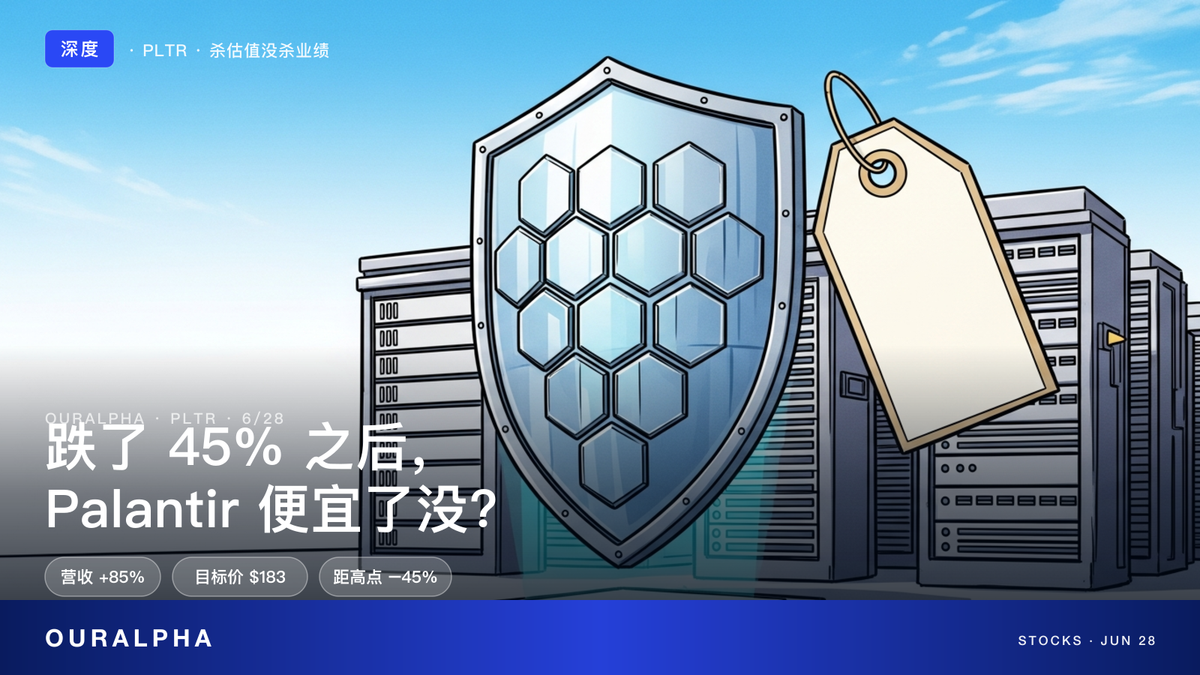
After $100 Billion in Market Cap Evaporated, Is Palantir Actually Cheap Now?
PLTR has shed ~45% from its peak while revenue growth accelerated from 48% to 85%. This selloff killed the multiple, not the business — and the data shows why this may be the best entry point in two years.
Bottom line: this PLTR selloff killed the multiple, not the business. Sentiment dragged it from $207 down to just above $110 — while revenue growth accelerated from 48% to 85% over the same stretch. "Cheap" is the wrong word for Palantir in absolute terms — it has never been cheap — but relative to its own history and relative to its growth rate, this is the most attractive entry point in two years. The data below shows why.
I. First, the price: where did it actually land?
As of the most recent close, PLTR was trading around $112.93, hugging its 52-week low of $106:
| Current price | ≈ $112.9 |
| 52-week range | $106.4 — $207.5 |
| From all-time high | ~−45% |
| Year-to-date | ~−40% |
| Market cap | ~$271B (~2.4B shares) |
This is one of the deepest drawdowns in PLTR's public history. The key question: did the fundamentals break, or is this purely a valuation reset? Four quarters of results give you the answer.
II. Four quarters of earnings: not just holding up — accelerating
Below is the core data from Palantir's last four reported quarters. Focus on the revenue growth column — the trend is up, not down.
Quarterly revenue (USD billions) and YoY growth
Q2'25
Q3'25
Q4'25
Q1'26
Q1'26's +85% is Palantir's highest-ever single-quarter YoY growth rate.
Rule of 40 score (revenue growth + profit margin — the gold standard for SaaS efficiency)
Scores above 40 are considered excellent. Here's where Palantir sits:
94
Q2'25
114
Q3'25
127
Q4'25
145
Q1'26
A few more Q1'26 metrics to frame the underlying business quality:
| GAAP net income | $871M (GAAP profitable) |
| Adjusted operating margin | ~60% |
| Adjusted free cash flow | $925M (57% margin) |
| Cash & short-term investments | ~$8B, zero interest-bearing debt |
| US revenue share | 79% of total (+104% YoY) |
| Customer count | 1,007 (+31% YoY) |
Management raised FY2026 revenue guidance to $7.65–$7.66B (+~71% YoY). The plain-English read: the stock keeps falling. The business keeps accelerating. Guidance keeps getting raised.
III. So what does "cheap" actually mean here?
Let's be direct: in absolute terms, Palantir is still not cheap. Trailing P/E of ~127x, P/S of ~52x (TTM) — this is not a bargain-bin price. Anyone telling you PLTR is a steal either hasn't looked at the numbers or is selling you a narrative.
"Cheap" has three layers of meaning. Palantir qualifies for the last two — and those are often where the real money is made:
① Cheap relative to itself — the cheapest it's been
Forward P/E compresses from ~87x on FY26 estimates to ~39x on FY28 estimates at the current growth trajectory. That's a valuation level PLTR hasn't seen in a long time. The stock is ~45% off its $207 high.
② Cheap relative to growth — the most important layer
This is the crux. The multiple got cut nearly in half while revenue growth accelerated from 48% to 85% and the Rule of 40 score rose from 94 to 145. You're paying less for a faster-growing business — the growth-adjusted value proposition has actually improved.
③ Cheap relative to analyst targets
The Wall Street consensus price target is ~$183, implying 60%+ upside from the current ~$113; the high target is $255 (+125%) and the low is $70 (−38%). A company with accelerating revenue and rising profits, trading at a 35%+ discount to the analyst consensus — the debate isn't whether the business is performing, it's whether the growth can last.
Bottom line: the bet isn't on how cheap it is in absolute terms — it's on whether the market's fear about growth sustainability has overshot.
IV. So what exactly is the market afraid of?
To judge whether the fear is overdone, you have to lay out the bear case. This selloff is driven by four things:
1European government contract risk: France's DGSI is phasing out Palantir in favor of domestic vendor ChapsVision; a UK parliamentary committee has raised concerns about over-reliance on Palantir. The "sovereign AI" narrative is eroding its moat in international government contracts.
2Persistent insider selling: executives have been selling in the ~$132–160 range, reinforcing the market perception that management views the stock as fairly valued.
3Intensifying AI competition: as LLM capabilities commoditize, the market questions whether Palantir's AIP platform moat can hold.
4Sector-wide risk-off: the broad de-rating of high-multiple AI and growth names hit PLTR hardest, given its elevated beta (~1.6).
On the other side, bulls have real catalysts: a foundational role in the US Army's NGC2 data layer, the previously announced 10-year ~$10B Army contract, a strategic partnership with Zeta Global; even Michael Burry trimmed his short position, and Cathie Wood added at the lows. The wide divergence of views itself signals that sentiment — not fundamentals — is driving the price.
V. A different angle: one market commentator's case for ignoring the noise
A popular US markets content creator recently dedicated a full video to this pullback, with a clear message: don't let community panic dictate your moves — focus on the fundamentals, and use the dip to build your position. Here are his core arguments, offered as a third-party data point for your consideration.
🎬 Video Perspective · The following reflects the commentator's personal views and strategy. This does not represent OurAlpha's position and does not constitute investment advice.
① Taking apart the biggest bear narrative
The dominant bear thesis weighing on the stock right now: as Anthropic and other LLMs (Claude, etc.) grow more capable, they'll eat Palantir's lunch. He thinks this is a plausible-sounding but fundamentally flawed read, and he breaks it down with an analogy:
🧠 LLMs = The Brain
Models like Claude handle the "thinking" — reasoning and intelligence.
⚙️ Palantir = The Nervous System + Muscle
AIP and Foundry translate that thinking into real-world enterprise action.
His core argument: a brilliant brain alone can't handle enterprise AI's "dirty work" — ensuring answer reliability and auditability, controlling compute and hardware costs, navigating compliance and privacy law, guaranteeing cybersecurity, and integrating seamlessly with existing enterprise systems. That's Palantir's home turf. In his view, LLMs and Palantir are complementary, not competitive — the stronger the model, the more you need an operating system capable of deploying it in the real world.
② We've seen this movie before
He draws a parallel with 2022, when PLTR fell from ~$40 to ~$6 as the dominant narrative was "it's just a consulting firm." Those who held conviction and bought into that panic made money. He sees the same script playing out now: fundamentals improving, stock cut in half by sentiment.
③ How he's playing it
He's publicly stated his approach: dollar-cost averaging (DCA) in, treating "fundamentals-up, price-down" moments as discounted entry points, with a self-imposed price ceiling for adding. (Note: this is his personal strategy, not a recommendation; any position sizing should reflect your own cost basis, portfolio weight, and risk tolerance.)
"In the short run, the market is a voting machine but in the long run, it is a weighing machine."
— Benjamin Graham, cited by the commentator as a reminder to focus on business quality and tune out short-term noise and media sentiment.
Note: Some valuation and growth figures cited in the video (including forward P/E estimates and margin calculations) are the commentator's own estimates and may differ from company-reported figures. All numbers in the body of this article are sourced from SEC filings.
VI. Risk factors (read these)
· Still expensive in absolute terms: ~127x P/E, ~52x P/S — any growth miss could trigger another sharp multiple compression.
· All-in on growth continuity: the returns implied by today's price require revenue to maintain 60%+ growth. If that acceleration reverses, the thesis flips.
· Government contract political and compliance risk: European replacements, ICE contract controversy, and renewal uncertainties are non-financial tail risks.
· High volatility: beta ~1.6, with 5%+ single-day swings routine — not suited for leverage or an oversized position.
Conclusion
Palantir hasn't gotten cheap. But it has come down from a price that was pricing in perfection-and-then-some to a price where the valuation, while still elevated, at least starts to make sense. Four consecutive quarters of results tell the same story: the selloff killed the multiple, not the business — and that business line keeps accelerating upward.
For long-term bulls on enterprise AI adoption who can stomach the volatility, the risk/reward here is meaningfully better than it was at $200 six months ago. But the premise never changes — you're buying the growth story, not a value stock.
OurAlpha · US Equity Research
Every piece backed by data, not narrative. We'll be watching PLTR again next earnings season.
Data sources: Palantir investor relations / SEC 8-K quarterly filings, public market data. All figures as of publication date; market prices change in real time.
Disclaimer: This article represents OurAlpha editorial research and opinion and does not constitute investment advice or a solicitation to buy or sell any security. US equities and options are highly volatile. All investment decisions are made at the reader's own risk and judgment.
This content is for informational purposes only and does not constitute investment advice, trading advice, or any guarantee of returns.