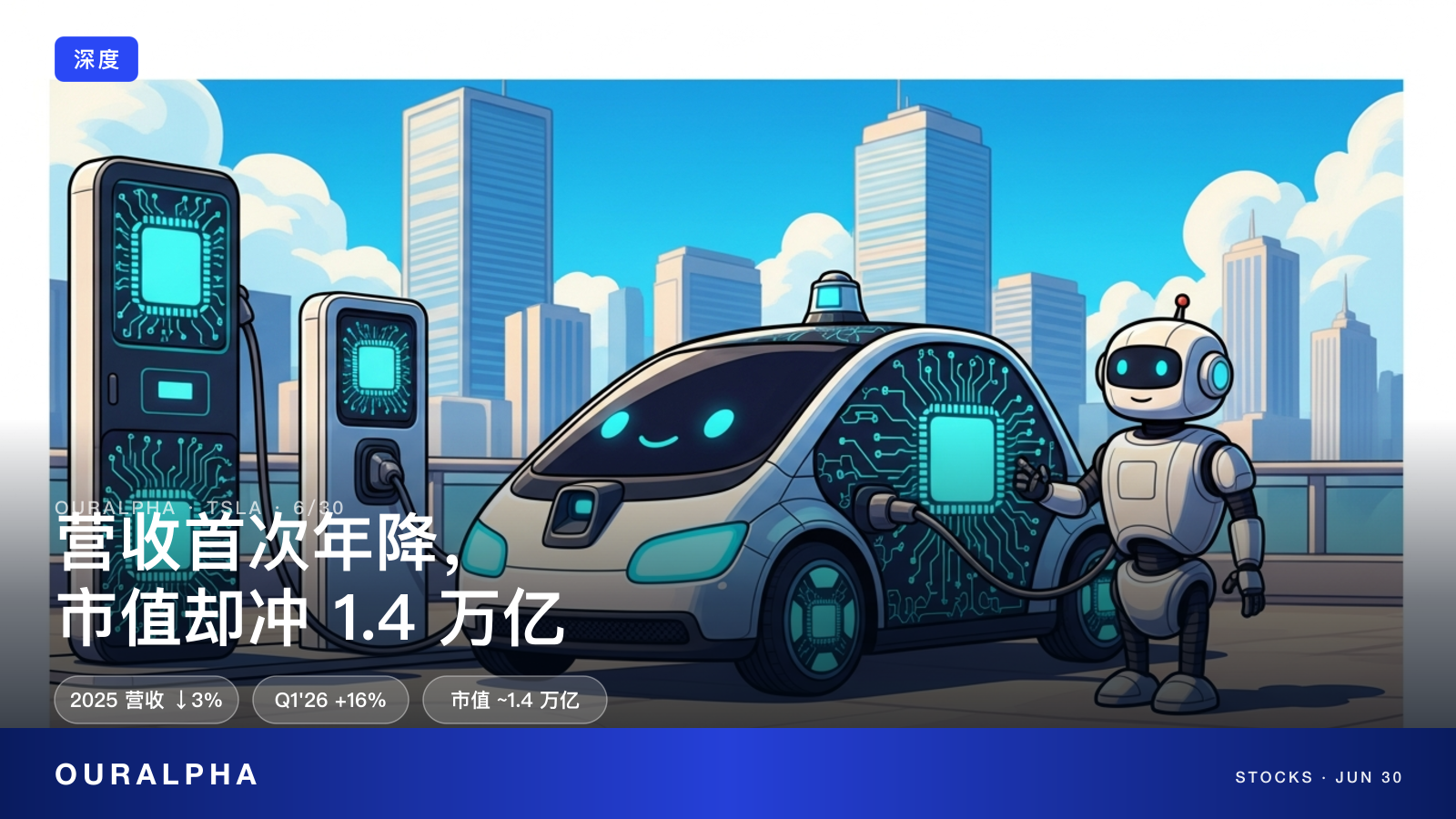
Tesla's Revenue Fell for the First Time Ever — So Why Is It Worth $1.4 Trillion?

Tesla posted its first-ever annual revenue decline in 2025, yet its stock hovers near $400 with a 300x P/E. We break down what the market is actually pricing in.

OURALPHA · US EQUITIES DEEP DIVE
From "Automaker" to "Physical AI Platform"
Tesla's Three-Layer Valuation Narrative
When a company valued at roughly $1.4 trillion posts its first-ever annual revenue decline, yet the market keeps pushing the stock higher — we take the machine apart to see what's actually inside.

Start with the latest snapshot. In Q1 2026, Tesla revenue returned to +16% YoY growth at $22.4B, with gross margin climbing back to 21.1% — the highest since 2022, free cash flow of $1.44B, and net income turning positive YoY. On these numbers alone, the company looks like it's recovering.

But zoom out to full-year 2025 and the picture is far more complicated. That year Tesla delivered a deeply mixed scorecard: full-year revenue of $94.8B, down 3% YoY — the first annual revenue decline in the company's public history. Its European market share fell to roughly 1.4%, and the title of global BEV sales leader was officially claimed by BYD.

Quarterly metrics recovering, annual narrative under pressure — yet the stock hovers near $400, market cap sits at roughly $1.4T, P/E still north of 300x. The market clearly isn't pricing it as a carmaker anymore. What investors are paying for is the future that Robotaxi, humanoid robot Optimus, and energy infrastructure represent — a future that hasn't arrived yet.

This piece aims to answer three questions: What is Tesla actually earning money from today? How much real revenue are the three growth engines the market prizes so highly actually generating right now? And where is this narrative most vulnerable?

$22.4B / Q1 2026 Revenue ↑16% (back to growth · gross margin 21.1%)
$94.8B / FY2025 Revenue ↓3% (first annual decline since IPO)
1.63M units / FY2025 Deliveries ↓9% (overtaken by BYD)
~$1.4T / Market Cap (June 2026) P/E 300x+
01 Business Overview: A Four-Legged Company

Tesla reports only two segments — Automotive and Energy Generation and Storage — plus a "Services and Other" revenue line. But break it down by business logic and today's Tesla is really four pieces stitched together:

① Automotive (cash cow, shrinking share)
Model 3/Y are the clear workhorses; S/X heading toward end-of-life; Cybertruck in limited production. Still the revenue and cash flow foundation, but growth has peaked — it's stepping back from "valuation driver" to "funding vehicle."
② Energy (the growth engine that's already delivering)
Megapack commercial/utility-scale storage + Powerwall residential + solar. The only one of the three growth narratives actually showing substantial, fast-growing revenue on the income statement.
③ Autonomy & AI (the narrative engine)
FSD software subscriptions, Robotaxi network, Dojo/AI inference chips. Current revenue is minimal — yet this is what the entire valuation rests on.
④ Optimus Robotics (pure option value)
The humanoid robot Musk calls the source of "80% of Tesla's future value." External revenue is essentially zero today — a pure long-dated call option.

The key to understanding Tesla is recognizing the "temporal mismatch" across these four segments: the profitable one (auto) is decelerating, the growing one (energy) isn't yet large enough, and the ones priced most richly into the valuation (autonomy, robotics) haven't started generating real earnings. This mismatch is precisely why the stock can be "revenue down, valuation up" at the same time.

02 Financial Deep Dive: Revenue Down, Margins Up

2.1 Revenue Mix: Auto Bleeds, Energy and Services Step Up

In 2025, the three segments showed a clear offsetting dynamic. Auto revenue fell from $77.1B in 2024 to $69.5B (-9.8%), while Energy and Services both posted double-digit growth, pulling Auto's share of the total from nearly 79% down to 73%.

Chart 1 | Revenue Mix: 2024 vs. 2025 (% of total)
2024 2025
Automotive
78.9% · $77.1B
73.3% · $69.5B
Energy Generation & Storage
10.3% · $10.1B
13.5% · $12.8B (↑26.6%)
Services & Other
10.8% · $10.5B
13.2% · $12.5B (↑19.0%)
Source: Tesla 2025 8-K filings / SEC. Bars scaled to revenue share; illustrative only.

2.2 Quarterly Revenue: From Decline Back to Growth

Zoom into the quarterly data and you see a clear "U-shape." H1 2025 saw sharp YoY declines driven by model transitions and soft demand; H2 gradually recovered as the refreshed Model Y ramped and energy exploded; by Q1 2026, revenue returned to +16% YoY at $22.4B.

Chart 2 | Quarterly Total Revenue Trend ($B)
Q1'25 $19.3B
Q2'25 $22.5B
Q3'25 $28.1B (peak)
Q4'25 $24.9B
Q1'26 $22.4B (+16% YoY)
Source: Tesla quarterly 8-K filings / SEC.

2.3 Profitability and Cash Flow: Quality Improving

The bigger story isn't revenue but the steady gross margin recovery. Total GAAP gross margin climbed from 16.3% at the start of 2025 all the way to 21.1% in Q1 2026 — the highest since 2022. The drivers: lower per-vehicle costs, a larger mix of high-margin energy revenue, and "hard profit" improvement beyond regulatory credits.

Chart 3 | Gross Margin Recovery Trajectory
Q1'2516.3%
Q2'2517.2%
Q3'2518.0%
Q4'2520.1%
Q1'2621.1%
Source: Tesla quarterly 8-K filings / SEC.

Cash flow is equally solid: FY2025 free cash flow of $6.2B (+74% YoY), with cash and investments on the balance sheet at $44.1B (+21%). This is the key point — it's this still-functioning "auto cash machine" that's funding the AI and robotics burn.

Financial Snapshot · Q1 2026
Total Revenue$22.39B (+16%)
GAAP Net Income$477M (+17%)
Non-GAAP EPS$0.41 (+52%)
Gross Margin21.1%
Free Cash Flow$1.44B
03 Three Growth Engines: The Gap Between Story and Cash

The three segments the market is most excited about are Robotaxi, Optimus, and Energy. But as investors, the first thing we need to do is the most basic thing — ask how much revenue each is actually contributing today. The chart below may be the most important one in this entire piece.

Chart 4 | Current Revenue Share of the Three "Growth Engines" (FY2025)
Key distinction: what's earning money vs. what's still just narrative
Energy Storage ~13.5%
$12.8B · realized, fast-growing, high-margin
Robotaxi ≈ 0%
Management guidance: no material revenue in 2026
Optimus Robotics ≈ 0%
Zero external revenue; pure long-dated option value
Bottom line: of the three engines, only Energy is actually generating revenue on the income statement today; Robotaxi and Optimus are essentially zero in 2025–2026 financial results — they're supporting expectations, not current earnings.

3.1 Energy: The Underappreciated Growth Engine That's Already Delivering

This is the only segment of the three where the numbers actually speak for themselves. In 2025, Energy Generation and Storage revenue came in at $12.8B (+26.6% YoY), with full-year storage deployments hitting a record 46.7 GWh — 14.2 GWh in Q4 alone. More importantly, Energy gross margins of ~30% are meaningfully ahead of Auto's 18–20%.

Chart 5 | Energy Storage Deployments and Revenue (Annual)
2024 Deployments 31.4 GWh / Revenue $10.1B
2025 Deployments 46.7 GWh / Revenue $12.8B
Source: Tesla earnings filings / SEC.

The growth story is backed by capacity expansion: the Lathrop (CA) and Shanghai Gigafactories at roughly 40 GWh each, Nevada at ~3 GWh, plus the Houston factory under construction targeting 50 GWh (expected online by end-2026) — bringing global storage capacity toward 133 GWh/year. Next-generation Megapack 3 (5 MWh per unit) and Megablock (20 MWh) are slated for late 2026. AI data center demand for utility-scale storage is emerging as a fresh tailwind for this segment.

But the risk side is real too: management has explicitly flagged 2026 Energy gross margin pressure from price competition, policy uncertainty, and tariffs. Tesla's storage cells are heavily dependent on Chinese suppliers (notably CATL), which is both a cost advantage and a geopolitical exposure — prompting the joint venture with LG Energy Solution on a $4.3B U.S. LFP cell plant (targeted 2027 startup) as a hedge.

3.2 Robotaxi: Tech Is Running, Revenue Isn't Yet

This is the most exciting — and most easily misread — part of the story. As of Q1 2026, Tesla's driverless Robotaxi service has expanded from Austin to Dallas and Houston, paid miles roughly doubled quarter-over-quarter, and Cybercab (no steering wheel, no pedals; target cost below $30K) entered production at the Texas factory in April.

That sounds compelling. But remember Musk's own words on the earnings call: Robotaxi will not generate material revenue in 2026; meaningful contribution is pushed out to 2027. The current fleet is still predominantly converted Model 3/Y vehicles, at a scale of tens to a few hundred units (Morgan Stanley projects roughly 1,000 by end-2026). In other words, this is a business where the technology proof-of-concept has happened — but the commercial ramp has not.

The real, money-generating bridge right now is FSD software. Q1 2026 saw 1.28M FSD subscribers as Tesla transitions to a pure subscription model. This high-margin software revenue — though still small and reported within Services/Automotive — is the cash bridge connecting "selling cars" to "selling autonomy as a service," and the most tangible early proof point for the Robotaxi narrative.

3.3 Optimus: An 80% Long-Dated Call Option

Musk has repeatedly insisted that Optimus and AI will account for roughly 80% of Tesla's future value. To that end, Tesla made an aggressive call: discontinuing Model S and X in Q2 2026 to retool Fremont's production lines for robotics. Third-gen Optimus (V3) is expected to debut mid-year, with production ramp targets of July–August 2026, following a typical slow S-curve start. Planned capacity is staggeringly ambitious — Fremont targeting 1M units per year, with Texas aiming for 10M units longer-term.

A note of caution is warranted here. Third-party research (Deutsche Bank, Goldman Sachs, among others) generally concludes that meaningful production (thousands of units) won't come before H1 2027 at the earliest, with deployments in the tens of thousands more likely landing in 2028–2029. Optimus currently generates zero external revenue — it's an option priced purely on imagination. The upside ceiling is enormous, but the path to realization is littered with unresolved hurdles in supply chain, reliability, and safety certification.

04 Competitive Landscape and Moats

4.1 Automotive: The Crown Changes Hands

2025 was a turning point: BYD's annual BEV volume reached roughly 2.26M units (+28%), formally overtaking Tesla's 1.64M (-9%) for the first time and ending Tesla's long run as the global BEV leader. Including PHEVs, BYD's total deliveries approached 4.6M units.

Chart 6 | 2025 Global BEV Deliveries: Tesla vs. BYD (million units)
Tesla 1.64M (↓9%)
BYD 2.26M (↑28%)
Source: Manufacturer announcements / industry trackers.

The picture is more nuanced, though: Tesla remains the leader in its home U.S. market (BYD has no passenger car presence there yet) and stays strong in China — December 2025 deliveries of nearly 97,000 units were the second-highest month on record. The problem isn't demand destruction; it's product age. Against BYD's, Xiaomi's, and Geely's wider price ladders and faster refresh cycles, Tesla is increasingly relying on discounting to sustain volume — eroding the tech premium it once commanded.

4.2 Robotaxi and Robotics: A Crowded Field

In autonomous mobility, Waymo has scaled driverless operations across more cities, with Zoox and Pony AI also accelerating. In humanoid robotics, China's Unitree is capturing use cases at aggressive price points, while Figure AI, 1X, and Agility Robotics are carving out enterprise positions. Tesla isn't running in a vacuum — every new narrative has a well-funded, more focused competitor behind it.

4.3 Moats: Where Are the Defensible Advantages?

Data Flywheel
A global fleet of over 9 million vehicles continuously feeding real-world driving data is scarce fuel for training Tesla's vision-only end-to-end FSD — an asset competitors cannot replicate quickly.
Vertical Integration and Manufacturing
From cells and chips (proprietary AI5 inference chip, joint wafer fab with SpaceX) to unboxed manufacturing processes, Tesla is working to drive its cost curve below where competitors can follow.
Shared Technology Stack Across Energy, AI, and Robotics
Battery chemistry, power electronics, and AI compute reused across vehicles, storage, and robots can theoretically generate meaningful cross-segment leverage. This "Physical AI Platform" narrative is what fundamentally distinguishes Tesla from a traditional automaker.

The moats are real. But whether they translate into profits depends on execution and timing — and Musk's historical "optimism" on timelines is itself a variable that deserves a discount.

05 Valuation and Debate: Two Competing Worldviews

A ~$1.4T market cap and P/E above 300x — measured by traditional automaker metrics, this valuation is "mathematically indefensible." But the market isn't buying a car company. Ultimately, the Tesla story collapses into one question: which worldview do you believe?

▲ Bulls: The AI Chapter Is Just Beginning
A 9-million-vehicle data flywheel creates an insurmountable lead in autonomy; Robotaxi taps a multi-trillion-dollar mobility market; Optimus opens up a $10T+ addressable market; Energy provides steady, high-margin cash flow. Under this logic, the current valuation is just a "floor" — some aggressive analysts (Dan Ives, for one) have a $3T target by end-2026.
▼ Bears: The Core Business Is Bleeding
BYD has taken the BEV crown, European share has fallen to ~1.4%, delivery growth has stalled; forced discounting is eroding the premium. If Tesla is "just a car company" for the next two years, a 300x P/E is unsupportable; any delay to Cybercab or Optimus timelines could trigger a 30–40% sharp correction. 2026 capex has been guided above $25B — burning cash while returns remain elusive.

Our read: Tesla is fundamentally a "cash cow + options portfolio." Automotive and Energy form the underwriteable base business; Robotaxi and Optimus are two high-beta, high-uncertainty call options. The current stock price is pricing both options as if they're highly likely to be exercised — while meaningful revenue contribution is, at best, a 2027 story.

Final Thoughts · Our Three Conclusions
1. Don't confuse narrative with financials. Of the three engines, only Energy is generating real revenue on the income statement today (~13.5%); Robotaxi and Optimus remain near-zero in actual results.
2. The base business is stabilizing. Gross margin back at 21.1% and solid cash flow mean the "cash machine" can still fund the long-term bets — what separates Tesla from a money-losing tech company.
3. The tension is timing, not direction. The technology trajectory is likely correct and the moats are real; the true risk lies in the pace of execution and how many years of patience the market is willing to prepay.
Key Data Summary
FY2025 Revenue$94.8B (-3%)
Auto / Energy / Services$69.5B / $12.8B / $12.5B
FY2025 Deliveries1.63M units (-9%)
FY2025 Storage Deployments46.7 GWh (record)
Q1 2026 Gross Margin21.1%
FSD Subscribers1.28M
Market Cap / P/E~$1.4T / 300x+
Sources: Tesla SEC 8-K / 10-K filings, quarterly shareholder letters, and public industry trackers. Financial figures current through Q1 2026; market cap and stock price as of June 2026. This article is for research and informational purposes only and does not constitute investment advice. Markets carry risk; make your own independent decisions.
OurAlpha · Decode U.S. Equities With Us

This content is for informational purposes only and does not constitute investment advice, trading advice, or any guarantee of returns.

Keep Reading

The AI Gold Rush: Who's Quietly Getting Rich Across the Semiconductor Supply Chain?

OURALPHA · US EQUITIES IN DEPTH · SUPPLY CHAIN PANORAMA
US Semiconductor Supply Chain: A Full Breakdown
In the AI Gold Rush, Who's Quietly Printing Money?
From EDA software and lithography machines to GPUs, foundries, and memory — we trace the complete journey from a grain of sand to an AI chip, peeling back every layer of the supply chain that is minting trillion-dollar giants by the dozen.

The market tends to talk about "AI" as a single trade. Look closely, though, and you'll find AI is not

Read full story →

Stay ahead of the market — never miss a deep dive

Follow OurAlpha for AI-driven US equity research and market insight, every day.