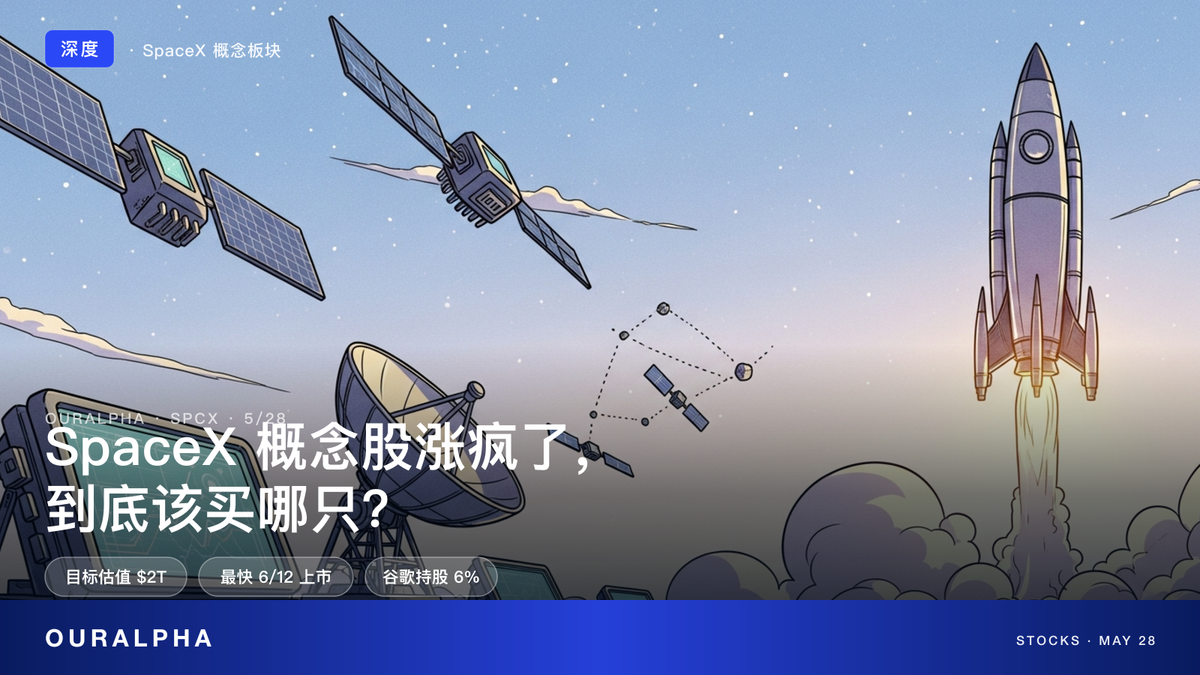
SpaceX IPO Next Month: Which "Proxy" Stocks Are Actually Worth Buying?
SpaceX filed its S-1 targeting a $1.75–2T valuation, igniting a frenzy in related stocks. But most plays buy hype, not equity — here's how to cut through the noise.
TL;DR · The One-Line Story
SpaceX has officially filed its S-1 (targeting the ticker SPCX on Nasdaq, at a $1.75T–$2T valuation, with a listing as early as June 12), igniting an entire "SpaceX proxy" trade — but the purity of these names varies enormously, and only one tier is actually worth holding long-term.
- Three tiers in the trade: ① True equity proxies (Google GOOGL holds ~6%) ② Packaged funds (XOVR / DXYZ / VCX, most trading at steep premiums to NAV) ③ Peer/sector plays (Rocket Lab RKLB, AST SpaceMobile ASTS — rising on SpaceX's tide, but not SpaceX itself)
- SpaceX the company: Post-xAI consolidation, 2025 revenue ~$18.7B, net loss $4.94B; in 2024 (pre-consolidation), the core business generated ~$791M net income — xAI is the sole reason for the 2025 swing to a loss. Starlink alone contributes 61% of revenue and ~$4.4B in operating income
- For long-term exposure, we prefer Google (GOOGL): Use a company trading at 28x earnings and generating ~$100B/year in net income to get SpaceX's theoretical IPO-implied stake value — roughly ~$100B — as a free option, with zero premium-collapse risk
- For a trade, we prefer Rocket Lab (RKLB): Pure sector play, liquid options market, its own Neutron first-flight catalyst; we recommend a bull call spread to manage cost, not a naked long call
- The biggest pitfalls: Funds like DXYZ / VCX trading 50%+ above NAV, and the "sell the news" unwind on listing day
The biggest edge in this trade is recognizing what retail is actually getting wrong: investors think they're "positioning ahead of the SpaceX IPO," but public names that carry genuine SpaceX equity without charging a heavy premium are rare. Google (GOOGL) is the cleanest one — its $900M investment in 2015 is worth a theoretical $100–122B at the IPO target valuation of $1.75–2T, yet the market is pricing almost none of that into GOOGL's stock.
At the other end, closed-end and interval funds like DXYZ and VCX do hold SpaceX on paper, but their market prices have persistently traded well above actual NAV. You're not buying SpaceX's value — you're buying the premium itself, and that premium compresses when the IPO lands and sentiment cools. DXYZ fell as much as 80% in 2025. That's what a premium collapse looks like.
As for Rocket Lab (RKLB) and AST SpaceMobile (ASTS), these are peers and in some cases competitors to SpaceX — they're riding the tailwind of a strong year for the space sector, plus their own fundamental catalysts. They're suited for tactical trades and options plays, not as long-term SpaceX substitutes. The framework is simple: for a long-term hold, screen for equity purity; for a trade, screen for liquidity and near-term catalysts.
A few terms upfront (each will be footnoted again on first use below):
- IPO (Initial Public Offering): A company's first sale of shares to the public on a stock exchange
- S-1: The registration statement a U.S. company files with the SEC before an IPO — the first public disclosure of its financials
- NAV (Net Asset Value): What each share of a fund is actually worth. Trading above NAV is a "premium," below is a "discount"
- Call / Put: A call gives you the right to buy at a set price; a put gives you the right to sell at a set price
- IV (Implied Volatility): The market's forward-looking expectation of price swings, embedded in option prices. Higher IV = more expensive options
- Strike / Expiration: The strike is the agreed buy/sell price; the expiration is the date the contract expires worthless if unexercised
- GAAP: U.S. Generally Accepted Accounting Principles — the strictest standard for reporting net income or net loss
1. How Big Is This IPO, Really
Before dissecting the proxy plays, you need to understand just how heavy the parent company is.
SpaceX (not yet public, proposed ticker SPCX) officially filed its S-1 with the SEC around May 20, 2026 (having confidentially filed on April 1). According to multiple reports, the underwriting syndicate spans 21 banks, with a target raise of $75–80B+, a target valuation of $1.75T–$2T, and a listing as early as June 12.[Fortune]
At $1.75T, this would be the largest IPO in U.S. capital market history — more than 10x the size of Alibaba's listing. That's the root cause of the entire proxy-play sector catching fire: a trillion-dollar name entering the public market forces a repricing of everything adjacent.
The S-1 financials contain one key point that many readers will misread — it needs to be spelled out:
- 2025 consolidated (including xAI): SpaceX acquired xAI (which includes the X platform and Grok) in February 2026. On a retroactively restated basis, 2025 revenue was approximately $18.7B with a GAAP net loss of $4.94B. The loss was driven almost entirely by AI — the AI segment posted a 2025 operating loss of $6.35B.[Morningstar]
- The legacy space business, pre-consolidation: was actually profitable — the core entity earned approximately $791M in net income in 2024. It only swung to a net loss after the xAI drag was folded in for 2025.
In other words, the clickbait headline "SpaceX is losing money" misattributes the losses — the bleeding is coming from its freshly acquired AI business, not from rockets and satellites. xAI is what dragged the consolidated entity into the red.
The real engine behind the entire story is Starlink (SpaceX's satellite internet business): in 2025 it contributed approximately $11.4B in revenue (61% of total) and approximately $4.4B in operating profit, with roughly 10.3 million global subscribers. Put simply, Starlink is SpaceX's cash cow and profit center. As one outlook piece put it bluntly: no Starlink, no IPO story.
One easy-to-overlook beneficiary: SpaceX's acquisition of xAI brought the Colossus 1 data center into the fold — a facility housing 220,000 Nvidia (NVDA) GPUs at 300MW, with Anthropic reportedly contracting compute at roughly $1.25B per month (through May 2029), for a total deal value of approximately $40B–45B depending on the source.[The VC Corner (S-1 Teardown)] IPO proceeds are earmarked to expand AI infrastructure further — making Nvidia one of the hidden picks-and-shovels winners here.
II. SpaceX Proxy Plays Come in Three Tiers
This is the most important table in this article. What the market calls "SpaceX proxy plays" can be divided into three tiers based on how directly they expose you to SpaceX equity — each with a completely different purity level, risk profile, and appropriate trading approach.
| Ticker | SpaceX Exposure Method | Equity Purity | Key Risk | Best For |
|---|---|---|---|---|
| Google GOOGL | Direct ownership of ~6% SpaceX equity | Real equity, but negligible relative to GOOGL's market cap (~1.3%) | Even a massive SpaceX rally won't move the needle on Google | Long-term investors (safest) |
| XOVR (ERShares ETF) | Holds SpaceX via SPV, ~23% of fund | True equity wrapper (net expense ratio 0.75%) | Stale mark-to-model valuation; fund still lags the index | Investors wanting a basket |
| DXYZ (Destiny Tech100) | SpaceX is ~14.5% of portfolio | Real equity, but trades at a persistent large premium to NAV | Premium collapse (fell >80% in 2025) | High-risk speculators |
| VCX (Fundrise Innovation Fund) | Holds SpaceX + Anthropic, etc. | Real equity, but premium is more extreme and redemptions are restricted | Interval fund illiquidity; extreme premium | Most investors should avoid |
| Rocket Lab RKLB | Peer/competitor — no SpaceX equity | None (no SpaceX holdings) | Still unprofitable; Neutron maiden flight execution risk | Trading / options |
| AST SpaceMobile ASTS | Direct-to-device play (competing with Starlink) | None (no SpaceX holdings) | Rich valuation; early-stage commercialization | Trading / options |
Tier 1: Pure Equity Proxies — Only Google Qualifies
Google's parent Alphabet (GOOGL) invested $900M in SpaceX back in the 2015 Series F, when SpaceX was valued at just $12B. The position stayed under the radar until April 2026, when a routine Alaska regulatory filing — requiring disclosure of shareholders above 5% — revealed that as of year-end 2025, Google holds 6.11% of SpaceX.[Bloomberg / Yahoo Finance]
Back-of-the-envelope math at the $2T IPO target implies a theoretical value of roughly $122B for that stake. Factor in potential dilution from SpaceX's xAI acquisition — which could bring Google's ownership down to ~5% — and the figure lands around $100B at a $1.75T valuation. These are illustrative estimates based on target valuations; actual book cost, post-dilution ownership, and accounting recognition will depend on final IPO pricing and Google's own disclosures. Regardless, this is shaping up to be one of the most profitable financial investments Alphabet has made in a decade.
XOVR (ERShares' private-public crossover ETF) is the second "true equity" option: as of May 2026, its SpaceX position via SPV is roughly $281–292M, representing approximately 23% of the fund (Morningstar pegs it at ~23.11%). Total AUM is about $1.36B; internally, SpaceX is marked at a $1.55T valuation, with a net expense ratio of approximately 0.75%. Worth noting: despite carrying that much SpaceX, the fund is down roughly ~2% YTD while the S&P 500 is up ~9.7% over the same period — a reminder that "SpaceX is in the fund" doesn't mean "you're capturing SpaceX's upside." The rest of the public portfolio and the mark-to-model pricing both dilute that exposure.[24/7 Wall St.]
Tier 2: Packaged Funds — Looks Like the Most Direct Route, Actually the Most Dangerous
DXYZ (Destiny Tech100) is retail's go-to "SpaceX substitute," with SpaceX making up ~14.5% of the portfolio. The problem is its persistent, steep premium to NAV: at end of March, NAV per share was only $24.56 while the market price briefly ran to $57–60, a 50%+ premium. That premium is highly unstable — the fund cratered more than 80% in 2025 — and management fees run 2–3%. On the day SpaceX filed its S-1, the stock jumped 18% pre-market, but when a move is entirely sentiment-driven premium expansion, it tends to reverse sharply once the IPO actually prices.
VCX (Fundrise Innovation Fund) is even more extreme: as an interval fund, it surged nearly 900% from launch, trades at a stunning premium to NAV, and limits quarterly redemptions to 5–25% of shares — illiquid enough that you may not be able to exit when it counts. Most investors should avoid this category entirely.
Tier 3: Sector Peers — Rising Tide, But Not SpaceX
Rocket Lab (RKLB) and AST SpaceMobile (ASTS) are, strictly speaking, not SpaceX proxies — they're peers and in some cases direct competitors in the space sector. But under the "trillion-dollar IPO ignites the entire space sector" thesis, they've outrun nearly everything else — and each has independent fundamental catalysts of its own (covered below). This tier works for trading; it doesn't work as a long-term SpaceX substitute.
三、长期投资:为什么我们选谷歌(GOOGL)
If your goal is "buy it, hold it, sleep at night," our answer is Alphabet (GOOGL) — not any fund proxy. Three reasons:
First, you get SpaceX exposure essentially for free. As of May 26, Alphabet traded at roughly $388.88, with a market cap of ~$4.7 trillion, a P/E of ~28.9x, Q1 2026 revenue of $109.9B (+22% YoY), and EPS of $5.11. The SpaceX position, which rough estimates peg at ~$100B on a target-valuation basis, represents only ~1.3% of Alphabet's total value — the market hasn't meaningfully priced it as a standalone asset. When you buy GOOGL, the core thesis is Search, Cloud, Gemini, and Waymo. SpaceX is a free call option on top.
Second, there's no premium-collapse risk. This is the fundamental difference between GOOGL and DXYZ/VCX. With fund proxies, you're buying a premium; with Alphabet, you're buying a profitable operating business. Even if SpaceX's IPO disappoints on day one, GOOGL won't get cut in half — but a fund like DXYZ can see its premium evaporate overnight.
Third, liquidity and certainty are unmatched. Alphabet is one of the most liquid equities in the market, with deep options chains (relevant for the next section). For retail investors, it offers the best risk-adjusted value of any way to participate in the SpaceX story.
Equity Purity 5/10: Direct ownership, but only ~1.3% of Alphabet's value — SpaceX upside has limited impact on GOOGL at the index level.
Financial Quality 9/10: ~$100B in annual earnings, 28x P/E; AI/Cloud/Search fundamentals stand on their own without SpaceX propping up the valuation.
Risk Profile 8/10: No premium-collapse risk, best-in-class liquidity; primary risks are antitrust litigation and AI capex.
Catalyst Sensitivity 6/10: Post-IPO, the position's value will be more clearly reflected on Alphabet's balance sheet (partially priced in already), but it's not the primary stock driver.
To be direct: if you want "SpaceX triples and I triple with it" leverage, Alphabet can't give you that — it's simply too large. GOOGL is the choice for "I want steady, indirect SpaceX exposure while owning a great business." For real upside leverage, keep reading — the options section is next.
IV. Options Play: Why Rocket Lab (RKLB)
If you want to lever a small bet for maximum catalyst torque, options on Google are a poor fit (SpaceX's marginal impact is too small to move the stock), and DXYZ/VCX are off the table too (premium + liquidity issues make option pricing deeply unfriendly).
Our options vehicle is Rocket Lab (RKLB), for clear reasons:
- Strong options liquidity and high IV: As retail's go-to aerospace name, RKLB has an active options chain with elevated implied volatility — well-suited for directional structured plays.
- Its own independent catalysts: RKLB isn't just riding SpaceX sentiment — Q1 2026 revenue hit $200.3M (+64% YoY), the first quarter above $200M, beating its own guidance ceiling; gross profit doubled to $76.5M; backlog hit a record $2.2B (+108% YoY); and it landed new partnerships with Anduril and Raytheon.[Rocket Lab Q1 2026 Earnings]
- Neutron maiden flight in H2: Neutron (a mid-size reusable rocket targeting the same market as SpaceX's Falcon 9) is slated for its maiden flight in H2 2026 — a concrete catalyst that partially overlaps with the SpaceX IPO window.
- Beta already proven: The stock has run from ~$25 a year ago to ~$150 recently (~6x in a year), with 50%+ gains in just the past month.
Note: AST SpaceMobile (ASTS — direct-to-cell satellite, the same lane as Starlink's direct-to-cell offering) also qualifies as an options candidate: ~$129.6, up from ~$22 to ~$131 over the past year, recently +17% in a single move, with FY2026 revenue guidance of $150–200M. It offers higher beta but is at an earlier stage of commercialization with more uncertainty. RKLB strikes a better balance between beta and fundamental visibility, which is why it's our primary pick.
Options Strategy: Bull Call Spread, Not a Naked Long Call
The core tension in the current environment: RKLB's IV is elevated — which means options are expensive. A naked long call carries two pitfalls: ① you're overpaying premium for high IV; ② once a catalyst resolves, IV collapses (IV crush) and you can still lose money even if direction is right, compounded by theta decay eating value daily.
That's why we favor a bull call spread — buy a lower-strike call, sell a higher-strike call, same expiration. The short leg recoups premium, hedging against high IV, reducing cost basis, and capping risk to a defined amount.
Strategy A (Primary) · Bull Call Spread (illustrative at ~$150 current price; always check live option chains before trading):
- Expiry: 2–3 months out (covers the 6/12 SpaceX IPO window + early positioning for the H2 Neutron catalyst)
- Structure: Buy $160 call + sell $200 call
- Max loss: Net premium paid (your total risk, fully defined)
- Max gain: ($200 − $160) − net premium = $40 minus cost, achieved if stock closes at or above $200 at expiry
- Breakeven: $160 + net premium paid
- Thesis: You're betting RKLB grinds higher through the catalyst window without needing a moonshot; the short leg offsets the cost of high IV
Strategy B (Alternative) · Cash-Secured Put — for those who are long-term bullish on RKLB but find the current price too rich and want to acquire shares at a lower cost:
- Sell a put at a lower strike (e.g., $125–135) and collect premium upfront
- If the stock stays above the strike, you keep the premium free and clear; if it drops below, you're assigned shares at an effective discount — essentially a lower entry on a name you wanted to hold long-term anyway
- Important: Reserve the full cash collateral (strike × 100 shares); don't sell naked
Three Risks You Must Understand
- Sell the news: The 6/12 IPO is a known, well-anticipated catalyst. On the day it lands, the entire sector may pull back as the event resolves. Don't go all-in the day before the IPO.
- Neutron launch delay: Aerospace timelines slip constantly. If the Neutron maiden flight is pushed out, RKLB will pull back meaningfully.
- IV crush: IV collapses after a catalyst resolves — which is exactly why we use a spread rather than a naked long. Even so, size these positions with money you can afford to lose; all positions here are defined-risk.
五、最容易踩的三个坑
Boiling down the analysis above into three "don'ts":
- Don't pay for the premium: DXYZ and VCX may look like the closest thing to SpaceX, but you're buying in at a 50%+ premium to NAV — not SpaceX's underlying value. That premium compresses when sentiment fades.
- Don't use peers as a proxy: RKLB and ASTS are solid trading vehicles, but they hold zero shares of SpaceX. Don't convince yourself that holding them long is the same as owning SpaceX.
- Don't gamble on IPO day: A trillion-dollar IPO is a textbook "known catalyst." The most likely script on day one is a gap-up followed by profit-taking. If you want to trade the catalyst, position early and use a defined-risk structure — don't chase it on the open.
Data Credibility Tiers
OurAlpha's four-tier data credibility framework — so you can instantly distinguish hard facts from editorial judgment:
- Tier A (Official Disclosures): Financial figures from SpaceX's S-1 prospectus (2025 revenue ~$18.7B, net loss $4.94B, AI segment operating loss $6.35B, 2024 parent net income ~$791M, Starlink $11.4B revenue / 61% margin / ~$4.4B operating income); Google's 6.11% stake (Alaska regulatory filings); Rocket Lab Q1 2026 earnings (revenue $200.3M, backlog $2.2B). These are the evidentiary foundation for this article's core conclusions.
- Tier B (Management / Official Guidance): Starlink's 10.3M subscribers, Colossus data center with 220K GPUs, Anthropic compute contract (~$1.25B/month, ~$40B–45B total) — sourced from S-1 / company disclosures as cited by mainstream media.
- Tier C (Mainstream Financial Media): IPO target valuation of $1.75–2T, fundraise of $75–80B, June 12 listing date (Fortune / CNBC / Bloomberg / Morningstar) — Note: valuations and dates are targets, not confirmed facts, and remain subject to change. XOVR / DXYZ / VCX holdings, NAV, and premium data (24/7 Wall St. / Benzinga / Yahoo Finance) — these figures move daily; always use live data at the time of execution.
- Judgment (OurAlpha Opinion, Not Fact): "Buy Google for the long term, trade RKLB via spreads" is editorial judgment based on the facts above and does not constitute investment advice. The specific strikes cited in the options strategies ($160/$200/$125–135) are illustrative structures only, not recommended levels — always reference the live options chain, prevailing IV, and your own risk tolerance before placing any trade.
Risk Disclosure: Nothing in this article constitutes investment advice. SpaceX's IPO valuation and timeline are subject to change; options are high-risk instruments that can result in total loss of principal; thematic equities can be highly volatile. Exercise independent judgment and size positions appropriately.
Sources
- SpaceX files IPO prospectus, reveals revenue is up — but losses are too — Fortune
- 6 Charts on SpaceX's Pre-IPO Financials — Morningstar
- SpaceX SPCX IPO S-1 Full Teardown: Valuation, Starlink, xAI, Anthropic — The VC Corner
- Alphabet's $122 Billion SpaceX Bombshell Surfaced In A Routine Alaska Filing — Bloomberg / Yahoo Finance
- XOVR Promised Pre-IPO SpaceX Upside, But It Is Down 2% YTD — 24/7 Wall St.
- Rocket Lab Q1 2026 Financial Results: Revenue $200.3M, Backlog $2.2B — StockTitan
- The SpaceX IPO Could Be Weeks Away — Here Are the 2 Tech Stocks That Will Benefit Most — The Motley Fool
This content is for informational purposes only and does not constitute investment advice, trading advice, or any guarantee of returns.