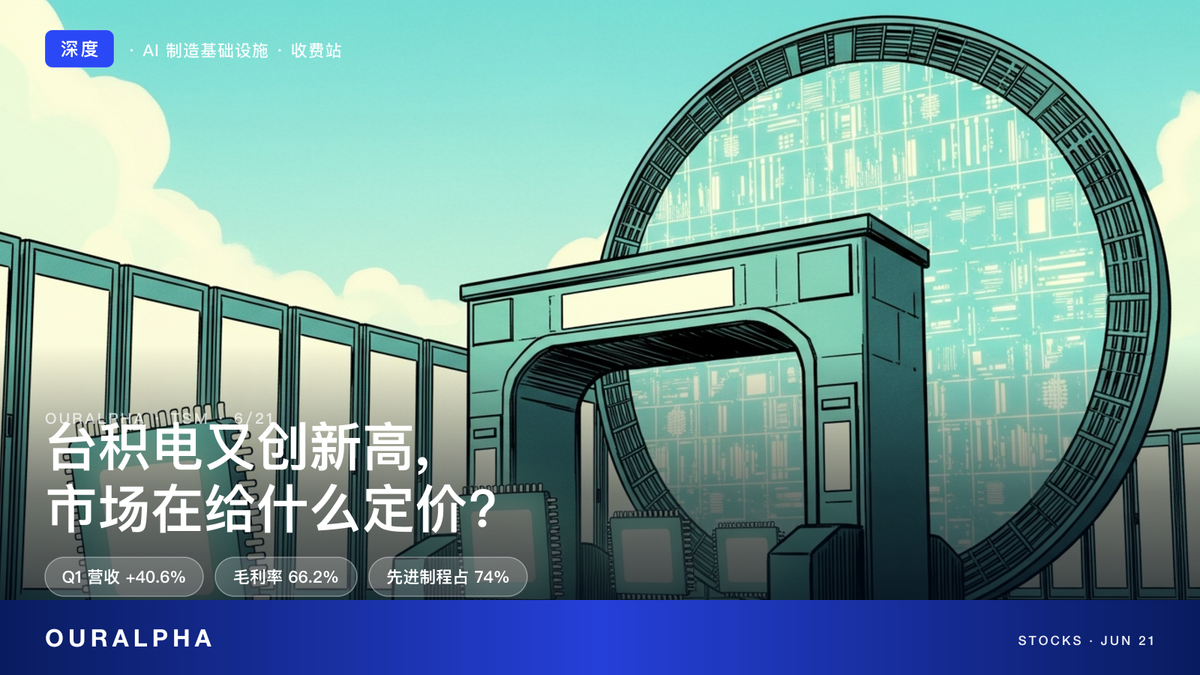
TSMC Keeps Breaking Records — What Exactly Is the Market Pricing In?

TSMC's Q1 FY2026 revenue surged 40.6% YoY with a 66.2% gross margin and net income up 58.3% — the eighth consecutive quarter of double-digit profit growth. The market isn't valuing a foundry; it's pricing the essential manufacturing backbone of the entire AI era.

TSMC just hit another all-time high.

The knee-jerk reaction at these levels is usually "it's run too far, too risky to touch." But anyone who has actually worked through the last year of earnings knows the more important story isn't the stock price — it's that TSMC's earnings power is entering one of the strongest periods in its history.

Quarter after quarter, it has beaten expectations. Not by a little.

$35.9B
Q1 Revenue · +40.6% YoY
66.2%
Gross Margin · Best-in-class
+58.3%
Net Income YoY · 8th Straight Quarter of Double-Digit Growth
~70%
Global Foundry Market Share
PART 01
A "manufacturer" with margins that shame most software companies

In Q1 FY2026, TSMC posted revenue of $35.9 billion — up 40.6% YoY in USD terms — with net income rising 58.3%. That marks eight consecutive quarters of double-digit profit growth.

The margin profile is what really stands out. Put these three numbers side by side and the picture becomes striking:

Fig. 1 · All three margin lines are best-in-class
Gross Margin 66.2%
Operating Margin 58.1%
Net Margin 50.5%
Source: TSMC Q1 FY2026 Earnings · Annualized ROE: 40.5%

Semiconductor manufacturing is one of the most capital-intensive, margin-punishing businesses on the planet. A leading-edge fab costs $20–30 billion to build. Customers demand a new process generation every two years. Yield loss during node ramp can exceed 30%. To post a 66% gross margin in that environment isn't just impressive — it signals a moat that goes well beyond being a "factory."

What's even more notable is the asymmetry of the growth: profits are outpacing revenue, and margins are still moving higher.

Fig. 2 · Earnings growth consistently outpacing revenue growth (YoY)
Revenue +40.6%
Net Income +58.3%
Revenue is growing fast. Profits are growing faster. Margins are still expanding.
PART 02
What's driving growth now isn't the iPhone

For years, smartphones were TSMC's largest revenue platform. That's no longer the case. High-Performance Computing (HPC) has overtaken mobile, now accounting for more than half of total revenue.

In other words, the engine pulling TSMC higher isn't Apple's next iPhone cycle — it's Nvidia, AMD, Broadcom, Marvell, and the hyperscalers: Amazon, Google, Microsoft. The entire AI supply chain.

There's an angle here that tends to get overlooked: everyone watches Nvidia's earnings for AI read-throughs, but TSMC is actually the cleaner window into the full AI capex cycle. No matter who wins this round — GPUs, ASICs, custom silicon — the orders all flow back to TSMC. Nvidia can lose a customer and keep selling chips. Without TSMC, the entire AI infrastructure stack grinds to a halt.

If Nvidia is the picks-and-shovels play for the AI gold rush, TSMC is the factory that forges the shovels for everyone else.
It's not an AI theme stock. It's the toll booth for the entire AI infrastructure build-out.
PART 03
The order book isn't just growing — it's getting richer

The most important thing to watch in TSMC's order mix is the rising share of advanced nodes. In the latest quarter, 3nm accounted for roughly 25% of wafer revenue, 5nm for ~36%, and 7nm for ~13%. Taken together, sub-7nm nodes contributed 74% of total wafer revenue — and that percentage is still climbing.

Fig. 3 · Advanced nodes driving 74% of wafer revenue
Wafer revenue by process node (Q1 FY2026)
3nm 25%   5nm 36%   7nm 13%   Mature Nodes 26%

What does this mean? It means TSMC's customers aren't just ordering more — they're ordering higher-margin product. Advanced nodes carry materially higher ASPs and fatter margins than mature nodes. That's why you get this unusually clean combination: revenue growing fast, profits growing faster, margins still expanding. This is the real reason the stock has kept making new highs — not sentiment, but fundamentals actually delivering.

PART 04
2nm: fully booked before it even ramped

Looking two years out, the market's focus is on 2nm (N2). The node uses Gate-All-Around (GAA) transistor architecture — the biggest structural change since 16nm — and will serve as the platform for next-generation AI GPUs, AI ASICs, and high-performance computing chips. N2 entered volume production in Q4 2025 with solid yields and began contributing to revenue in March 2026.

Here's the key: capacity was spoken for before the ramp even began. Apple is the anchor launch customer, with Nvidia and AMD close behind. N2P and A16 are scheduled to follow in the second half of the year. That's the conviction behind TSMC's decision to guide full-year capex to $52–56 billion, biased toward the top of the range.

PART 05
$52B in capex — and why it's not the red flag it looks like

A $52+ billion capex number triggers reflexive concern about overcapacity. But there's a critical distinction that often gets muddled here.

Hyperscaler capex (Microsoft / Amazon / Google)
Essentially a bet on demand that hasn't materialized yet. It's speculative by nature.
TSMC's capex
In large part, it's fulfilling orders already on the books. The constraint isn't customer demand — it's TSMC's own capacity to absorb it. Roughly 70–80% of capex is directed toward advanced nodes.

These are fundamentally different risk profiles. One is paying for possible demand; the other is paying for committed demand. CEO C.C. Wei has publicly stated the company is working to avoid becoming a bottleneck for the AI supply chain. Advanced packaging tells the same story: TSMC's CoWoS monthly capacity has been raised to roughly 125,000 wafers, and it still can't keep up with demand from key customers. Where the bottleneck is, that's where the demand is.

PART 06
The market's biggest mistake: treating it like a cyclical

In our view, the most persistent misread on TSMC is valuing it through the lens of a traditional semiconductor cycle stock. The company today looks increasingly like an AI infrastructure platform — not a foundry that rises and falls with the chip cycle.

The clearest evidence: management has been raising guidance, not trimming it. The five-year CAGR outlook for AI accelerator revenue has been revised up steadily from the mid-40% range to 55–59%:

Fig. 4 · AI accelerator revenue 5-year CAGR guidance — steadily revised higher
2024–2029 compound growth rate, management guidance (USD)
Prior guidance (Q4 2024) ~45%
Latest guidance (Q1 2026) 56%–59%
Also: company-wide 5-year revenue CAGR raised to ~25%; FY2026 full-year revenue growth guidance raised to above 30%.

The logic is a self-reinforcing loop: the more AI scales, the greater the demand for advanced nodes; the greater the demand, the stronger TSMC's pricing power; the stronger its pricing power, the better its margins and free cash flow — which fund the next round of capex to widen the lead further. Look at the core metrics over the past year and they're almost all moving in the same direction: revenue up, margins up, free cash flow up, advanced-node mix up, AI revenue share up.

The market has never been pricing this as a foundry. It's been pricing it as the most critical piece of manufacturing infrastructure in the AI era.

PART 07 · RISKS
The real risk isn't competition — it's the cycle itself

None of this means there are no risks. TSMC's biggest vulnerability isn't a competitor — it's the AI capex cycle itself. The stock's valuation is now deeply tied to continued AI infrastructure spending.

If Microsoft, Amazon, Google, and Meta start pulling back on data center investment — if AI ROI starts disappointing, or Nvidia's order growth slows materially — TSMC won't be immune. Having HPC at more than half of revenue is a double-edged sword: it's been the biggest growth driver this cycle, but it's also the most concentrated risk exposure. That said, based on current earnings and order trends, there are no signs of that stress yet. Near-term is a separate question: the stock is at all-time highs, and technical-level profit-taking pressure is real. No point pretending otherwise.

PART 08 · CONCLUSION
Not pricing a foundry — pricing an era

So why does TSMC keep hitting new highs? Our answer is straightforward: the market isn't valuing a contract chipmaker — it's pricing the most critical manufacturing infrastructure of the entire AI age.

For long-term investors, TSMC may not be the most exciting name in the portfolio, but it's arguably the company in the AI supply chain with the strongest track record of fundamental delivery. Its value isn't determined by next quarter's earnings — it's determined by the scale to which global AI compute demand grows over the next five years.

As long as the long-term AI thesis remains intact, the question worth sitting with isn't "are we at the top?" — it's how much further this AI infrastructure buildout has left to run.

This article represents research and editorial views from OurAlpha. All data sourced from TSMC's Q1 FY2026 earnings report and publicly available information. Nothing herein constitutes investment advice. Markets carry risk; all investment decisions should be made independently.

This content is for informational purposes only and does not constitute investment advice, trading advice, or any guarantee of returns.

Keep Reading

The AI Gold Rush: Who's Quietly Getting Rich Across the Semiconductor Supply Chain?

OURALPHA · US EQUITIES IN DEPTH · SUPPLY CHAIN PANORAMA
US Semiconductor Supply Chain: A Full Breakdown
In the AI Gold Rush, Who's Quietly Printing Money?
From EDA software and lithography machines to GPUs, foundries, and memory — we trace the complete journey from a grain of sand to an AI chip, peeling back every layer of the supply chain that is minting trillion-dollar giants by the dozen.

The market tends to talk about "AI" as a single trade. Look closely, though, and you'll find AI is not

Read full story →

Stay ahead of the market — never miss a deep dive

Follow OurAlpha for AI-driven US equity research and market insight, every day.