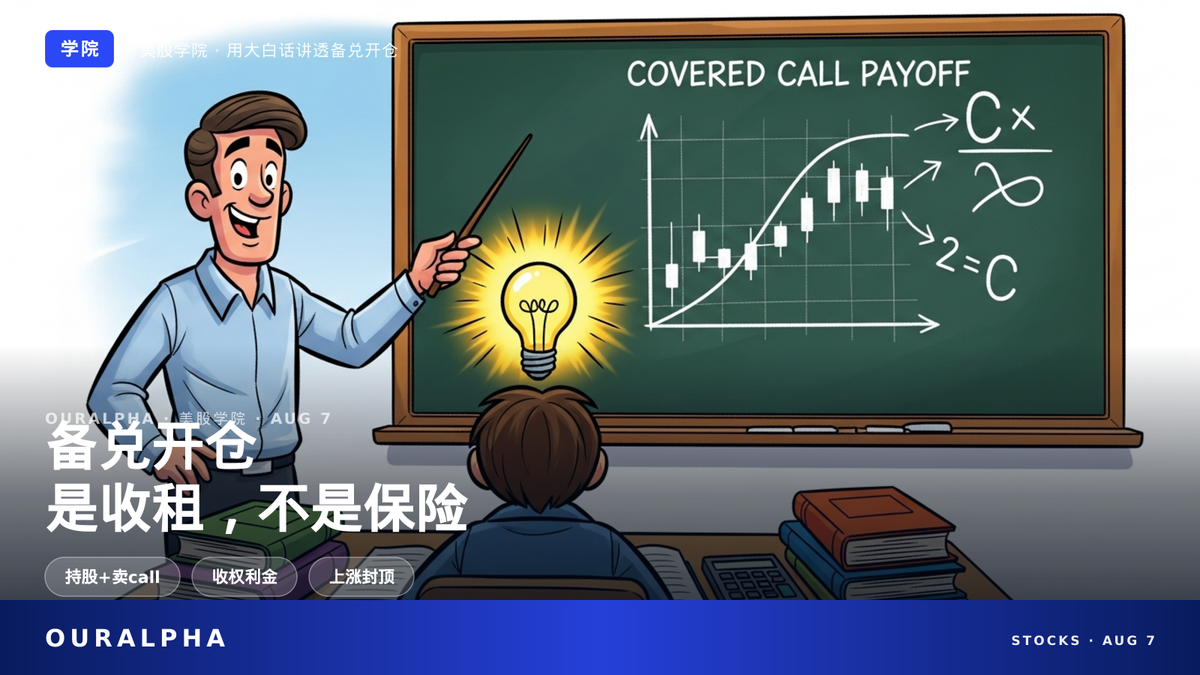
What Is a Covered Call? How It Works, Risks, and Real Examples
A covered call is a common strategy to boost income from stocks you own, but many mistakenly think it protects against losses. This article explains its mechanics, income, and risks in plain language.
Is a Covered Call a Guaranteed "Insurance"?
The Truth: It's an Income Booster, Not Downside Protection
Many beginners hear that covered calls let you "collect rent," thinking they boost income and protect against losses. But that's not the case.
It's actually about trading away some upside for a guaranteed premium—an income-boosting strategy, not a hedge.
Below, we use a house-deposit analogy to help you fully understand how covered calls make money and the risks involved.
TL;DR · IN SHORT
- A covered call = owning stock + selling a call option, collecting premium to boost income.
- Upside is capped at the strike price; downside is only thinly cushioned by the premium.
- It's an income tool, not insurance—it won't protect against big drops.
KEY TERMS
Covered Call: Holding a stock while selling a call option on that same stock, collecting a premium but giving up upside above the strike price.
Premium: The fee the option buyer pays to the seller; it's the direct income from a covered call.
Assignment: When the option buyer exercises, the seller is required to sell the stock at the strike price.
Buy-Write: A strategy of simultaneously buying the stock and selling a call option; the institutional name for a covered call.
CONTENTS
- How Does a Covered Call Actually Work?
- How Do You Calculate the Profit and Risk of a Covered Call?
- Can a Covered Call Protect Against Downside Like Insurance?
- What Market Conditions Suit a Covered Call?
- What Happens If the Sold Call Is Exercised (Stock Is "Called Away")?
- What Extra Risk Is There in Selling a Covered Call Before the Ex-Dividend Date?
- What's the Difference Between a Covered Call and a Cash-Secured Put?
- FAQ
How Does a Covered Call Actually Work?
Simply put, a covered call means you own the stock and then sell a corresponding call option. For example, if you hold 100 shares of a company's stock, you can sell one call option contract on that stock (each contract covers 100 shares)[3] and collect a premium. The word "covered" means you use your own shares as collateral—if the buyer exercises, you have the shares ready to deliver, avoiding the "naked" situation where you don't own the stock and are forced to buy it at a high market price to deliver.
Here's an example: Suppose you own 100 shares of a stock trading at $100. You sell a call option with a strike price of $105 expiring in one month, collecting a premium of $2 per share (i.e., $200 total). If the stock price stays at or below $105 at expiration, the option expires worthless and you keep the $200. If the stock rises to $110, the buyer exercises, and you must sell your shares at $105, earning (105-100)×100+200 = $700. But even if the stock jumps to $120, you still only make $700—your upside is capped. This "capped upside" is the core feature of a covered call: by selling the call, you've sold the potential upside above the strike price to someone else in exchange for a guaranteed premium.
How Do You Calculate the Profit and Risk of a Covered Call?
The profit structure of a covered call can be calculated with a formula: Maximum profit = (Strike price - Stock cost basis + Premium per share) × 100 × number of contracts, achieved when the stock price is at or above the strike price at expiration. The breakeven point = Stock cost basis - Premium per share[4]. This formula might look abstract, so let's break it down: Strike price minus stock cost basis is your profit on the stock when you sell it; adding the premium per share is the extra "rent" you collected. If the stock price is at or above the strike price at expiration, you get this maximum profit. The breakeven point tells you how far the stock can fall before you start losing money—as long as the stock doesn't drop below "cost basis minus premium," you're not losing overall, because the premium gives you a little cushion.
On the risk side, if the stock falls, the premium only provides limited cushioning. For example, if the stock drops from $100 to $90, you lose $10 per share, but with the $2 premium, your actual loss is $8 per share. If the stock goes to zero, the theoretical maximum loss is nearly your entire cost basis minus the premium received[4]. So it doesn't protect against big drops. In other words, the premium is like a thin foam pad—it can cushion minor bumps, but if you fall from a tall building, the foam pad won't catch you.
Can a Covered Call Protect Against Downside Like Insurance?
No! This is the biggest misconception. The call option in a covered call only gives you a premium when you sell it, but if the stock price falls, the option buyer won't exercise (because the strike price is above the market price), and you get no extra compensation. The premium is just a thin buffer—for example, if the stock drops 20%, the premium might only cover 2-3% of the loss[5]. Think of the premium as "rent": you rent out your house and collect rent, but if the house's value drops, the rent doesn't make up for the loss in value.
Research shows that in March 2020, when the S&P 500 fell about 32%, covered-call-style funds also suffered significant losses, proving they can't replace true downside protection[13]. So, a covered call is an "income booster," not "insurance." If you're worried about a big drop, consider buying put options or simply reducing your position, rather than relying on a covered call to "catch" you.
What Market Conditions Suit a Covered Call?
Covered calls suit a neutral or mildly bullish outlook on the underlying stock[2]. For example, if you expect the stock to trade sideways or rise slightly over the next month, selling an at-the-money or out-of-the-money call can earn extra premium. Here, "at-the-money" means the strike price is close to the current stock price, and "out-of-the-money" means the strike price is above the current price. Selling at-the-money options gives higher premiums but a higher chance of assignment; selling out-of-the-money options gives lower premiums but is safer. You can choose based on your view of the stock's movement.
If you expect a big rally, a covered call will cap your gains, so you'd be better off just holding the stock; if you expect a big drop, a covered call won't protect you, so you'd be better off selling the stock or buying puts. So it's best suited for "sideways" or "slow bull" markets. For example, if you think the stock will trade between $100 and $110 over the next few months, selling a $105 call and collecting premium each month can be a nice income stream.
What Happens If the Sold Call Is Exercised (Stock Is "Called Away")?
In a covered call strategy, if the stock price is above the strike price at expiration, the buyer exercises, you get assigned, and you must sell the stock at the strike price[1]. For example, if you sold at $105, even if the market price is $110, you only get $105, but adding the premium, your total return is still decent. Note that American-style options can be exercised by the buyer on any trading day before expiration, but exercise usually happens at expiration. After assignment, your shares are removed from your account and replaced with cash.
If you don't want to sell your shares, you can buy back the option before expiration (possibly at a loss on the premium), or "roll" the option: buy back the current option and sell another with a later expiration or higher strike price[6]. This lets you keep the stock but at an extra cost. Rolling is like "renewing a lease": you first buy out the old lease (pay a penalty), then sign a new lease (collect new rent). If the stock has risen a lot, rolling may not be worth it because buying back the old option can be expensive.
What Extra Risk Is There in Selling a Covered Call Before the Ex-Dividend Date?
In covered calls, the ex-dividend date is the highest-risk time for early assignment. If the call is in-the-money and its remaining time value is less than the upcoming dividend, the buyer is likely to exercise early to capture the dividend, causing your stock to be "called away" early[8]. Here's why: if the buyer exercises and buys your stock, they'll get the dividend on the ex-dividend date; if the dividend is larger than the option's time value, the buyer has an incentive to exercise early.
For example, if the stock is $100, the strike is $95, the option has $5 intrinsic value and $0.50 time value, and the dividend is $1, the buyer would exercise early to get the dividend. So if you don't want to be assigned before the ex-dividend date, be careful. A simple solution: buy back the option before the ex-dividend date, or avoid selling near-term in-the-money options before the ex-dividend date.
What's the Difference Between a Covered Call and a Cash-Secured Put?
A covered call and a cash-secured put are mathematically very similar. By put-call parity, with the same strike price and expiration, their risk-return profiles are nearly identical[12]. The difference is the starting position: a covered call is "own stock + sell call," while a cash-secured put is "hold cash + sell put." Put-call parity sounds advanced, but you can understand it this way: if you want to buy the stock at $100, a covered call means you buy the stock at $100 first, then sell a call to collect premium; a cash-secured put means you sell a put to collect premium, and if the stock falls to $100, you get assigned and buy the stock. Both can end up with you buying the stock at $100 and collecting premium, so they're mathematically similar.
A covered call suits you if you already own the stock and want to boost income; a cash-secured put suits you if you want to buy the stock at a certain price while earning premium. For example, if you want to buy a stock at $90, you can sell a put with a $90 strike, collect premium, and if the stock falls below $90, you get assigned and buy the stock at a discount. If the stock stays above $90, you keep the premium. So, if you own the stock, use a covered call; if you have cash and want to buy the stock, use a cash-secured put. Choose based on your situation.
常见问题 FAQ
How many shares do I need to sell a covered call?
In U.S. options, one standard contract covers 100 shares[3], so you need to own at least 100 shares to sell one covered call.
Do I have to pay taxes on the premium from a covered call?
Yes. The premium is income and is included in your gains for tax purposes. If the option expires worthless, the premium is treated as a short-term capital gain; if assigned, it's added to the sale proceeds of the stock. The exact tax rate depends on your holding period and income level[10].
If I'm worried about a big drop, can I rely on a covered call to hedge?
Not recommended. The premium from a covered call only provides a thin buffer—for example, if the stock drops 20%, the premium might cover only 2-3% of the loss, which won't protect against a real crash[5]. If you're truly concerned about downside risk, consider buying put options or reducing your position, rather than relying on a covered call to "catch" you[13].
Are margin requirements high for a covered call?
No. Because the position is covered by stock, FINRA Rule 4210 states that a short call option that is covered by the underlying security does not require additional margin[9].
What is the maximum loss on a covered call?
If the stock price drops to zero, the theoretical maximum loss is nearly your entire stock cost basis minus the premium received, because the premium only provides limited cushioning and cannot cover losses from a big drop[4].
What's the difference between a covered call and a naked call?
A covered call involves owning the stock, so risk is limited; a naked call involves no stock ownership, so risk is unlimited. The risk of a covered call is much lower than that of a naked call[9].
SOURCES
[1] Investopedia - Covered Calls: How They Work and How to Use Them in Investing
[2] OIC - Covered Call (Buy/Write)
[3] Cboe - Equity Options Specifications
[4] Fidelity - Anatomy of a Covered Call
[5] Fidelity - What is a covered call?
[6] OIC - Covered Call (Buy/Write)
[7] FINRA - Trading Options: Understanding Assignment
[8] Fidelity - Dividends and Options Assignment Risk
[9] FINRA Rule 4210 - Margin Requirements
[10] IRS - Publication 550, Investment Income and Expenses
[11] Cboe / Ibbotson Associates - Case Study on BXM Buy-Write Options Strategy
[12] Investopedia - Put-Call Parity
[13] Interactive Brokers Campus - Covered Call ETFs: The Myth of Downside Protection
This content is for informational purposes only and does not constitute investment advice, trading advice, or any guarantee of returns.