Which Stocks Are Data Center Stocks? How They Benefit and the Risks

Data center stocks are not just AI chips; they also include 'shovel sellers' like power, REITs, and cooling. One article to understand the benefit logic and risks.

OURALPHA · ACADEMY

What Exactly Are Data Center Stocks?
It's Not Just AI Chips—There Are Also These 'Shovel Sellers'

OurAlpha Academy · One Article to Understand the Money-Making Logic of the Data Center Supply Chain

Many people think data center stocks are just AI chip stocks, but the entire supply chain also includes power, REITs, cooling, and more.

These 'shovel sellers' may be even more sensitive to interest rates, grid bottlenecks, and circular financing risks than the chip stocks themselves.

To understand data center stocks, first distinguish who is the 'developer,' who is the 'landlord,' and who is the 'shovel seller.'

TL;DR · IN SHORT

  • Data center stocks = a basket of companies that benefit from AI data center construction, spanning multiple industries.
  • The starting point of the benefit logic is cloud giants' capital spending, with the big four expected to spend $725 billion in 2026.
  • REITs collect 'rent,' power companies supply electricity, and chip and cooling equipment makers sell 'shovels'—different roles, different risks.

KEY TERMS

Data Center: A dedicated facility that houses servers, storage, and networking equipment, used to run computing, storage, and AI training/inference workloads.

Data Center REIT: A real estate investment trust that specifically owns and leases out data center properties. Under U.S. federal tax law, it must distribute at least 90% of its taxable income to shareholders as dividends.

Hyperscaler: Tech giants like Microsoft, Amazon, Google, and Meta that build and operate massive cloud computing and AI data centers. They are the primary source of capital spending for data center construction.

Neocloud: Emerging cloud service providers (like CoreWeave, Nebius) that focus on renting out GPU computing power. They rely on multi-year 'take-or-pay' compute contracts and high leverage to finance data center expansion.

Capital Expenditure (Capex): A company's investment spending on long-term assets like buildings and equipment. For cloud giants, this mainly refers to data center construction and server/chip purchases. It is a key leading indicator for the data center supply chain.

Circular Financing: A cross-transaction structure where companies up and down the supply chain invest in and buy from each other. Critics argue this may artificially inflate apparent demand, and it is a core controversy in current concerns about an 'AI/data center bubble.'

CONTENTS

  1. Which Companies Are Actually Included in Data Center Stocks?
  2. What Is the Logic Behind How Data Center Stocks Benefit?
  3. What Is the Difference Between Data Center REITs and Ordinary Tech Stocks?
  4. Why Are Power Stocks Also Considered Data Center Stocks?
  5. Why Do Semiconductors and the 'Shovel Seller' Segment Benefit Most Directly?
  6. What Is the Difference Between Neoclouds and Traditional Cloud Providers?
  7. What Are the Risks of Data Center Stocks?
  8. FAQ

Which Companies Are Actually Included in Data Center Stocks?

Simply put, data center stocks are not an official industry classification, but a market term for a basket of companies that benefit from the wave of AI and cloud data center construction[1]. It spans multiple different industries, such as cloud giants (Microsoft, Google), data center REITs (Equinix, Digital Realty), power utilities (Constellation Energy), semiconductors (Nvidia), server hardware (Dell), and networking and optical modules (Arista).

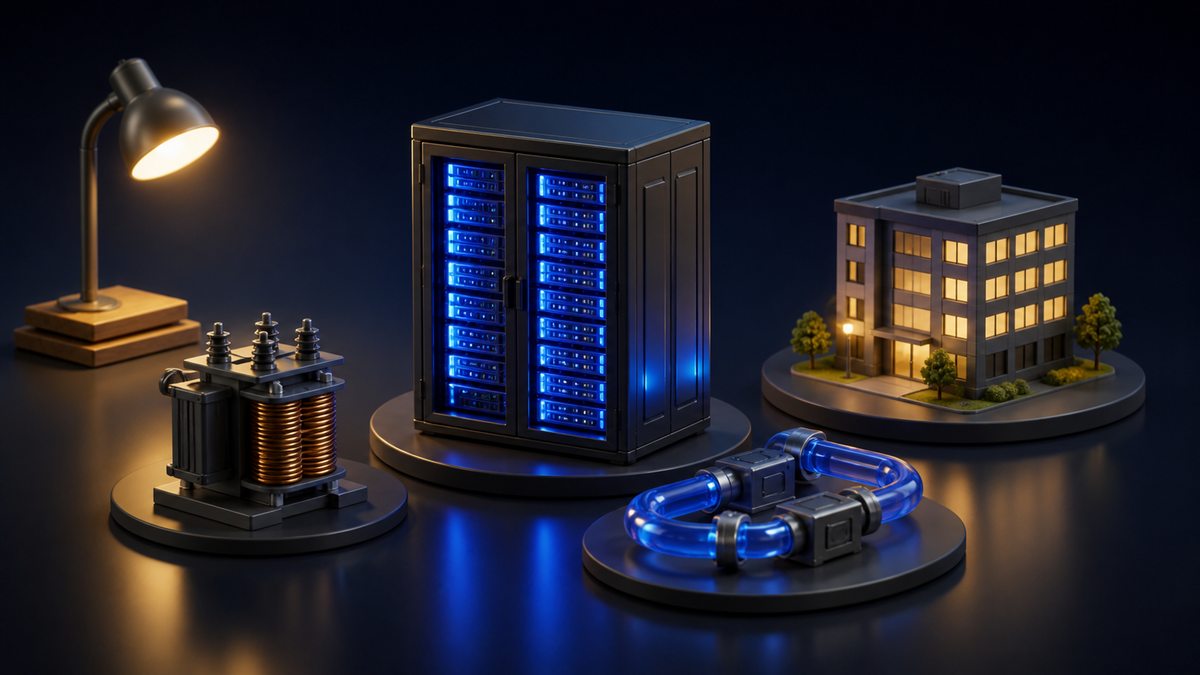
Think of 'data center construction' as a large urban development project. These companies are like different players in that project: there are 'developers' who handle overall planning (cloud giants), 'landlords' who provide the land (REITs), 'power companies' who supply electricity, 'suppliers' who provide building materials and equipment (chips, servers, network gear), and 'leasing companies' who rent out equipment (Neoclouds). They all benefit from the same thing—more and more data centers being built—but they make money in completely different ways.

So, when you buy a 'data center stock,' you might be buying a chip company, a power plant, or even a 'landlord' REIT. This classification is more like a 'theme' than an 'industry,' so before investing, you need to carefully understand what each company actually does to judge whether it truly benefits and to what extent.

What Is the Logic Behind How Data Center Stocks Benefit?

The starting point of the benefit logic is the capital expenditure (Capex) of cloud giants. Capex can be understood as 'construction investment'—like a company deciding how much to spend on building new factories and buying new equipment. For cloud giants, this money is mainly used to build data centers and purchase servers and chips. For example, Microsoft guided in its FY2026 Q4 earnings that its 2026 calendar year capital expenditures and finance leases would be about $175 billion, with roughly two-thirds going to short-cycle assets like CPUs/GPUs and the rest to data center buildings themselves[2]. Short-cycle assets refer to equipment that is replaced quickly and has a shorter useful life, like chips and servers, while the buildings themselves are long-term assets. Alphabet, Google's parent company, also raised its full-year capital expenditure guidance to $195 billion-$205 billion in Q2 2026, with about 60% going to servers and 40% to data centers and network equipment[3].

According to statistics, the combined capital expenditures of Google, Amazon, Microsoft, and Meta in 2026 are expected to total about $725 billion, up about 77% from roughly $410 billion in 2025[4]. This huge sum eventually flows to chip makers, server vendors, power companies, and REITs—this is the 'water source' for the entire supply chain. Think of capital expenditures as a river: upstream are the tech giants, who 'sprinkle' the money down, and downstream are the various suppliers, like farmland along the river, which need irrigation to grow. Without this money, the entire supply chain would dry up.

Therefore, when following data center stocks, the first thing to watch is the capital expenditure plans of these giants. If they announce increased investment, it usually means the performance of companies in the supply chain may improve; conversely, if they cut investment, it could bring pressure.

What Is the Difference Between Data Center REITs and Ordinary Tech Stocks?

Data center REITs play the role of 'landlord' in the benefit chain. A REIT (Real Estate Investment Trust) is a company that invests specifically in real estate. Unlike ordinary companies, it cannot freely use its profits; it must distribute most of its earnings to shareholders. Under U.S. federal tax law, a REIT must distribute at least 90% of its taxable income to shareholders as dividends to qualify for tax exemption at the corporate level[5]. In other words, when a REIT makes money, it must give at least 90% of it to shareholders, keeping very little for itself. Therefore, REITs typically have higher dividend yields and are more like a 'rent-collecting' business than a high-growth tech stock.

For example, if you buy an ordinary tech stock, the company might reinvest its profits in R&D or expansion, and the stock price might rise. But a REIT is more like a 'landlord': it rents out data centers to customers, and most of the rent it collects is directly distributed to you. So your return mainly comes from dividends, not from big stock price gains.

The two largest data center REITs globally are Equinix and Digital Realty. Equinix raised its full-year revenue guidance for the second consecutive quarter after Q2 2026 earnings, to 11%-12% year-over-year growth. The company said this was the largest single guidance raise in its history, directly reflecting accelerating AI infrastructure demand[6]. This shows that even a 'rent-collecting' business can benefit from the AI wave, because customers need more data centers to house their servers.

Why Are Power Stocks Also Considered Data Center Stocks?

Electricity has become a new bottleneck for data center expansion. Data centers are 'electricity hogs'—servers and cooling systems all require massive amounts of power. A 2024 report from the U.S. Department of Energy's Lawrence Berkeley National Laboratory (LBNL) showed that U.S. data center electricity consumption accounted for about 4.4% of total U.S. electricity use in 2023, and is projected to rise to 6.7%-12% by 2028[7]. This percentage may seem small, but it is growing rapidly, and data centers are often concentrated in specific regions, which can put enormous pressure on local grids. The International Energy Agency (IEA) also estimates that global data center electricity consumption will rise from about 415 terawatt-hours in 2024 to about 945 terawatt-hours in 2030, with AI-accelerated servers' electricity consumption growing at an annual rate of about 30%[8]. A terawatt-hour is a huge unit of electricity—imagine a city's annual electricity use. AI servers are especially power-hungry because GPU chips have high power requirements.

So, companies like Constellation Energy, which signed a 20-year power purchase agreement with Microsoft and restarted the Three Mile Island nuclear plant specifically to power AI data centers, are also classified as data center stocks[9]. This is like in a gold rush: besides the gold miners, the people selling water and shovels also make money. Power companies are the 'water sellers'—data centers can't function without electricity, so as power demand surges, power stocks naturally benefit.

Why Do Semiconductors and the 'Shovel Seller' Segment Benefit Most Directly?

Semiconductors/AI chips are one of the most direct beneficiaries of data center construction. Nvidia's data center revenue in Q1 FY2027 reached $75.1 billion, up 92% year-over-year, accounting for the vast majority of the company's total revenue[10]. This is because AI training and inference require massive amounts of GPU chips, and Nvidia is the main supplier, so its performance growth has been remarkable. In addition, power equipment and cooling (like Vertiv), server systems (like Super Micro, Dell), and networking and optical modules (like Arista Networks) form the 'shovel seller' camp. For example, Vertiv reported Q2 2026 net sales of $3.274 billion, up 24% year-over-year, and raised its full-year guidance to about $14 billion in sales[11].

These companies don't own data centers themselves, but they make money by selling equipment and services, just like the shovel sellers in a gold rush. Not every gold miner strikes gold, but the shovel sellers are sure to make money. Data center construction requires a lot of servers, cooling systems, and network equipment, and these 'shovel sellers' benefit from the construction regardless of which data center ultimately succeeds.

However, it's also important to note that these companies' performance can be volatile because their revenue is highly dependent on the capital expenditure cycle. If the giants cut investment, orders may decline.

What Is the Difference Between Neoclouds and Traditional Cloud Providers?

Neoclouds (like CoreWeave, Nebius) are the most highly leveraged players in the data center stock space. They sign multi-year 'take-or-pay' compute contracts with cloud providers/AI companies, then use those contracts to borrow money to build data centers. Their business is essentially 'renting out GPU compute,' not offering a comprehensive cloud platform[12].

Think of it this way: traditional cloud providers (like AWS, Azure) are like large shopping malls—they build the space, then attract tenants and offer various services. Neoclouds are more like companies that rent out 'high-end equipment.' They first sign long-term leases with customers (say, 5 years), then take those leases to the bank to get loans, buy a large number of GPUs, and rent them out to customers. The advantage of this model is that once a contract is signed, future revenue is secured. But the downside is that if customers default or demand drops, the company still has to repay its debt, which puts a lot of pressure on it.

This model grows extremely fast when AI demand is strong, because AI companies need massive compute but can't afford or don't want to buy it themselves, so they rent GPUs from Neoclouds. However, if demand falls short of expectations, high leverage and long-term contracts can lead to significant financial strain, or even a cash flow crisis.

What Are the Risks of Data Center Stocks?

One risk is overcapacity. Data center REITs explicitly list 'overcapacity due to demand falling short of expectations' as a major risk factor in their latest 10-K filings (the annual report that U.S. listed companies must submit to the SEC), including customer self-building/consolidation of data centers and industry downturn, which could lower occupancy rates and rental levels[13]. In other words, if all companies frantically build data centers but demand doesn't materialize, there will be 'vacancies,' rents will fall, and REIT revenue will decline.

Another risk is the 'circular financing' controversy—there are extensive cross-investments and cross-purchases of compute/chips among companies like Nvidia, OpenAI, Oracle, Microsoft, and CoreWeave. Critics worry this structure may artificially inflate real demand, and it is a core point of contention in the current 'AI/data center bubble' debate[14]. For example, Company A invests in Company B, and Company B uses that money to buy chips from Company A. Both companies' revenues grow, but actual demand may not be as high—it's like 'left hand passing to right hand,' artificially inflating prosperity. If these concerns materialize, they could trigger a market correction of overvalued stocks.

Therefore, when investing in data center stocks, you can't just look at the growth story. You also need to consider whether demand is real, whether finances are healthy, and whether there are risks of excessive leverage and cross-transactions.

常见问题 FAQ

Why Are Data Center Stocks Especially Sensitive to Interest Rate Changes?

Many parts of the chain rely on 'borrowing to expand': REITs are required to distribute at least 90% of their taxable income to shareholders, leaving little cash on hand, so they mainly borrow to build data centers[5]; Neoclouds go even further—they sign long-term compute contracts first, then use those contracts to get bank loans to buy GPUs, making them even more leveraged[12]. Rising interest rates directly increase these companies' financing costs and also make REIT dividends less attractive relative to bonds. Therefore, data center stocks (especially REITs and Neoclouds) are especially sensitive to interest rate changes.

Why Have Data Center Stocks Surged Since 2026?

Mainly because cloud giants' capital expenditures have continued to surge. The big four's combined capital expenditures in 2026 are expected to total about $725 billion, up about 77% from 2025, directly boosting demand and earnings expectations for companies up and down the supply chain[4].

Could Data Centers Be Overbuilt, Leading to Overcapacity?

It's possible. REITs have already listed 'overcapacity due to demand falling short of expectations' as a major risk in their 10-K filings. If demand declines, occupancy rates and rents could fall[13].

How Can Ordinary Investors Participate in Data Center Stock Investing?

You can directly buy individual stocks from different parts of the supply chain, such as cloud giants, data center REITs, power companies, chip makers, server/cooling equipment makers, etc. You can also choose to focus on just one segment you understand better, rather than trying to own everything. It's important to note that different segments have completely different business models, growth rates, and risks (for example, REITs are more about collecting rent, while semiconductors are more cyclical). Before investing, it's best to clarify which type of role you're buying and then allocate based on your own risk tolerance.

If the Power Grid Can't Keep Up, Could It Slow Down Data Center Expansion?

There is that risk. Data centers are often concentrated in specific regions, and their electricity demand is concentrated and huge, which can put enormous pressure on local grids[7][8]. This is why companies like Constellation Energy, which can provide stable power (for example, signing a 20-year power purchase agreement with Microsoft and restarting the Three Mile Island nuclear plant specifically for AI data centers), are considered an important part of the data center stock story—whether power can keep up directly affects the speed of data center construction and operation[9].

What Extra Risks Should Investors Watch When Investing in Neoclouds (Like CoreWeave, Nebius)?

Neoclouds' business model is to first sign multi-year 'take-or-pay' compute contracts, then use those contracts to borrow money to buy GPUs and build data centers[12]. This means that once a contract is signed, revenue is relatively secured, but the debt the company carries doesn't decrease just because customer demand changes. If customers default or AI compute demand falls short of expectations, high leverage can amplify financial pressure, and could even lead to cash flow problems. Before investing, you need to pay extra attention to these companies' debt levels and the creditworthiness of their contract customers.

Are Data Center Stocks, AI Stocks, and Semiconductor Stocks the Same Thing?

Not exactly. AI stocks are broader in scope, semiconductor stocks are just one part of the data center supply chain, and data center stocks also include non-semiconductor segments like power and REITs.

SOURCES

[1] Data Center Stocks 2026: 50+ Companies (StockTitan)
[2] Microsoft FY2026 Q4 Earnings Press Release
[3] Alphabet Q2 2026 Results (SEC 8-K)
[4] Tech AI spending approaches $700 billion in 2026 (CNBC)
[5] 26 U.S. Code §857 — Taxation of REITs (Cornell Law)
[6] Equinix Q2 2026 Results and Guidance
[7] DOE Report on Data Center Electricity Demand
[8] IEA Energy and AI Report
[9] Constellation to Launch Crane Clean Energy Center
[10] NVIDIA Q1 FY2027 Results
[11] Vertiv Q2 2026 Results
[12] Neocloud Stocks: The Public GPU-Cloud Operators (Macroplane)
[13] Digital Realty Form 10-K FY2025 (SEC)
[14] NVIDIA is about to spend $750 billion on AI (NPR)

This content is for informational purposes only and does not constitute investment advice, trading advice, or any guarantee of returns.

Keep Reading

How to Pick High-Dividend U.S. Stocks: Yield, Payout Ratio, and Pitfalls Explained

OURALPHA · ACADEMY

Are High-Dividend Stocks a Money-Making Miracle or a Trap?
Understand These 5 Things Before You Jump In

OurAlpha Academy · Plain-English Guide to the Logic Behind High-Dividend Investing

Seeing stocks with 8% or 10% dividend yields? Don't get too excited—high dividends can be a trap.

Many high yields are just an illusion caused by falling stock prices, like AT&T's dividend being cut in half in 2022.

What really matters is the payout ratio, cash flow, and dividend consistency—not just chasing the

Read full story →

Stay ahead of the market — never miss a deep dive

Follow OurAlpha for AI-driven US equity research and market insight, every day.