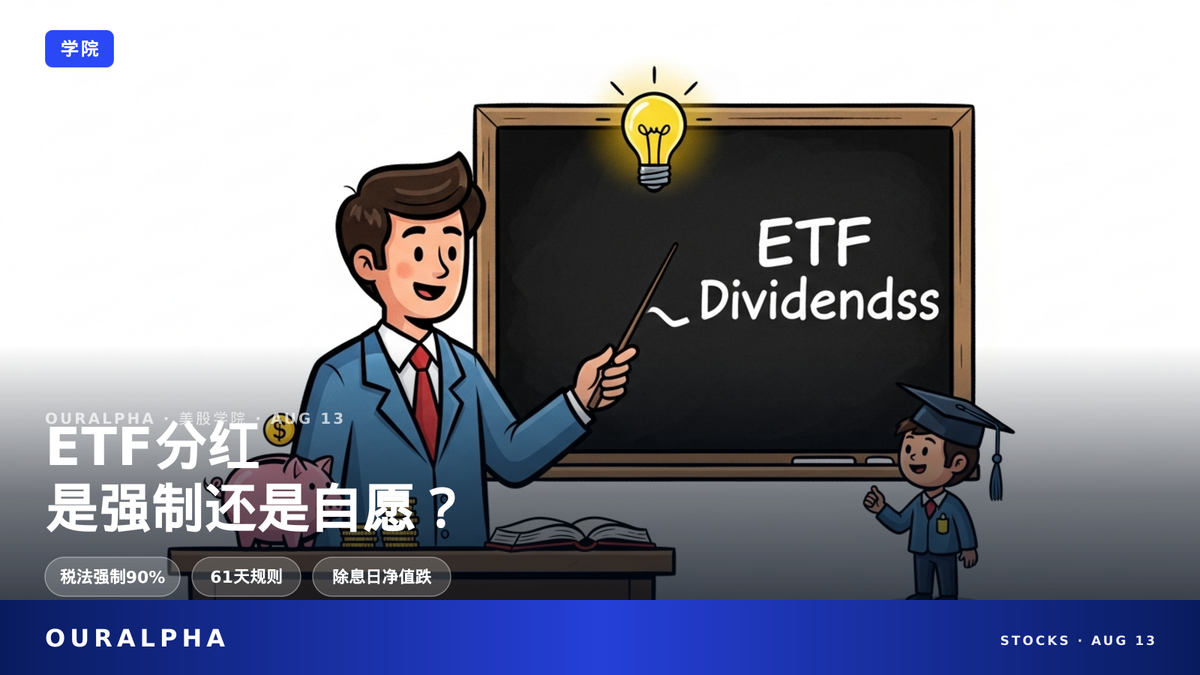
What Are ETF Dividends? Payout Rules and Tax Details
ETF dividends are legally required, not voluntary. But the tax rate depends on your holding period—do you know the 61-day rule?
Do US Stock ETFs Pay Dividends?
How They Work and How They're Taxed, Explained Simply
Many people think ETF dividends are just the fund company being generous, but it's actually US tax law forcing them.
To keep their tax-free 'pass-through' status, ETFs must distribute at least 90% of their taxable net income to shareholders.
But the tax rate on what you receive—0% or 37%—depends on a often-overlooked '61-day rule.'
TL;DR · IN SHORT
- ETF dividends = passing along stock dividends to you, not extra income.
- Tax law forces ETFs to distribute at least 90% of net income, or the fund pays taxes.
- Hold for less than 61 days, and dividends may be taxed at up to 37%.
- On the ex-dividend date, the NAV drops, but that's an accounting adjustment, not a loss.
KEY TERMS
RIC (Regulated Investment Company): A tax status for funds under US tax law Subchapter M, requiring ETFs to distribute at least 90% of taxable net investment income to shareholders to avoid corporate income tax at the fund level.
Qualified Dividend: Dividends that meet certain holding period and other conditions, taxed at the lower long-term capital gains rates of 0%/15%/20% instead of ordinary income tax rates.
Ex-Dividend Date: The date on which buyers of the fund are no longer entitled to the upcoming dividend, and the fund's NAV is mechanically reduced by the dividend amount.
Capital Gain Distribution: Realized gains from a fund's forced sales due to rebalancing or index changes, typically paid once a year, distinct from regular dividends.
CONTENTS
- Do US Stock ETFs Pay Dividends?
- Why Must ETFs Pay Dividends? Is It Voluntary?
- How Are ETF Dividends Paid? How Often?
- Why Does the NAV Drop After a Dividend? Is It a Loss?
- Do ETF Dividends Need to Be Taxed? How to Distinguish Qualified vs. Non-Qualified Dividends?
- Besides Dividends, What Else Do ETFs Pay?
- Are Higher Dividend Yield ETFs Always Better?
- FAQ
Do US Stock ETFs Pay Dividends?
Simply put: yes, and many do. ETFs themselves don't create profits; their 'dividends' are essentially passing along the dividends and interest from the underlying stocks or bonds, based on your ownership share[1]. So, as long as an ETF holds dividend-paying stocks or interest-bearing bonds, it will generally pay dividends.
For example, if you buy an ETF tracking the S&P 500 (like SPY), the companies it holds, such as Apple and Microsoft, pay dividends each year, and the ETF pools those dividends and distributes them to you. If you're not sure what an ETF is, check out this article: What is an ETF? Differences and Risks vs. Stocks and Funds Explained.
Here's a key point: an ETF isn't a profit-making company; it's just a 'basket' that packages a bunch of stocks or bonds together. When you buy an ETF, you indirectly own those assets in the basket. So, when the stocks in the basket pay dividends, the ETF doesn't keep the money; it passes it along to you proportionally. Think of it like sharing an apartment with friends: the landlord collects rent each month and splits it among you based on your share of the space—the landlord doesn't create the rent, just collects and distributes it. The ETF is the 'landlord,' and the underlying companies are the 'tenants.'
So, if you see an ETF advertised as 'high dividend,' there must be underlying stocks paying dividends or bonds paying interest. If an ETF holds stocks that don't pay dividends, it won't pay you any. So, to get dividends from an ETF, first figure out which 'laying hens' are in its portfolio.
Why Must ETFs Pay Dividends? Is It Voluntary?
It's not voluntary at all. Most US ETFs are registered as 'regulated investment companies' (RICs) under tax law. To maintain their tax-free 'pass-through' status, funds must distribute at least 90% of their taxable net investment income (plus 90% of net tax-exempt income) as dividends to shareholders; otherwise, the entire fund is subject to corporate income tax[2].
In other words, dividends are legally required, not a matter of the fund company being 'in a good mood.' It's like a landlord being required to share a portion of rent with tenants, or face heavy taxes.
This system is designed to avoid double taxation. Imagine if an ETF kept its earnings instead of distributing them: the ETF would pay corporate income tax as a company, and then when you sell the ETF, you'd pay capital gains tax again—the same money taxed twice, which is unfair to investors. To prevent this, US tax law gives ETFs (and mutual funds) a 'green channel': as long as they distribute at least 90% of their earnings, they don't pay corporate tax, and earnings are taxed only once, at the investor level. That's the 'pass-through' status—earnings flow through the fund to investors, and the fund doesn't hold back.
So, dividends aren't the fund's 'generosity' but a legal obligation. If you see an ETF that doesn't pay dividends, it's either breaking the rules (almost impossible) or its assets don't generate income (like gold ETFs, since gold doesn't pay interest or dividends).
How Are ETF Dividends Paid? How Often?
ETF dividends are paid in cash, directly into your brokerage account. If you've enabled 'dividend reinvestment' (DRIP, offered by most brokers), the cash dividend is automatically used to buy more shares of the ETF (including fractional shares) in the secondary market[3].
There's no standard frequency; it's set by the fund: broad-based stock ETFs (like SPY) typically pay quarterly[4]; some monthly income/covered call strategy ETFs (like JEPI, JEPQ) pay monthly[5]; others pay semi-annually or annually. So, how often your ETF pays depends on its prospectus.
A few details are worth expanding on. First, cash dividends are automatically credited; you don't need to do anything. The money goes into your account balance. If you have DRIP enabled, the broker will automatically use that cash to buy more ETF shares on the payment date (or shortly after), including fractional shares (like 0.3 shares), so your holdings grow, creating a compounding effect. It's like having a hen that lays eggs; instead of eating the eggs, you hatch them into chicks, which grow up and lay more eggs—more and more eggs.
Second, dividend frequency varies by fund, depending on its investment strategy and underlying assets. For example, broad-based index funds (like SPY) track the S&P 500, whose components mostly pay quarterly dividends, so they pay quarterly. In contrast, covered call strategy ETFs like JEPI and JEPQ earn option premiums in addition to dividends, which can be settled monthly, so they pay monthly, providing investors with more consistent cash flow.
Third, to find out when and how much a specific ETF pays, the easiest way is to check its 'dividend calendar' or prospectus. Funds usually announce ex-dividend and payment dates in advance, which you can find on the fund's website or your broker's app.
Why Does the NAV Drop After a Dividend? Is It a Loss?
On the ex-dividend date, the fund's net asset value (NAV) is mechanically reduced by the dividend amount (e.g., from $50 to $48 for a $2 dividend)[6]. It's like taking $100 out of your wallet and putting it in another pocket—the wallet has less, but your total assets haven't changed.
So, a drop in NAV after a dividend isn't an investment loss; it's an accounting adjustment. Don't panic when you see the NAV drop.
To understand better, let's use a concrete example. Suppose an ETF has a NAV of $50 per share, and you hold 100 shares, worth $5,000 total. One day, the fund declares a $2 per share dividend. On the ex-dividend date, the NAV automatically adjusts from $50 to $48 (50-2=48). Your 100 shares are now worth $4,800, and you receive $200 in cash (2×100). Your total assets are still $5,000 ($4,800 + $200), not a penny less.
But here's a common misunderstanding: the drop in price (or NAV) after a dividend isn't because the market is bearish; it's because the fund has 'stripped out' a portion of its assets to give to you. It's like having a big cake; you cut off a slice to eat, and the remaining cake is smaller, but the total cake you have (eaten + remaining) hasn't changed.
However, note that after a dividend, the price does 'gap down,' but market sentiment can cause the price to rise or fall during the day, which is unrelated to the dividend itself. So, if you see the NAV drop after a dividend, don't rush to panic; figure out whether it's a 'real drop' or an 'ex-dividend adjustment.'
Do ETF Dividends Need to Be Taxed? How to Distinguish Qualified vs. Non-Qualified Dividends?
Yes, they're taxed, but the rates can differ a lot. If the ETF holds US (or qualifying foreign) company stocks, and you hold the ETF shares for more than 60 days within the 121-day window around the ex-dividend date (the '61-day rule'), the ordinary dividends may be taxed at the lower long-term capital gains rates of 0%/15%/20%, making them 'qualified dividends'; otherwise, they're taxed at ordinary income rates (up to 37%)[8].
Note that it's not enough for you to meet the 61-day rule—the ETF itself must also hold the underlying stocks for the same 61/121-day period; otherwise, even if the fund labels the dividend as 'qualified,' the portion you receive may still be taxed as non-qualified[9]. This is because the ETF is a 'pass-through' structure; whether the dividends it receives are 'qualified' depends on how long the fund held the stocks. It's like renting from a sublessor; if the sublessor hasn't lived there the required number of days, you can't enjoy the discount either.
Different types of ETFs have different tax treatments for dividends. REITs (real estate investment trusts) don't pay corporate tax themselves, so their dividends usually don't qualify for the qualified dividend rate and are taxed at ordinary income rates; dividends from foreign stocks may also not qualify unless there's a tax treaty; and 'tax-exempt interest dividends' from municipal bond ETFs, if they invest in US state or local government bonds, are typically exempt from federal income tax, and possibly state tax (depending on your state)[10].
Let's break down the '61-day rule.' Suppose an ETF goes ex-dividend on June 1. The '121-day window' is roughly from 60 days before to 60 days after the ex-dividend date, i.e., April 2 to July 30. You must hold the ETF for at least 61 days within that window, and those 61 days can't be in a 'short sale' or 'option hedge' position. For example, if you buy on April 10 and hold until July 1, that's 82 days, meeting the requirement, so the dividend is taxed as qualified. But if you buy on May 20 and sell on June 5, that's only 16 days, not meeting the requirement, so the dividend is taxed as ordinary income.
Besides Dividends, What Else Do ETFs Pay?
In addition to regular dividends, ETFs typically make an additional 'capital gain distribution' once a year (often in December), from net capital gains realized when the fund is forced to sell securities due to index rebalancing or constituent changes. These are taxed at long-term capital gains rates (up to 15% or higher depending on your bracket), regardless of the stock price's rise or fall[7].
What's a capital gain distribution? Although ETFs are passively managed, indices periodically adjust their constituents. For example, if a stock is removed from the S&P 500, the ETF must sell it. If the sale price is higher than the purchase price, a capital gain is realized. These gains can't stay in the fund indefinitely; they must be distributed to shareholders, or the fund would face taxes. So, at the end of each year, many ETFs pay an 'extra bonus'—that's the capital gain distribution.
This payment is unrelated to the fund's NAV performance. Even if the NAV has dropped since you bought, as long as the fund had internal trading profits, you may still receive a capital gain distribution. For example, you buy an ETF at the start of the year, and the NAV drops from $100 to $90, but the fund sold a stock that had risen significantly during a mid-year rebalance, making a profit. At year-end, you'll still receive a capital gain distribution. It's like owning shares in a restaurant; business is bad, but the owner sold the kitchen equipment for a profit, so you still get a dividend at year-end.
Each January-February, your broker sends you Form 1099-DIV: Box 1a shows total ordinary dividends, Box 1b shows the qualified portion, and Box 2a shows capital gain distributions. These are taxed at different rates, and you need to report them accordingly on your individual income tax return, Form 1040[11]. However, if you hold the ETF in a retirement account like an IRA or 401(k), you don't pay taxes on these dividends currently; you'll pay taxes when you withdraw, according to withdrawal rules.
Are Higher Dividend Yield ETFs Always Better?
Not necessarily. When evaluating an ETF's 'yield,' there are two common measures: the SEC 30-day standardized yield (which only includes net interest/dividend income from the last 30 days, annualized) and the 'distribution yield' (or TTM yield, calculated as total dividends paid over the past 12 months divided by the latest NAV, which may also include option premium income for options strategies). These two can differ significantly; a higher distribution yield doesn't mean the fund is more profitable, and you should be wary if the dividend includes a 'return of capital' component[12].
So, don't just jump in because the yield is high; understand where the income comes from. If you're planning to dollar-cost average long-term, check out this article: What is Dollar-Cost Averaging into US Stock Indices? Principles, Risks, and How-To Guide.
Let's explain these two yields. The SEC 30-day standardized yield is what funds must disclose; it only calculates the interest and dividends the fund actually received in the last 30 days, then annualizes it. This number is conservative and easy to compare across funds. The distribution yield, on the other hand, is calculated by dividing the total distributions over the past 12 months by the current NAV. This number may include capital gain distributions and even 'return of capital'—for example, some funds, to maintain high dividends, may distribute a portion of your principal back to you. It's like taking money out of your savings and calling it 'interest'; over the long term, your assets shrink.
For example, an ETF might have an SEC 30-day yield of 3%, but a distribution yield of 8% over the past 12 months. The 5% difference could come from capital gain distributions, option premiums, or even return of capital. If you see the 8% and jump in, thinking you'll earn a steady 8% annually, you might be fooled.
So, when evaluating an ETF's dividend capability, don't just look at one number. Break down the sources: are they from dividends, interest, option premiums, or capital gains? Are they sustainable? For instance, covered call strategy ETFs (like JEPI) have higher distribution yields, but they include option premium income, which fluctuates with market conditions and isn't fixed. Also, if an ETF's distribution yield is significantly higher than its SEC 30-day yield, be cautious—it might be 'eating into principal.'
常见问题 FAQ
Are there any US stock ETFs that don't pay dividends at all?
Yes, it's possible. If an ETF holds assets that don't generate dividends or interest (like many growth stocks that don't pay dividends, or commodities like gold), then the ETF naturally has no dividends to pay. But most broad-based stock ETFs and bond ETFs do pay dividends because their underlying holdings generate dividends or interest.
Why do some US stock ETFs pay monthly dividends and others quarterly?
The frequency is set by the fund itself, depending on the underlying assets and investment strategy. Broad-based index ETFs (like SPY) track components that mostly pay quarterly dividends, so the fund pays quarterly. In contrast, covered call strategy ETFs like JEPI and JEPQ have monthly option premium income in addition to dividends, so they choose to pay monthly to provide investors with more consistent cash flow.
For US stock ETF dividends, does the fund automatically withhold taxes, or do I need to file taxes myself?
You need to file and pay taxes yourself; the fund doesn't withhold. Each January-February, you'll receive Form 1099-DIV from your broker, which lists the total dividends and their classifications (ordinary, qualified, capital gain distributions, etc.). You then report these on your individual income tax return, Form 1040, at the applicable rates.
After receiving an ETF dividend, does my total assets really increase?
Not on the ex-dividend date. The dividend just converts a portion of the fund's assets into cash in your account. For example, the NAV drops from $50 to $48, and you receive $2 in cash, so your total assets (share value + cash) remain roughly the same. What truly increases your total assets over the long term is the appreciation of the underlying assets and the compounding effect of reinvesting dividends, not the 'dividend' action itself.
Can ETF dividends be automatically reinvested? What is DRIP?
Yes. DRIP stands for Dividend Reinvestment Plan, offered by most brokers. The cash dividend is automatically used to buy more shares, including fractional shares, enabling compounding.
If I hold ETFs in an IRA/401(k), do I still need to pay taxes on dividends?
In tax-deferred or tax-exempt accounts like IRAs or 401(k)s, you don't pay taxes currently; taxes are deferred until withdrawal, or tax-free in the case of Roth accounts.
How can I tell if an ETF's high dividend is 'robbing Peter to pay Paul' (return of capital)?
Compare the SEC 30-day standardized yield with the distribution yield (TTM yield) over the past 12 months. If the distribution yield is significantly higher than the SEC 30-day yield, the difference may come from capital gain distributions, option premiums, or could include return of capital—that is, returning your own principal as 'dividends.' In such cases, further analyze whether the dividend sources are sustainable, rather than just looking at the yield number.
SOURCES
[1] Do ETFs Pay Dividends? - Fidelity
[2] Instructions for Form 1120-RIC (2025) - IRS
[3] DoubleLine ETF Trust - Form 485BPOS (SEC EDGAR prospectus)
[4] SPY Dividend History, Dates & Yield - StockAnalysis
[5] SCHD vs JEPI: Dividend Growth or Monthly Income? - ETF.com
[6] How Distributions Work - AdvisorShares
[7] SPDR Series Trust - Form 485BPOS (SEC EDGAR prospectus)
[8] Topic no. 404, Dividends and other corporate distributions - IRS
[9] What are qualified dividends and how are they taxed? - Fidelity
[10] How Are ETF Dividends Taxed? - ETF.com
[11] About Form 1099-DIV, Dividends and Distributions - IRS
[12] Evaluating ETF yield - Schwab Asset Management
This content is for informational purposes only and does not constitute investment advice, trading advice, or any guarantee of returns.