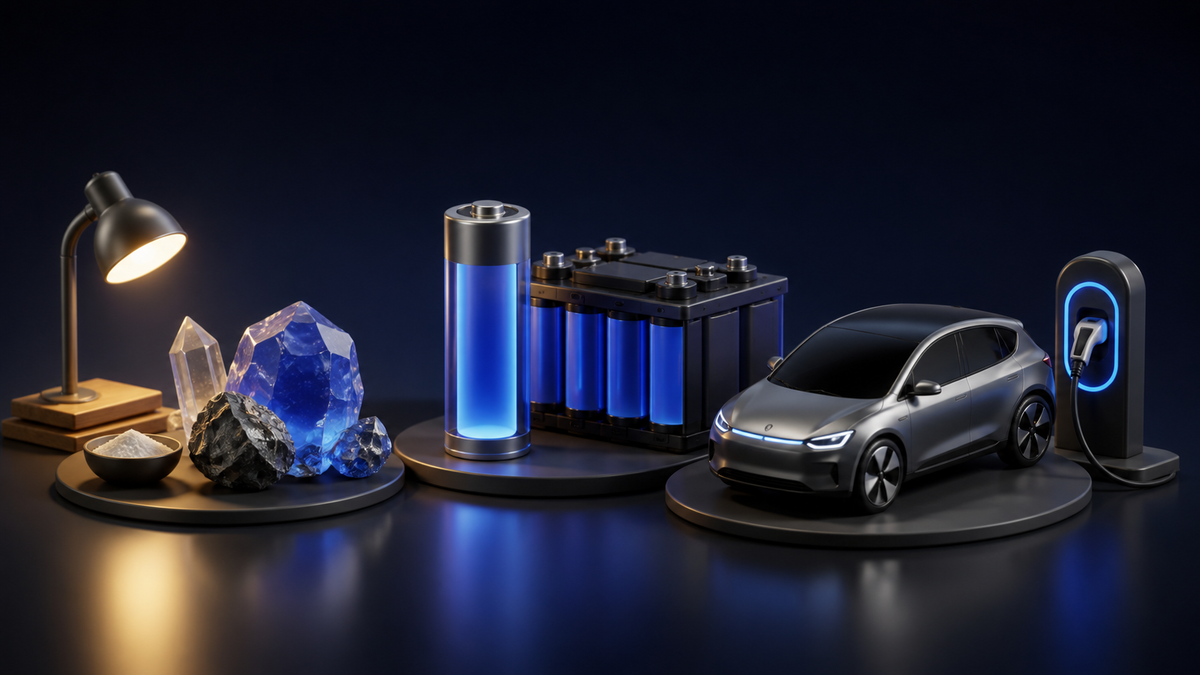
What Is the EV Supply Chain? Upstream Lithium, Midstream Batteries, Downstream Vehicles & Charging Explained
The EV supply chain is more than just automakers: upstream lithium mining, midstream batteries, and downstream charging each offer opportunities and risks. The $7,500 tax credit has expired, and the policy subsidy is gone.
What Is the EV Supply Chain Really About?
A Simple Guide from Lithium Mines to Charging Stations
Many people think the EV supply chain is just a few carmakers, but what really drives costs and profits are the upstream lithium, cobalt, and nickel mines, the midstream battery cells, and the battle over charging standards.
Also, the $7,500 U.S. EV tax credit expired on September 30, 2025, so the 'policy subsidy' investment thesis no longer holds.
This article breaks down the entire supply chain and shows how money flows through each link.
TL;DR · IN SHORT
- The EV supply chain splits into upstream mining, midstream batteries, downstream vehicles and charging, with midstream batteries capturing the most profit.
- Chinese battery makers CATL and BYD together hold about 55% of global market share, dominating midstream manufacturing.
- The $7,500 U.S. EV tax credit expired on September 30, 2025, so the 'policy subsidy' thesis no longer holds.
- The U.S. has imposed tariffs of up to 100% on Chinese EVs and batteries, forcing supply chain localization and slowing the EV plans of traditional automakers like Ford and GM.
- The NACS charging standard has become the unified North American connector, adopted by major automakers after Tesla opened its patents.
KEY TERMS
EV Supply Chain: The full chain from raw material extraction (upstream) like lithium, cobalt, and nickel, to battery material refining and cell manufacturing (midstream), to battery assembly, vehicle production, and charging networks (downstream).
NMC / LFP Batteries: Two main battery chemistries: NMC (nickel-cobalt-manganese) offers higher energy density and longer range; LFP (lithium iron phosphate) contains no cobalt or nickel, is safer and cheaper, but has lower energy density.
FEOC (Foreign Entity of Concern): A U.S. Treasury designation for 'foreign entities of concern,' including companies controlled by China, Russia, Iran, or North Korea. Battery components or critical minerals from these entities make vehicles ineligible for federal tax credits.
NACS (North American Charging Standard / SAE J3400): Tesla's open charging connector standard, adopted by the U.S. government and nearly all major automakers as the unified North American charging interface since 2023.
CONTENTS
- What exactly does the EV supply chain include?
- Why is the midstream battery the 'heart' of the supply chain?
- Why did the $7,500 U.S. tax credit disappear?
- How big is the impact of the 100% U.S. tariff on Chinese EVs?
- Why has the NACS charging standard unified North America?
- Why do EVs need twice as many chips as gas cars?
- What are the sub-sectors of U.S. EV concept stocks?
- FAQ
What exactly does the EV supply chain include?
Simply put, the EV supply chain is like cooking a meal: upstream is buying ingredients (lithium, cobalt, nickel, graphite, etc.), midstream is washing, chopping, and cooking (material refining, cell manufacturing), and downstream is serving the dish (battery assembly, vehicle production) and after-meal service (charging networks, recycling).[1] Every step is interconnected; if any link fails, the whole meal can be ruined. For example, if upstream lithium supply tightens, midstream battery makers must bid up raw material prices, and downstream automakers either raise prices or cut production.
Chile and the Democratic Republic of the Congo hold about 50% of global lithium and cobalt reserves, respectively.[1] So, mining supply in these two countries directly affects battery costs. Think of lithium and cobalt as the 'salt' and 'sugar' of batteries—without them, you can't make a battery. If these countries face policy changes, strikes, or natural disasters, global battery prices will fluctuate. Midstream manufacturing is dominated by Asia: China produces about three-quarters of the world's lithium batteries, accounts for 70% of global cathode material capacity, and refines more than half of the world's lithium, cobalt, and graphite.[2] This means most of the world's battery 'cooking' happens in China, and automakers elsewhere rely heavily on China for battery supply.
Why is the midstream battery the 'heart' of the supply chain?
The battery is the core component of an EV and accounts for the highest cost share. It's like the human heart—without it, the vehicle won't run. Currently, there are two main battery types: NMC (nickel-cobalt-manganese) offers high energy density and long range, suitable for high-performance models like luxury EVs that prioritize acceleration and long-distance driving; LFP (lithium iron phosphate) contains no cobalt or nickel, is safer and cheaper, but has lower energy density, making it ideal for daily commuting in small city cars.[6] You can think of NMC as the 'premium version' and LFP as the 'economy version,' each with its own use cases.
Midstream manufacturing is dominated by Asia, especially China. In 2025, global EV battery installations reached 1,187 GWh, up 31.7% year-over-year. CATL led with a 39.2% market share, the only battery maker above 30%, followed by BYD at 16.4%, together accounting for about 55% of the global market.[9] This concentration gives battery makers strong pricing power, directly determining profit distribution across the chain. Think of it this way: if the battery maker is the 'head chef,' the automaker is the 'restaurant owner.' When the chef is skilled and famous, the owner must accept the chef's pricing, so profits naturally tilt toward the chef.
Why did the $7,500 U.S. tax credit disappear?
The IRS previously offered up to a $7,500 federal tax credit for new energy vehicles (IRC Section 30D), but under the 'One Big Beautiful Bill' Act, this credit expired on September 30, 2025. Vehicles purchased after that date no longer qualify.[3] It's like a limited-time discount at the supermarket suddenly ending—consumers lose a big incentive when buying a car, which may dampen purchase intentions.
Previously, to qualify for the credit, starting in 2024, at least 50% of the value of battery critical minerals had to be sourced or processed in the U.S. or a free-trade partner, and battery components and critical minerals could not be produced or processed by a FEOC (Foreign Entity of Concern).[4] This rule was designed to encourage supply chain localization and reduce dependence on countries like China. But now these rules are history, and the policy incentive is gone, impacting models and manufacturers that relied on subsidies. For example, some models that were priced lower thanks to the subsidy may have to raise prices, hurting sales.
How big is the impact of the 100% U.S. tariff on Chinese EVs?
Since September 27, 2024, the U.S. has imposed a 100% tariff on Chinese EVs under Section 301 of the Trade Act (a legal tool for imposing punitive tariffs on countries found to have 'unfair trade practices'), along with tariffs of 25%-100% on batteries and battery components.[5] This directly raises import costs and pushes U.S. automakers to localize their supply chains. Imagine a Chinese EV that originally sold for $30,000—after a 100% tariff, it becomes $60,000, losing almost all competitiveness. So, Chinese EVs struggle to enter the U.S. market, giving American automakers more breathing room.
But tariffs also trigger ripple effects: Ford, GM, and other traditional automakers have delayed EV plans due to slowing demand and financial pressure. For example, GM cut its 2024 production target (from 300,000 to 250,000 units) and delayed the launch of a new U.S. EV plant to 2026; Ford delayed its electric pickup truck launch by a year to 2027, reduced its EV capital expenditure share from 40% to about 30%, and recorded $19.5 billion in special charges for its EV business at the end of 2025.[12] It's like planning a big push but finding the market isn't buying, so you have to scale back and protect profits first.
Why has the NACS charging standard unified North America?
Charging connector standards were a major obstacle to EV adoption. Imagine if your phone only worked with a specific brand's charger—annoying, right? Same for EVs. Tesla opened its NACS connector in November 2022, and in 2023-2024, SAE International standardized it as J3400. The U.S. government officially recognized it, and major automakers like BMW, Mercedes-Benz, and Toyota plan to switch.[7] This means future North American charging stations will be uniformly compatible with NACS, just like USB-C unified phone charging. Consumers get more convenient charging, and charging station utilization improves.
Tesla's Supercharger network may become industry infrastructure, and other operators like ChargePoint and EVgo need to adapt.[13] For investors, this changes the competitive landscape of the charging industry: whoever adapts to NACS first can capture more users.
Why do EVs need twice as many chips as gas cars?
EVs require about 2-2.5 times more chips than traditional gas vehicles, mainly from power semiconductors (like silicon carbide SiC devices) used in traction inverters, onboard chargers, and battery management systems.[10] Why so many? Because gas cars use engines and transmissions to control power, while EVs rely entirely on power electronics to convert and distribute electrical energy. For example, the battery management system must monitor the temperature and voltage of every cell in real time, requiring many sensors and control chips. Think of an EV as a 'giant smartphone,' with chips as its 'brain' and 'nerves.'
So, the semiconductor supply chain is equally critical in the EV industry. For a broader look at semiconductors, check out our Semiconductor Supply Chain Overview.
What are the sub-sectors of U.S. EV concept stocks?
From upstream to downstream, U.S. EV concept stocks roughly fall into four categories: upstream lithium mining (like Albemarle, the world's largest lithium producer, with brine and hard-rock lithium resources in Chile, Australia, and the U.S., and a key lithium supplier to major EV and battery makers like Tesla[8]), midstream batteries (but major players are in A-shares/HK stocks, few in the U.S.), downstream vehicles (like Tesla, Rivian, Lucid[14]), and charging infrastructure (like ChargePoint, EVgo[13]).
Among them, Rivian focuses on the R1T pickup, R1S SUV, and is advancing its mid-size platform R2/R3; Lucid's core products are the luxury sedan Lucid Air and SUV Lucid Gravity, with plans to launch a mid-size platform vehicle by the end of 2026.[14] On the charging side, ChargePoint is one of North America's largest charging network operators, with about 46,500 charging stations in the U.S. as of mid-2026; EVgo is one of the largest public DC fast-charging networks in the U.S., originating from an NRG Energy project in 2010 and going public via SPAC (special purpose acquisition company, a faster listing method than traditional IPO) in 2021.[13] There are also indirectly related companies in semiconductors, materials, etc. For a more systematic classification, see U.S. Stock Sector Classification: GICS 11 Sectors.
常见问题 FAQ
Can I still get the $7,500 federal EV tax credit?
No—the $7,500 federal EV tax credit expired on September 30, 2025. Vehicles purchased after that date no longer qualify.[3]
What is Tesla's market share in the U.S. EV market?
In Q2 2026, Tesla held about 50% of the U.S. battery-electric vehicle market, down from 54.2% in Q1.[11]
Why do Chinese battery makers CATL and BYD hold more than half of the global market?
CATL and BYD together hold about 55% of the global EV battery market mainly because China has scale and technology advantages in refining key minerals like lithium, cobalt, and graphite, and in battery manufacturing, plus a huge domestic market, creating cost competitiveness.[2]
What is the investment logic difference between LFP and NMC batteries?
LFP (lithium iron phosphate) batteries contain no cobalt or nickel, are cheaper and safer, and suit vehicles with lower range requirements; NMC (nickel-cobalt-manganese) batteries have higher energy density and longer range but cost more. From an investment perspective, LFP makers rely more on scale to cut costs, while NMC makers are more exposed to cobalt and nickel price volatility.[6]
Does the 100% U.S. tariff on Chinese EVs affect Tesla and traditional automakers (Ford, GM) the same way?
No. The tariff mainly hits automakers and battery makers that depend on Chinese supply chains, raising their costs; Ford and GM have delayed EV plans because of it, while Tesla's supply chain is more localized, so the direct impact is relatively smaller.[5][12]
What is the difference between Rivian and Lucid, the two U.S. EV startups?
Rivian focuses on the R1T pickup and R1S SUV, with a practical/off-road positioning, and is developing the mid-size platform R2/R3 for the mass market; Lucid's core products are the luxury sedan Lucid Air and SUV Lucid Gravity, positioned higher-end, with plans to launch a mid-size market vehicle by the end of 2026.[14]
How does the EV supply chain relate to cyclical stocks?
Upstream resources like lithium and cobalt are highly cyclical, with prices fluctuating with supply and demand, so related stocks are often considered cyclical. To learn more about cyclical stocks, see What Are Cyclical Stocks? How They Move with the Economy.
SOURCES
[1] RMI - The EV Battery Supply Chain Explained
[2] RMI - The EV Battery Supply Chain Explained
[3] IRS - Clean vehicle tax credits
[4] Congress.gov CRS - Foreign Entity of Concern Requirements in the Section 30D Clean Vehicle Credit
[5] Federal Register - Notice of Modification: China's Acts, Policies and Practices Related to Technology Transfer
[6] U.S. Department of Energy Alternative Fuels Data Center - Batteries for Electric Vehicles
[7] Joint Office of Energy and Transportation - SAE J3400 Charging Connector
[8] Albemarle Corp - SEC Form 10-K (FY2023)
[9] SNE Research data (via electrive.com/CnEVPost summary reports)
[10] S&P Global Mobility - Automotive Semiconductor Market Trends
[11] Cox Automotive - Q2 2026 EV Sales Report Commentary
[12] CNBC - Ford to record $19.5 billion in special charges as it pulls back on EV plans
[13] ChargePoint company announcement / EVgo company introduction
[14] Rivian / Lucid Group - SEC Form 10-K
This content is for informational purposes only and does not constitute investment advice, trading advice, or any guarantee of returns.