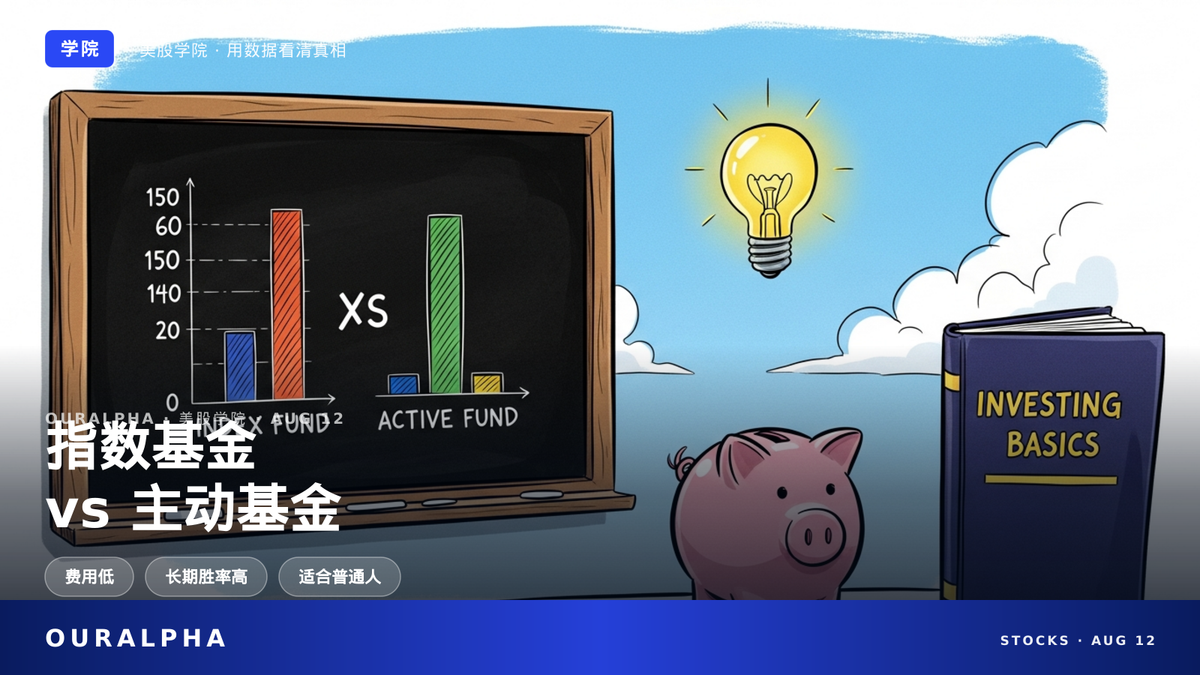
Index Funds vs. Active Funds: How Should Ordinary Investors Choose?
Index funds have low fees and a higher long-term win rate; active funds struggle to beat the market. The data shows which one ordinary people should choose.
Index Funds vs. Active Funds:
Which Should Ordinary People Choose?
Many people think fund managers can beat the market with their expertise, but the data tells a different story.
Index funds capture the market's average return; active funds bet on the luck of beating the average.
After reading this, you'll understand why even Warren Buffett recommends index funds for ordinary people.
TL;DR · IN SHORT
- Index funds have lower fees and more stable long-term returns.
- Most active funds fail to beat the index, and past performance is hard to predict the future.
- Ordinary people are better off with index funds—they're simpler and cheaper.
KEY TERMS
Index Fund: A fund that passively tracks a market index (like the S&P 500), aiming to replicate its returns at very low cost.
Actively Managed Fund: A fund where a manager actively picks stocks and times the market to try to beat a benchmark index, but with higher fees.
Expense Ratio: The annual fee a fund charges as a percentage of assets, which directly impacts long-term returns.
Tracking Error: The degree to which a fund's returns deviate from its index; for index funds, it's usually near zero.
CONTENTS
- What's the Real Difference Between Index Funds and Active Funds?
- Why Do Most Active Funds Underperform the Index?
- How Much Lower Are Index Fund Fees Compared to Active Funds?
- Can Active Funds Ever Beat the Index?
- Why Does Buffett Recommend S&P 500 Index Funds for Ordinary People?
- Do Index Funds Fall More in a Bear Market?
- For a First-Time Investor, Should You Choose Index Funds or Active Funds?
- FAQ
What's the Real Difference Between Index Funds and Active Funds?
Simply put, an index fund is like 'copying the homework'—it doesn't pick stocks itself but directly replicates the components and weights of a market index (like the S&P 500), aiming to match the market's ups and downs[1]. An active fund, on the other hand, is like 'solving the problems yourself'—the fund manager uses research and analysis to actively pick stocks and time buys and sells, hoping to beat the market benchmark[3].
Think of it this way: an index fund is 'lazy investing'—it admits it can't predict the market, so it simply gets the market's average return at a very low cost. An active fund is 'diligent investing'—it believes expertise can generate excess returns, but the price is higher management fees and trading costs.
Here, the 'market index' can be understood as a 'standard answer list.' For example, the S&P 500 is like a 'honor roll' of 500 large U.S. companies, and an index fund buys them in proportion according to that list. An active fund, however, is like a 'stock-picking expert' who might think some companies on the list aren't good and swap them out, or think one is undervalued and buy more. This 'free play' is active management.
Also, index funds usually trade very infrequently because as long as the index components don't change, they don't need to buy or sell stocks. Active funds, in contrast, may trade frequently to seize opportunities, which generates more trading costs that ultimately fall on investors.
Why Do Most Active Funds Underperform the Index?
According to the SPIVA report from S&P Dow Jones Indices, in 2025, 79% of U.S. large-cap active funds underperformed the S&P 500, and over 5 years, 89% underperformed; over 20 years, it's as high as 93%[5]. Morningstar's research also found that over the past 10 years, only 21% of active strategies survived and beat their passive counterparts[6].
The reason isn't mysterious: active funds pay higher research costs and trading commissions, which drag on returns. Moreover, even if a fund performs well one year, it may not continue the next—past performance is almost no help in predicting the future[13].
Think of investing as a long-distance race. An index fund runs the whole course at a steady pace, while an active fund tries to sprint and change speeds. Although it might lead occasionally, more often it falls behind due to excessive energy expenditure. The data confirms this: over the long term, the vast majority of active funds underperform the index.
Another key point: active funds aim to 'beat the benchmark,' but to do so, they must deviate from the index, such as overweighting certain stocks or sectors. This deviation itself introduces uncertainty—they might be right or wrong. Index funds don't make bets; they just follow the market. So over the long term, as the market trends upward, index funds can share in the growth.
How Much Lower Are Index Fund Fees Compared to Active Funds?
According to the Investment Company Institute (ICI) 2025 data, the average expense ratio for index equity mutual funds is just 0.05%, while actively managed equity funds average 0.64%—a difference of more than 10 times[4]. Don't underestimate these fractions of a percentage point; compounded over the long term, the gap is staggering.
For example: invest $100,000 for 20 years, an index fund with a 0.2% expense ratio could grow to about $372,800, while an active fund with a 1% expense ratio would only reach about $320,700—a difference of over $50,000[14]. That's the power of 'compounding.'
The expense ratio is the annual fee the fund deducts from your assets for management, operations, etc. For instance, if you invest $10,000 and the expense ratio is 1%, you'll pay $100 a year; at 0.05%, you'd only pay $5. It seems small, but compounded over 20 years, the difference becomes significant.
Additionally, because index funds trade less, their trading costs are lower, while active funds trade frequently, and commissions and market impact costs erode returns. These costs aren't directly shown in the expense ratio, but they ultimately show up in the fund's net asset value.
Can Active Funds Ever Beat the Index?
Yes, they can, but the odds are low. Morningstar research found that active funds have a higher chance of beating the index in down-market years, but over the long term, the proportion that consistently outperforms remains low—we'll explain the reasons and data in the next section[7].
Moreover, even if an active fund has a stellar year, it's hard to sustain. SPIVA's persistence scorecard shows that past excellent performance has almost no predictive value for the future[13]. So instead of betting on a fund manager's luck, it's better to hold an index fund steadily.
Choosing an active fund is somewhat like opening a mystery box: the 'dark horse' fund you get this time doesn't guarantee a repeat next time, and the manager might even change. This explains the earlier phenomenon—active funds that consistently beat the index are always a rare minority.
Why Does Buffett Recommend S&P 500 Index Funds for Ordinary People?
In 2007, Buffett made a 10-year bet with hedge fund Protégé Partners, wagering that an S&P 500 index fund would beat a basket of hedge funds. Ten years later, the result: the index fund returned 7.1% annually, while the hedge funds, after fees, returned only 2.2%—Buffett won decisively[10]. The key difference was fees—hedge funds charge high management and performance fees that steadily ate into investors' returns, while index funds have minimal fees and are almost unaffected.
The master's logic is simple: ordinary people can't consistently pick winners, and index funds capture the market's average return at very low cost, which over the long term already beats most professional investors.
Buffett practices what he preaches. In his will, he instructed that 90% of the cash left to his wife be invested in a low-cost S&P 500 index fund, and 10% in short-term government bonds[11]. In a world where even professional fund managers struggle to consistently beat the market, Buffett believes this simple portfolio will outperform most professionally managed complex portfolios over the long run.
Do Index Funds Fall More in a Bear Market?
Not necessarily—sometimes the opposite. Index funds fully replicate the index, so they fall about as much as the market; but active managers can reduce positions or switch to defensive stocks to limit losses. Morningstar data shows that in years when the benchmark falls, active funds beat the index about 51% of the time, but in up years only 38%[7]—this is one of the few scenarios where active funds have an edge.
But the trade-off is that active funds often lag during early market rebounds. Bear markets are often followed by quick recoveries—like after the 2020 pandemic crash, the market bounced back rapidly, and many active managers who hadn't re-entered the market fell behind.
To put it in numbers: if the market drops 20%, an index fund also drops 20%, while an active fund that reduced positions might only drop 15%; but when the market rebounds 30%, an active fund that didn't keep up might only gain 20%. When you add up 'losing less in a bear market' and 'gaining less in a bull market,' the active fund's long-term total return may not be advantageous.
The benefit of an index fund is that it won't miss a rebound due to a manager's misjudgment—as long as the market trends upward over the long term, it captures the full growth; if an active fund is overly cautious, it might miss out in a bull market, hurting long-term performance.
For a First-Time Investor, Should You Choose Index Funds or Active Funds?
For ordinary people without professional knowledge and time, index funds are the more worry-free and stable choice. They have low fees, high transparency, and you don't need to research fund managers' abilities—just believe the market will trend upward over the long term.
If you want to know how to buy specifically, you can refer to our How to Buy the S&P 500? Index Fund and ETF Investment Guide and SPY, VOO, VTI Differences Explained. Of course, if you have enough time and energy to research, active funds aren't impossible, but you must be clear about the risks and costs.
For beginners, index funds have another advantage: they don't require frequent decisions. You just buy regularly and hold long-term to get the market's average return. Active funds require you to constantly monitor manager changes, performance, etc., which is time-consuming and laborious for ordinary investors.
Additionally, index funds are highly transparent—you always know what stocks they hold, while active funds often only disclose holdings in quarterly reports, and by then they may be outdated. So if you don't want to spend too much effort on investing, index funds are clearly the better choice.
常见问题 FAQ
Are index funds always better than active funds?
Not always, but the odds are higher over the long term. Data shows that over the past 20 years, 93% of large-cap active funds underperformed the S&P 500[5], so index funds are more likely to deliver better returns.
Are index funds necessarily ETFs?
No. Index funds can be structured as traditional mutual funds or as exchange-traded funds (ETFs). They might track the same index, but the main differences are in how they trade and their minimum investment requirements. Always check the fund's prospectus for its type[2].
Can index funds replicate the index's returns 100%?
Not exactly, but usually very close. The difference between an index fund's returns and its index is called 'tracking error.' High-quality index funds typically have very small tracking errors[9], so you can look at this metric when choosing an index fund.
When starting to invest in index funds, should I invest a lump sum or in batches?
Both methods work. Many beginners choose 'dollar-cost averaging'—investing a fixed amount monthly. This helps avoid the psychological pressure of buying at a peak and averages out your purchase cost over time. The specific pace depends on your cash flow.
Are index funds suitable for retirement accounts?
Yes. Index funds have low fees and high tax efficiency, which helps compounding work better in a 401(k) or IRA[8].
SOURCES
[1] Investor.gov - Index Fund Glossary
[2] Investor.gov - Mutual Funds and ETFs
[3] SmartAsset - What Are Actively Managed Funds?
[4] ICI - Mutual Fund and ETF Fees Remained Near Historic Lows in 2025
[5] S&P Dow Jones Indices - SPIVA U.S. Persistence Scorecard
[6] Morningstar - Better Conditions Did Not Yield Better Results for Active Managers in 2025
[7] CNBC - Active funds struggle to beat index funds amid volatility, Morningstar finds
[8] Fidelity - ETFs vs. mutual funds: Tax efficiency
[9] Investopedia - Tracking Error
[10] Institutional Investor - Protégé Partners Pays Up in Buffett Bet
[11] Benzinga - Warren Buffett reveals the instructions in his will to invest 90% of wife's inheritance
[12] Vanguard - 50 years. 50 facts. Indexing since 1976.
[13] S&P Dow Jones Indices - SPIVA U.S. Persistence Scorecard
[14] Saxo - Index funds vs actively managed funds
This content is for informational purposes only and does not constitute investment advice, trading advice, or any guarantee of returns.