Leveraged ETF TQQQ: What Is It? Can You Hold It Long Term?

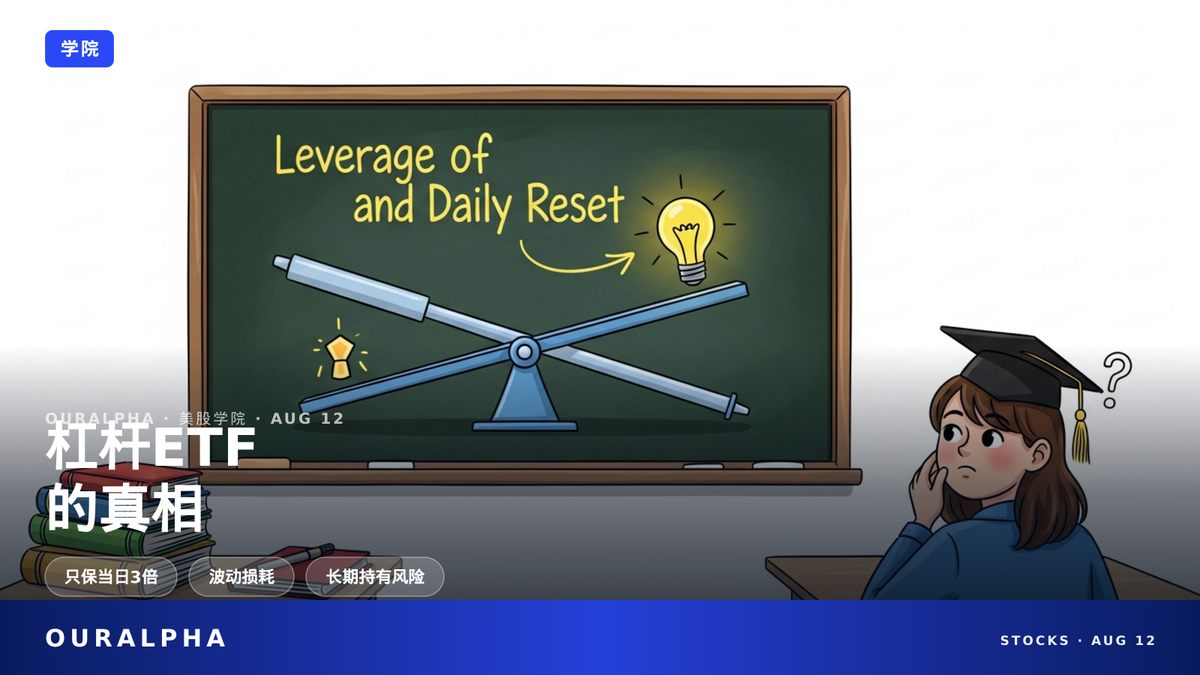
Leveraged ETFs only promise daily 3x returns. Holding them long term can lead to returns that diverge due to daily reset and volatility decay, and they can even lose money while the underlying index is flat.

Leveraged ETF TQQQ: What Is It? Can You Hold It Long Term?
OURALPHA · ACADEMY

What Is a Leveraged ETF (Like TQQQ)?
Can You Hold It Long Term?

OurAlpha Academy · Understand Leveraged ETFs in 3 Minutes

Many people think TQQQ delivers 3x the returns of QQQ, but the truth is—it only promises 3x on a daily basis.

The longer you hold, the more volatility drags your actual returns away from what you'd expect. The underlying index can even be flat while the fund loses money.

Understanding daily reset and volatility decay is key to avoiding these pitfalls.

TL;DR · IN SHORT

  • Leveraged ETFs only aim for 3x on a single day, not 3x over the long term.
  • Daily reset causes volatility decay, so the longer you hold in a choppy market, the more you lose.
  • TQQQ suits short-term trading, not long-term holding.

KEY TERMS

Leveraged ETF: An ETF that uses derivatives to aim for 2x or 3x the daily performance of an underlying index, such as TQQQ targeting 3x the daily return of the Nasdaq-100.

Daily Reset: Leveraged ETFs rebalance their holdings after each market close to bring the leverage ratio back to the target, causing long-term returns to diverge from a simple multiple.

Volatility Decay: In a choppy market, due to daily reset and compounding, the underlying index may end flat while the leveraged ETF's net asset value steadily erodes.

CONTENTS

  1. What Exactly Is a Leveraged ETF (Like TQQQ)?
  2. Why Do Leveraged ETFs Only Promise 'Daily' 3x?
  3. How Does 'Volatility Decay' Occur in Leveraged ETFs?
  4. What's the Difference Between TQQQ and QQQ? What Happens If You Hold Long Term?
  5. Can a Leveraged ETF Drop to Zero? Do You Need to Add Money?
  6. What Are the Fees for Leveraged ETFs? Are They Costly to Hold Long Term?
  7. Who Should Buy Leveraged ETFs? What Should You Watch Out For?
  8. FAQ

What Exactly Is a Leveraged ETF (Like TQQQ)?

Simply put, a leveraged ETF is a special type of exchange-traded fund. Instead of directly buying stocks, it uses derivatives like swap contracts and futures (think of them as financial contracts that give the fund 'extra leverage') to aim for a daily return that is 2x or 3x the move of the underlying index (the index it tracks and amplifies)[1]. For example, TQQQ's official goal is to deliver 3x the daily performance of the Nasdaq-100 Index, before fees[1]. Note the key word: 'daily,' not 'long-term.'

If you're not familiar with ETFs, check out What Is an ETF? Differences from Stocks and Mutual Funds. A simple analogy: a regular ETF is like buying a basket of fruit, while a leveraged ETF adds a magnifying glass—but that magnifying glass gets recalibrated every day.

Why Do Leveraged ETFs Only Promise 'Daily' 3x?

Because leveraged ETFs 'reset' after each trading day—they rebalance their holdings so that the next day's leverage ratio returns to the target (e.g., 3x)[2]. This means the fund only promises 3x for a single day. If you hold for more than one day, your return is the compounded result of daily leveraged returns, and the longer you hold, the more it diverges[2].

For example: Suppose the Nasdaq-100 rises 10% on day one, then falls 9.09% on day two, ending roughly flat. But TQQQ would rise 30% on day one, then fall 27.27% on day two, leaving the fund down about 5.45%[5]. That's the compounding effect where the underlying is flat but the leveraged ETF loses money.

How Does 'Volatility Decay' Occur in Leveraged ETFs?

Volatility decay is the biggest enemy of long-term leveraged ETF holders. Because of daily reset, in a choppy market, even if the underlying ends flat, the leveraged ETF's net asset value gets steadily eroded. The more volatile the market, the more pronounced the decay[3].

Think of it this way: resetting your portfolio's leverage to 3x every day is like rebalancing a seesaw daily. If it rocks back and forth, the friction in between eats away at your principal. So, leveraged ETFs can perform well in trending markets, but in a back-and-forth, range-bound market, the decay becomes very significant.

What's the Difference Between TQQQ and QQQ? What Happens If You Hold Long Term?

QQQ is a regular ETF that tracks the Nasdaq-100 Index, while TQQQ is a leveraged ETF that aims for 3x the daily performance of the same index[1]. If you're bullish on the Nasdaq's long-term rise, QQQ is enough. But with TQQQ, you're betting on 'daily' 3x, not 'long-term' 3x.

Real-world example: From November 2021 to the end of 2022, the Nasdaq-100 fell about 33%-35.6% cumulatively, while TQQQ plunged about 81.7% over the same period[6]. That means if you bought TQQQ at the peak, you'd need a gain of about 426% to break even, while QQQ holders would only need about 55%[6]. So, the risk of holding leveraged ETFs long term is far greater than you might imagine.

Can a Leveraged ETF Drop to Zero? Do You Need to Add Money?

When you buy shares of a leveraged ETF, your maximum loss is theoretically limited to your investment; you won't owe more than you put in[13]. However, in extreme cases where the underlying index drops sharply in a single day, a high-leverage fund could lose nearly all of its value in one day[13].

But you don't need to add margin like you would with futures, because leveraged ETFs achieve leverage at the fund level using derivatives, not by you borrowing money to buy stocks directly[10]. So, the worst-case scenario is losing your entire investment, but you won't end up owing more.

What Are the Fees for Leveraged ETFs? Are They Costly to Hold Long Term?

For example, TQQQ has a total expense ratio of 0.97%, but after a 0.15% fee waiver, the net expense ratio is 0.82%[7]. That's significantly higher than regular ETFs. Plus, because daily reset requires frequent rebalancing, leveraged ETFs have higher turnover (how often the fund buys and sells stocks, futures, etc.), which typically leads to lower tax efficiency and potentially larger short-term capital gains distributions[4].

If you hold long term, fees and taxes further erode your returns. So, even without considering volatility decay, high costs are another reason leveraged ETFs aren't suitable for long-term holding.

Who Should Buy Leveraged ETFs? What Should You Watch Out For?

Leveraged ETFs are generally only suitable for experienced traders for short-term trading or hedging, such as day trading or one- to two-day swing trades[3]. FINRA and the SEC have explicitly warned that these products are typically not suitable for retail investors who plan to hold for more than one trading day[3].

If you're thinking about using leveraged ETFs for long-term investing, we recommend first learning about What Are the Nasdaq-100 and QQQ? and S&P 500 Index Fund Investing Guide, and consider using regular index funds instead. Also, margin requirements for leveraged ETFs are typically higher than for regular ETFs—for example, the margin requirement for long positions is up to 100% of the position's market value[8]. However, regular investors can simply buy and sell them in a standard brokerage account without any extra steps.

常见问题 FAQ

Is TQQQ suitable for long-term holding?

TQQQ is not suitable for long-term holding: it only aims for 3x daily performance. Holding it long term can lead to returns that diverge from expectations due to daily reset and volatility decay, and it can even lose money while the underlying index rises[1][3].

Will I get a margin call like with futures if I buy leveraged ETFs?

No. Leveraged ETFs achieve leverage at the fund level through derivatives, not by you borrowing money directly, so you won't need to add margin[10]. Your maximum loss is limited to the amount you invested; you won't owe more. However, in extreme cases where the underlying index drops sharply in a single day, a high-leverage fund could lose nearly all of its value in one day[13].

What is the relationship between TQQQ and SQQQ?

SQQQ is the 3x inverse product of TQQQ, meaning it aims for 3x the inverse daily performance of the Nasdaq-100[11]. Both are short-term trading tools.

Why do leveraged ETFs have low tax efficiency?

Leveraged ETFs typically have lower tax efficiency because daily reset requires frequent rebalancing and high turnover. The fund frequently realizes and distributes capital gains (taxes on sold profitable positions), which can lead to more short-term capital gains taxes, increasing the tax burden for holders[4].

Do I need a margin account to buy leveraged ETFs?

No, you don't need a margin account to buy leveraged ETFs—they are essentially regular ETFs that you can buy in a standard brokerage account. However, their margin requirements may be higher than for regular ETFs[8].

Can volatility decay in leveraged ETFs be avoided?

Volatility decay cannot be completely avoided—as long as you hold for more than one day, the compounding effect from daily reset will cause decay. The only way to avoid it would be to sell and rebuy every day, which is not practical.

SOURCES

[1] ProShares UltraPro QQQ (TQQQ) Official Product Page
[2] SEC Investor Bulletin: Leveraged and Inverse ETFs
[3] FINRA Regulatory Notice 09-31
[4] FINRA: The Lowdown on Leveraged and Inverse Exchange-Traded Products
[5] How Leveraged ETFs Work: The Math of Daily Rebalancing (REX Shares)
[6] TQQQ's 3x Promise Quietly Cost Holders 81 Percent in 2022
[7] ProShares UltraPro QQQ Fact Sheet
[8] FINRA Rule 4210: Margin Requirements
[9] TQQQ Pulled $368M in a Single Day
[10] FINRA: Non-Traditional ETFs FAQ
[11] ProShares UltraPro Short QQQ (SQQQ) Official Product Page
[12] Understanding Taxable Distributions (Direxion)
[13] Leveraged ETFs: Frequently Asked Questions (ETF Database)

This content is for informational purposes only and does not constitute investment advice, trading advice, or any guarantee of returns.

Keep Reading

Index Funds vs. Active Funds: How Should Ordinary Investors Choose?

Index Funds vs. Active Funds: How Should Ordinary Investors Choose?
OURALPHA · ACADEMY

Index Funds vs. Active Funds:
Which Should Ordinary People Choose?

OurAlpha Academy · See the Truth with Data

Many people think fund managers can beat the market with their expertise, but the data tells a different story.

Index funds capture the market's average return; active funds bet on the luck of beating the average.

After reading this, you'll understand why even Warren Buffett recommends index funds for ordinary people.

TL;DR · IN SHORT

  • Index funds have lower fees and more stable long-term returns.
  • Most
Read full story →

Stay ahead of the market — never miss a deep dive

Follow OurAlpha for AI-driven US equity research and market insight, every day.