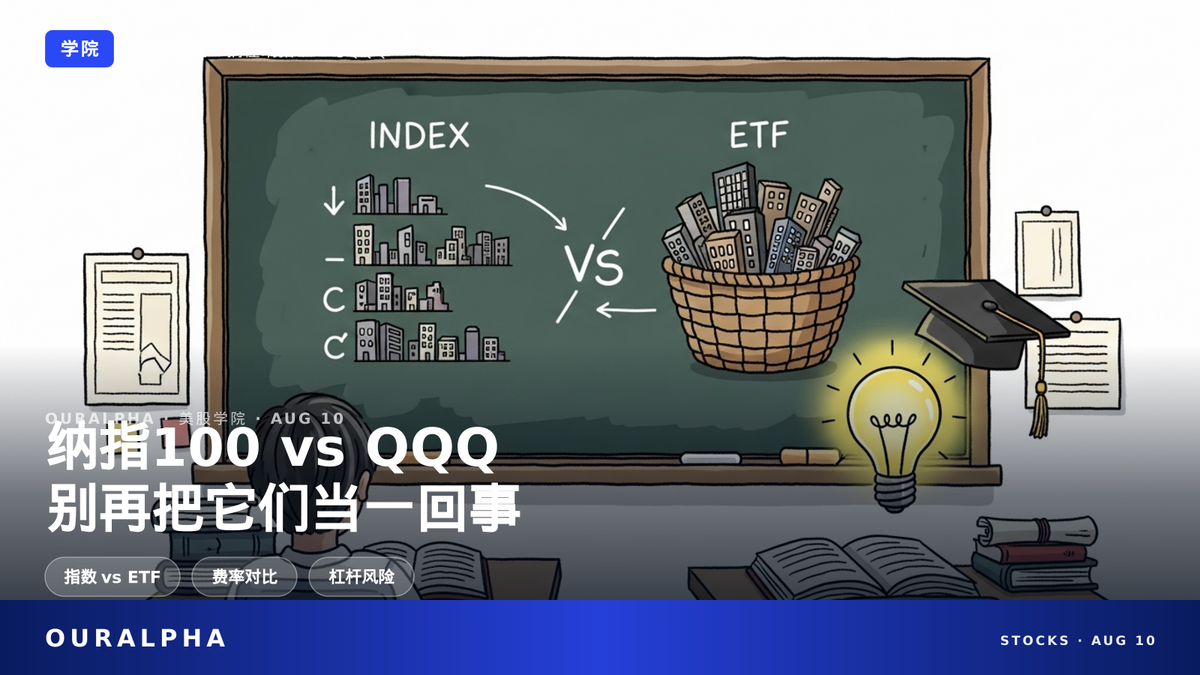
What Are Nasdaq-100 and QQQ? A Detailed Guide to the Index vs. ETF Difference
Nasdaq-100 is an index, QQQ is an ETF—they're not the same. Understand the difference to choose the right tool and avoid overpaying or buying the wrong thing.
Is Nasdaq-100 the Same as QQQ?
Understand the Difference Between an Index and an ETF Before You Invest
Many people treat Nasdaq-100 and QQQ as the same thing, but one is an index and the other is an ETF that tracks it.
Understanding the difference helps you pick the right investment tool and avoid overpaying or buying the wrong thing.
This article explains in plain language the essence of Nasdaq-100, QQQ, QQQM, and leveraged products.
Knowing what you're buying before you invest is the first step to rational decision-making.
TL;DR · IN SHORT
- Nasdaq-100 is an index; QQQ is an ETF that tracks it. They are not the same.
- QQQ and QQQM track the same index but have different fees; for long-term holding, QQQM saves more.
- Nasdaq-100 excludes financials and is heavily tech-focused, so it tends to be more volatile than the S&P 500.
- Leveraged ETFs like TQQQ are not suitable for long-term holding due to volatility decay risk.
KEY TERMS
Nasdaq-100 (NDX): A stock index composed of the 100 largest non-financial companies listed on the Nasdaq exchange, calculated using a modified market-capitalization weighting method.
QQQ (Invesco QQQ Trust): An exchange-traded fund (ETF) issued by Invesco that tracks the performance of the Nasdaq-100 index. It is one of the most actively traded ETFs globally.
Modified market-cap weighting: A methodology where component weights are generally based on market capitalization, but with caps on the weights of ultra-large companies to prevent the index from being overly influenced by a few giants.
CONTENTS
- What exactly is the Nasdaq-100?
- What's the difference between QQQ and the Nasdaq-100?
- What's the difference between QQQ and QQQM? Which should the average investor choose?
- How are weights allocated in the Nasdaq-100? Why doesn't one company dominate?
- Which is better for long-term investing: Nasdaq-100 or S&P 500?
- Does QQQ pay dividends? What are the management fees?
- Can leveraged ETFs like TQQQ be held long-term?
- FAQ
What exactly is the Nasdaq-100?
Simply put, the Nasdaq-100 (Nasdaq-100, ticker NDX) is a stock index made up of the 100 largest non-financial companies on the Nasdaq exchange, first published on January 31, 1985[1]. Think of it as a 'honor roll' that picks out the top companies in tech, communications, and other sectors, then calculates a number based on rules to represent their overall performance. You can imagine it as the 'class average,' but it's not a simple arithmetic average—it's weighted by company size, so bigger companies have a bigger impact on the index, just like a top student's score pulls the class average more. For example, if Apple's stock jumps, the Nasdaq-100 will rise more than if a small company's stock jumps, because Apple's market cap is larger and carries more 'weight' in the index.
Note that it excludes the financial sector (banks, insurance, etc.), so the index has almost no financial, energy, materials, or real estate sectors—it's heavily concentrated in technology and communication services[2]. It's like running a 'tech-themed restaurant' where the menu only has tech and communication 'dishes,' no 'financial dishes' like banks or insurance. As a result, the Nasdaq-100's ups and downs largely depend on the health of the tech industry. If tech does well overall, the Nasdaq-100 usually rises with it; conversely, if tech hits a rough patch, the Nasdaq-100 suffers. Also, because some companies (like Alphabet's GOOGL/GOOG dual-class shares) are included twice, the Nasdaq-100 actually contains 102 securities representing 101 companies[3]. It's like the same store having two windows, but it's still one store. So, despite the name '100,' the actual number of securities is slightly higher, and you might see 102 tickers when looking at the index components.
For example, representative components of the Nasdaq-100 include tech giants like Apple, Microsoft, Amazon, and Google's parent Alphabet, as well as consumer stocks like Costco[13]. You probably use their products or services every day, which is one reason the Nasdaq-100 is often called the 'tech bellwether.'
What's the difference between QQQ and the Nasdaq-100?
QQQ (Invesco QQQ Trust) is an ETF issued by Invesco, launched and listed on March 10, 1999, with the goal of tracking the performance of the Nasdaq-100 index[7]. Think of the index as a 'recipe' and QQQ as the 'dish' made from that recipe. When you buy QQQ, you're buying a share of a basket of Nasdaq-100 component stocks. For instance, buying one share of QQQ gives you a tiny piece of Apple, Microsoft, Amazon, and others—like ordering a 'family bucket' that includes various chicken pieces. This way, you don't need to buy each stock individually; just buy QQQ to hold the entire index portfolio in one go—convenient and hassle-free.
So, the Nasdaq-100 is the 'underlying asset,' and QQQ is the 'tool.' Many people mistakenly think QQQ is the Nasdaq-100 itself, but QQQ is just one of many products tracking the index. For example, Invesco also offers a cheaper version, QQQM, which tracks the same index[9]. It's like the same dish prepared by different restaurants—slightly different in taste, but the core ingredients are the same. Additionally, other fund companies offer ETFs tracking the Nasdaq-100, but QQQ is the most well-known due to its long history and high liquidity. So when people say 'buy the Nasdaq,' they often mean buying QQQ.
What's the difference between QQQ and QQQM? Which should the average investor choose?
QQQ and QQQM both track the Nasdaq-100, but their fees differ: QQQ's total expense ratio is 0.18% (after December 2025), while QQQM's is 0.15%[8][9]. Don't underestimate this 0.03% gap—over the long term, compounding makes the cost difference significant. For example, if you invest 100,000 yuan with an annualized return of 10% for 20 years, the fee difference between 0.18% and 0.15% could lead to a difference of several thousand yuan in returns. It's like saving a few yuan on coffee every day—over a year, it adds up to a nice meal. Specifically, with a 100,000 yuan investment, 10% annual return, and 20 years, the 0.18% fee leaves about 651,000 yuan, while the 0.15% fee leaves about 655,000 yuan—a gap of about 4,000 yuan. It may seem small, but the larger the investment and the longer the time, the bigger the gap.
Also, QQQ has higher liquidity and a more active options chain, making it suitable for traders; QQQM is better for long-term holders who prioritize low costs[9]. If you're a beginner planning to dollar-cost average over the long term, QQQM might be more cost-effective; if you need to trade frequently or use options, QQQ is more appropriate. It's like buying a car: QQQ is an automatic—convenient but slightly thirstier; QQQM is a manual—more fuel-efficient but requires some skill. Additionally, QQQ, as a veteran ETF, has large trading volume and tight bid-ask spreads, suitable for large capital flows; QQQM, while less liquid, doesn't matter much for long-term holders. So the choice depends on your investment style and holding period.
How are weights allocated in the Nasdaq-100? Why doesn't one company dominate?
The Nasdaq-100 uses a modified market-cap weighting method, where weights are generally based on market cap but with caps on ultra-large companies. Specifically, no single component can exceed 24% of the index weight; the combined weight of all components with a weight of 4.5% or more cannot exceed 48%, and exceeding this triggers a special rebalancing[4]. It's like electing a class president: even if the top student has great grades, they can't have all the power—limits are set so others have a say. If a company's market cap becomes too large and its weight exceeds 24%, a rebalancing is triggered, redistributing the excess weight to other components to ensure the index doesn't rely too heavily on a single stock.
Besides weight caps, the Nasdaq-100 also 'changes its lineup' regularly: an annual reconstitution occurs on the third Friday of December, with component changes taking effect; quarterly rebalancing happens in March, June, September, and December[5]. This is like a regular spring cleaning, kicking out companies that no longer qualify and bringing in new top performers. During the annual reconstitution, companies that have fallen in market-cap ranking or no longer meet inclusion criteria are removed, while new quality companies are added, ensuring the index always represents the current market leaders. Additionally, starting in May 2026, quarterly ranking reviews and a 'fast-track' inclusion mechanism will be introduced, allowing newly listed companies to enter the index more quickly[6]. For example, if a new company performs well after listing and ranks in the top 40 by market cap, it may be evaluated for inclusion after the 7th trading day—like giving newcomers a fast promotion track. This way, the index reflects market changes more promptly, avoiding missing out on emerging tech giants.
Which is better for long-term investing: Nasdaq-100 or S&P 500?
The Nasdaq-100 and S&P 500 overlap significantly: 84 of the Nasdaq-100's components are also in the S&P 500, and these overlapping stocks account for about 94% of the Nasdaq-100's weight; the two indices share 8 of their top 10 holdings[11]. But the S&P 500 covers 500 companies across various sectors, with more diversified weights; the Nasdaq-100 is concentrated in about 100 tech and growth companies, so it tends to be more volatile[11]. It's like one is a 'general class' studying all subjects, and the other is a 'tech-specialized class' focusing on tech. The S&P 500 includes financials, energy, healthcare, and other sectors, so its industry distribution is more balanced; when tech pulls back, the S&P 500 may be relatively resilient, while the Nasdaq-100, being highly concentrated, amplifies tech sector swings directly.
So, if you prefer more diversification and stability, the S&P 500 might be more suitable; if you're bullish on tech growth and can handle higher volatility, the Nasdaq-100 might align better with your preferences. Neither is inherently better—it depends on your risk tolerance and investment goals. Historically, the Nasdaq-100 tends to gain more in bull markets but may fall deeper in bear markets; the S&P 500 is relatively steadier. Some investors hold both to balance risk and return. To learn how to invest in the S&P 500, check out this article: How to Buy the S&P 500: A Guide to Index Funds and ETFs.
Does QQQ pay dividends? What are the management fees?
QQQ pays quarterly dividends to holders, and you can check the specific payment records and ex-dividend dates on the exchange's official data page[10]. Dividends aren't extra income; they're a portion of company profits distributed to shareholders, and the stock price adjusts accordingly. For example, if a company's stock is 100 yuan and it pays a 2-yuan dividend, the ex-dividend price drops to 98 yuan; you get 2 yuan cash, but your total assets remain the same. So dividends are like moving money from your left pocket to your right pocket—real gains come from company earnings growth. For QQQ, many of its component tech companies (like Apple and Microsoft) pay dividends, so QQQ regularly distributes the dividends it receives to holders. However, dividend amounts vary with component companies' policies and aren't fixed.
Regarding management fees, QQQ's total expense ratio has been reduced from 0.20% to 0.18%, and it has gained new permissions like reinvesting income and participating in securities lending[8]. These changes make QQQ more like a standard open-end ETF and more investor-friendly. Here, 'reinvestment income' refers to the fund level: before distributing dividends to holders, the fund can reinvest the dividends received from component stocks, reducing the drag of idle cash—it doesn't mean your personal dividends are automatically used to buy more shares. Securities lending can generate additional income, which helps boost long-term returns. For example, securities lending means the fund can lend out its held stocks to other market participants (including short sellers) and earn interest, which is shared between the fund and holders according to agreed terms, helping offset some operating expenses. Additionally, the fund-level reinvestment helps reduce cash drag and improve overall portfolio return efficiency. So, while the fee cut is modest, the potential benefits from new permissions may benefit investors more.
Can leveraged ETFs like TQQQ be held long-term?
TQQQ (ProShares UltraPro QQQ) is a 3x leveraged ETF tracking the Nasdaq-100, with the official objective of delivering 'three times the daily return of the Nasdaq-100, before fees and expenses'[12]. Sounds tempting, but leveraged ETFs have a daily reset mechanism that causes volatility decay, so long-term returns can deviate significantly from the index's cumulative performance[12]. For example, if the index rises 10% on day one and falls 10% on day two, the index doesn't return to its starting point—it's down about 1%, but the 3x leveraged ETF, due to daily reset, amplifies the loss, potentially down about 9%. Here's the math: Day 1, the index goes from 100 to 110, and the ETF from 100 to 130; Day 2, the index falls 10% from 110 to 99, and the ETF falls 30% from 130 to 91. The ETF ends up down 9%, while the index is only down 1%. That's volatility decay.
Therefore, the product's official documentation clearly states it's not designed for long-term holding. If you plan to invest in the Nasdaq-100 for the long term, stick with regular ETFs like QQQ or QQQM. Leveraged ETFs are better suited for short-term traders who might profit from intraday swings, but they require precise timing and carry extreme risk. For average investors, especially long-term dollar-cost averagers, the compounding decay of leveraged ETFs can erode returns and even lead to significant principal loss. To learn ETF basics, check out this article: What is an ETF? Differences and Risks vs. Stocks and Mutual Funds.
常见问题 FAQ
Are there bank stocks in the Nasdaq-100?
No. The Nasdaq-100 excludes financial companies, including banks and insurance, so you won't see traditional financial stocks in the index[2].
Which has lower fees, QQQ or QQQM?
QQQM's fee is 0.15%, lower than QQQ's 0.18%[9][8]. For long-term holding, QQQM saves more on costs.
How often does the Nasdaq-100 rebalance?
Components are adjusted annually on the third Friday of December, and weights are rebalanced quarterly in March, June, September, and December[5].
What well-known companies are in the Nasdaq-100?
It includes tech giants like Apple, Microsoft, Amazon, and Google (Alphabet), as well as consumer stocks like Costco[13].
How much capital do I need to buy QQQ?
Buying an ETF is like buying a stock—you need at least 1 share, so the capital depends on QQQ's price. You can start with a few hundred dollars.
Is TQQQ's 3x leverage for the long term or daily?
It's daily. TQQQ's official objective is to deliver three times the daily return of the Nasdaq-100, not three times the long-term cumulative return. Due to daily reset, volatility causes decay, so long-term returns can differ significantly from the index's performance[12].
SOURCES
[1] Nasdaq-100 (NDX) | Benchmark of the 21st Century — Nasdaq Official Website
[2] Celebrating the 40-year Rise of the Nasdaq-100 Index — Nasdaq Official Website
[3] NASDAQ-100 Fact Sheet (FS_XNDX) — Nasdaq Official Index Document
[4] Nasdaq-100 Index Methodology — Nasdaq Official Methodology Document
[5] Nasdaq-100 Index Methodology — Nasdaq Official Methodology Document
[6] Nasdaq-100 Index® Methodology Update: Why Now, and What It Means — Nasdaq Official Website
[7] Get to know QQQ: Charting 25 years of performance — Invesco Official Website
[8] Invesco QQQ Shareholders Vote to Approve Modernization — Invesco Official Announcement
[9] Case study: Accessing innovation and growth potential with QQQ and QQQM — Invesco Official Website
[10] Invesco QQQ Trust, Series 1 (QQQ) Dividend History — Nasdaq Official Market Data
[11] What's the difference between the Nasdaq-100 and the S&P 500? — Cailian Press
[12] TQQQ Summary Prospectus — ProShares Official Fund Document
[13] Celebrating the 40-year Rise of the Nasdaq-100 Index — Nasdaq Official Website
This content is for informational purposes only and does not constitute investment advice, trading advice, or any guarantee of returns.