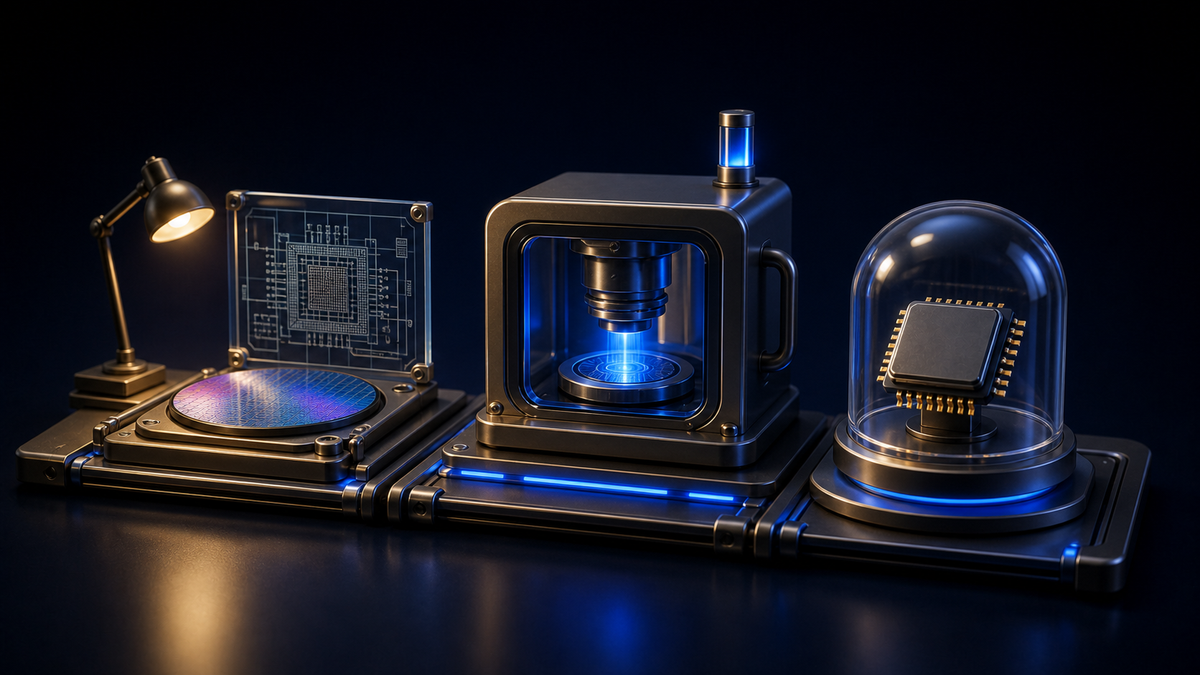
The Semiconductor Supply Chain: From Design to Manufacturing, Explained Simply

The semiconductor supply chain is divided into design, manufacturing, and packaging/testing. Nvidia only designs, TSMC manufactures, and ASML monopolizes lithography machines. Understand the whole chain in one read.

OURALPHA · ACADEMY

How Long Is the Semiconductor Supply Chain?
A Complete Map from Design to Manufacturing to Packaging

OurAlpha Academy · Breaking Down the Division of Labor and Giants Behind Chips

Many people think Nvidia is a 'chip maker,' but it only designs chips.

Almost all manufacturing is done by TSMC, and TSMC's most advanced equipment is 100% dependent on ASML.

Understanding this chain is key to understanding semiconductor stocks and geopolitical risks.

TL;DR · IN SHORT

  • The semiconductor supply chain has three main stages: design, manufacturing, and packaging/testing.
  • Nvidia designs but doesn't manufacture; TSMC does the manufacturing; ASML monopolizes lithography machines.
  • The chip industry is cyclical, so investors should watch out for downturns.

KEY TERMS

Fabless (No-Fab Model): Companies that only design and sell chips without owning fabrication plants, such as Nvidia and AMD.

Foundry (Wafer Foundry): Companies that manufacture chips for others, like TSMC, pioneered by Morris Chang in 1987.

IDM (Integrated Device Manufacturer): Companies that handle everything from design to manufacturing to packaging, like Intel and Texas Instruments.

Nanometer Process (Process Node): A measure of how tiny the transistors on a chip are. Smaller numbers (like 3nm) mean smaller, denser transistors, usually resulting in better performance and lower power consumption.

EUV Lithography Machine: Extreme ultraviolet lithography equipment essential for making chips below 3nm. Only ASML can build these globally.

CONTENTS

  1. What Are the Main Stages of the Semiconductor Supply Chain?
  2. Why Doesn't Nvidia Make Its Own Chips? What Is the Fabless Model?
  3. Why Can TSMC Dominate High-End Foundry Services?
  4. What Is ASML? Why Is It Said to Have a Stranglehold on the Global Chip Industry?
  5. Besides Manufacturing, What Other Stages Are Worth Watching?
  6. How Do the U.S. CHIPS Act and Export Controls Affect the Supply Chain?
  7. Why Is the Semiconductor Industry Cyclical? What Should Investors Watch Out For?
  8. FAQ

What Are the Main Stages of the Semiconductor Supply Chain?

Simply put, the semiconductor supply chain is like an assembly line, broadly divided into three main stages: design (IC design), manufacturing (wafer foundry/Fab), and packaging and testing (OSAT). Upstream, there are also EDA design software, semiconductor equipment, and materials, forming a division of labor: 'design companies → wafer foundries → packaging and testing companies'[1].

Think of a chip like a hardcover book: the design company writes the content (circuit design), the wafer foundry prints it (manufacturing), and the packaging and testing company does the binding and quality check (packaging and testing). EDA software is the word processor used for writing, and semiconductor equipment is the printing press. Each step is essential and highly specialized.

For example: Nvidia designs the GPU blueprint, hands it to TSMC for production, and then lets packaging and testing companies like ASE cut the wafer and package it into usable chips. Each stage has dedicated players, creating a highly specialized ecosystem. This division allows each stage to focus resources and excel, but it also means that if any single stage fails, the whole chain is affected.

Why Doesn't Nvidia Make Its Own Chips? What Is the Fabless Model?

Companies like Nvidia, AMD, Qualcomm, and Broadcom use the Fabless model—they only design and sell chips, don't own wafer fabs, and outsource manufacturing to foundries, avoiding the huge capital expenditures needed to build fabs[2].

Building an advanced wafer fab costs tens of billions of dollars, and technology evolves quickly, making it very risky. So Nvidia chooses to stay asset-light, focusing on design and leaving manufacturing to specialized foundries. It's like a restaurant that doesn't grow its own vegetables but buys from farms to focus on cooking.

The advantages of the Fabless model: First, it saves huge factory-building costs, allowing more investment in R&D and design. Second, it's flexible—you can choose the most advanced foundry at any time without bearing equipment depreciation risks. Third, it's focused—design companies can quickly respond to market demands. But the downside is clear: production capacity is controlled by others. If foundries face tight capacity, you might not get enough chips.

Why Can TSMC Dominate High-End Foundry Services?

TSMC is the pioneer of the Foundry (wafer foundry) model, founded by Morris Chang in 1987. It only manufactures chips based on customers' designs and doesn't design its own chips. By 2025, TSMC holds about 70% of the global pure-play foundry market, giving it absolute dominance[3].

TSMC's success comes from pioneering the foundry model, allowing countless Fabless companies to focus on design without the burden of building fabs. At the same time, TSMC has invested heavily in advanced processes, building deep technical barriers, and its yield control far exceeds competitors.

In contrast, Intel and Texas Instruments are IDMs (Integrated Device Manufacturers), handling everything from design to manufacturing to packaging[4]. But Intel has fallen behind in advanced processes and has opened up its foundry services, though its market share is far below TSMC's. The IDM model offers strong synergies, but the downside is massive capital expenditures. If a technology roadmap is misjudged, it can be a total loss.

What Is ASML? Why Is It Said to Have a Stranglehold on the Global Chip Industry?

ASML, based in the Netherlands, is the only company in the world that can mass-produce EUV (extreme ultraviolet) lithography machines. These machines are indispensable for making advanced chips at 3nm and below, with each unit costing tens of millions to over a hundred million dollars[5].

Simply put, without ASML's EUV lithography machines, TSMC, Samsung, and Intel cannot produce the most advanced chips. So ASML is the 'choke point' at the very top of the supply chain; its shipments directly determine global advanced process capacity.

Lithography works like using a projector to etch circuit patterns onto a silicon wafer. EUV lithography uses extreme ultraviolet light with an extremely short wavelength, allowing finer lines to be etched. But manufacturing such equipment is incredibly complex, and only ASML can do it, with limited annual output, so wafer fabs line up to buy them.

Besides Manufacturing, What Other Stages Are Worth Watching?

Besides manufacturing, EDA design software and semiconductor equipment are also critical. Synopsys and Cadence together hold about 80-85% of the global EDA market, and almost all advanced chip designs rely on their tools[8].

EDA software is like the 'CAD' for chip design; engineers use it to draw circuit diagrams and run simulations. Without EDA, even the most brilliant designers are stuck. So Synopsys and Cadence, though they don't make chips, hold the key to chip design.

On the equipment side, the global wafer fab equipment (WFE) market is projected to grow 11% to about $115.7 billion in 2025, hitting a record high[6]. This is mainly driven by AI-related investments in advanced processes and memory chips. Equipment includes lithography machines, etchers, and thin-film deposition tools, all core assets for wafer fabs.

In the packaging and testing stage, Taiwan's ASE is the world's largest OSAT (outsourced semiconductor assembly and test) provider, with about 44.6% market share in 2024, followed by America's Amkor[9]. Packaging and testing is the final step before chips ship, involving cutting, packaging, and testing. Though less technically demanding, it's indispensable.

The DRAM (memory chip) market is highly concentrated, with Samsung, SK Hynix, and Micron together accounting for about 90% of global DRAM revenue[7]. This oligopoly gives these giants strong pricing power, but it also invites antitrust scrutiny.

How Do the U.S. CHIPS Act and Export Controls Affect the Supply Chain?

In 2022, the U.S. Congress passed the CHIPS and Science Act, allocating about $52.7 billion for semiconductor manufacturing subsidies, R&D, and workforce development, plus a $2.4 billion tax credit to encourage building fabs in the U.S.[10].

The act's goal is clear: bring semiconductor manufacturing back to the U.S. and reduce dependence on Asian foundries. So TSMC and Samsung are building fabs in the U.S., but costs are much higher than in Asia, which is why subsidies matter.

At the same time, the U.S. Commerce Department's Bureau of Industry and Security (BIS) has been escalating export controls on advanced semiconductors to China, restricting exports of advanced process equipment and software tools, and adding multiple Chinese entities to the 'Entity List'[11]. These policies directly affect the layout and investment direction of the global semiconductor supply chain.

For investors, these policies mean: first, U.S. domestic semiconductor manufacturing may see growth; second, China's need for semiconductor self-sufficiency becomes more urgent; and third, the global supply chain may split into two camps.

Why Is the Semiconductor Industry Cyclical? What Should Investors Watch Out For?

The semiconductor industry has clear cycles, typically about 4 years for a 'boom to inventory correction' cycle: when demand is strong, companies increase capital spending to expand capacity; when demand cools, it often leads to overcapacity, falling prices, and inventory buildup[14].

This cycle is like weather: in good times, everyone plants crops like crazy (expanding capacity), but then there's too much harvest to sell (overcapacity), prices crash, and the next year they plant less, leading to shortages. So semiconductor companies' earnings often swing wildly.

Global semiconductor sales in 2025 reached $791.7 billion, up 25.6% year-over-year, a record high, but the industry predicts sales could surpass $1 trillion in 2026[12]. When investing in semiconductor stocks, beyond technology, be wary of cyclical downturns.

If you want to diversify risk, you can check out how to buy semiconductor industry ETFs; ETFs can spread out single-stock risk. Additionally, Intel's recent $20 billion financing bet on its foundry business reflects the challenges of IDM transformation, showing that even giants face pressure from cyclical swings and technology shifts.

常见问题 FAQ

What's the difference between TSMC and Intel?

TSMC is a pure foundry, only making chips for others. Intel is an IDM, designing and making its own chips. But Intel now also offers foundry services, though its market share is far below TSMC's.

What's the biggest risk of the Fabless model?

The biggest risk is that production capacity is controlled by others—Fabless companies don't own fabs, so if foundries like TSMC face tight capacity or prioritize other big customers, Fabless companies might not get enough chips, directly impacting shipments and revenue.

What would happen without ASML's EUV lithography machines?

Wafer fabs like TSMC, Samsung, and Intel would be unable to mass-produce the most advanced chips at 3nm and below, because EUV lithography is indispensable for such advanced processes. That's why the industry says ASML has a 'stranglehold' on the global advanced chip supply chain.

How much subsidy does the U.S. CHIPS Act give to semiconductor companies?

The CHIPS Act allocates about $52.7 billion for manufacturing subsidies, R&D, and workforce development, plus a $2.4 billion tax credit.

What exactly do U.S. export controls on chips to China restrict?

They mainly restrict exports of advanced process equipment and software tools, and place multiple Chinese entities on the 'Entity List,' limiting their access to U.S. technology.

Is Moore's Law still valid?

Moore's Law, proposed by Intel co-founder Gordon Moore in 1965, originally predicted that the number of transistors would double every year, revised in 1975 to about every two years. But in recent years, as processes approach physical limits, the pace has slowed, and the industry is looking for alternatives.

How can ordinary investors buy the entire semiconductor supply chain with one ETF?

You can look at semiconductor industry ETFs, such as those tracking the Philadelphia Semiconductor Index, which cover leaders across design, manufacturing, and equipment. For details, see how to buy semiconductor industry ETFs.

SOURCES

[1] Samsung Semiconductor: Overview of the Semiconductor Ecosystem
[2] Samsung Semiconductor: Semiconductor Glossary - Fabless
[3] Counterpoint Research: Global Foundry Market Share Quarterly Data
[4] Samsung Semiconductor: Overview of the Semiconductor Ecosystem
[5] ASML Holding N.V. — SEC Form 20-F Annual Report
[6] SEMI Press Release: Global Semiconductor Equipment Billings Forecast
[7] Counterpoint Research: Global DRAM and HBM Market Share
[8] SemiAnalysis: EDA Market Primer
[9] Yahoo Finance: ASE Technology vs Amkor Comparison (citing TrendForce data)
[10] Library of Congress Congress.gov: CHIPS Act Provisions and Implementation FAQs
[11] U.S. Commerce Department BIS Press Release: Strengthening Export Controls on Advanced Computing Chips to China
[12] Semiconductor Industry Association (SIA) Press Release
[13] Intel Newsroom: Moore's Law Press Kit
[14] Britannica Money: Semiconductor Stocks and Investing Explained

This content is for informational purposes only and does not constitute investment advice, trading advice, or any guarantee of returns.

Keep Reading

The Magnificent 7 Stocks: Who They Are, Explained with Risks

OURALPHA · ACADEMY

Who Are the Magnificent 7 Stocks?
Why Isn't It an Official Index?

OurAlpha Academy · A Clear Guide to the Magnificent 7

You've probably heard the term 'Magnificent 7' stocks, but do you know exactly which seven companies it refers to?

It's not an official index, nor is it a fixed list—it's an informal grouping coined by Wall Street.

Understanding its origins can help you better grasp the structure and risks of the U.S. stock market.

TL;DR · IN SHORT

  • The Magnificent
Read full story →

Stay ahead of the market — never miss a deep dive

Follow OurAlpha for AI-driven US equity research and market insight, every day.